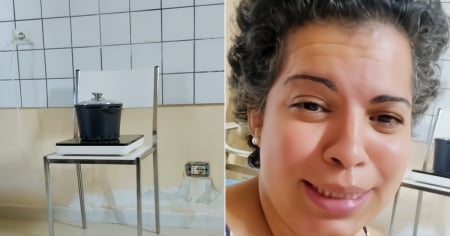
A young Cuban mother has shared on TikTok how she repurposes her baby's clothes to accommodate her growing child and save money amid the economic crisis the country is facing.
In the video shared by the user @anaisy_d, the young woman shows a small white monkey with spots and explains: “I’m a mom living in Cuba, and I’m going to show you what I do with some of my baby's clothes. This outfit is from when my baby was three months old and it still fits, but here it’s very short, so it's a bit stained. Generally, I give away the clothes that my baby outgrows; I keep the stained ones because I don’t like to give away things that are in very poor condition, and those that are in better shape I sell because I need to buy her other things.”
The young woman points out that, in this case, she decided to cut the garment to turn it into a blouse: “We need to recycle things, so I want to give it a second chance. It's more comfortable for me to make it into a blouse, and now it won’t be hanging like this anymore. Here, my love, everything that can be recycled will be recycled. I don’t know, let me know in the comments if any Cuban moms have ever done this with their baby's clothes.”
The post from @anaisy_d has already surpassed 151,000 views and generated a wave of reactions, both supportive and identificatory, from within and outside of Cuba.
"I live in Cuba, and the salary is not enough to even buy food, and every Cuban reading this will confirm it," commented one user, to which another responded, "What she says is true." A netizen added, "I can confirm this, and I don't live in Cuba."
Several messages expressed solidarity with the situation: “There is a lot of need in Cuba, but it’s a good option because you make the most of it, God bless you,” “I relate a lot to you as a Cuban mother living in Cuba, I did the same as you,” or “I am Cuban and live in Costa Rica and I do it as well.”
Other users shared similar experiences in different countries: "In Mexico, we also recycle clothes... it's the lower-class people who recycle and sell things," "We do it in Venezuela too, and I'm sure many other countries do as well," "I do it here in the Dominican Republic," or "In the United States, I continue to recycle; I haven't lost the habit from Cuba."
Some offered practical advice: “You can paint it; there is fabric paint available” or “Dish soap and alcohol work to remove the stain.” There were also comments that blended humor and resignation: “I’m not going to buy her clothes so she can play in the living room or on the balcony with no one seeing her… unnecessary expense” and “Cuban women recycle all over the world.”
Among the messages of encouragement, phrases such as "Blessings," "Keep fighting, don't give up," and "Long live a free Cuba" were repeated, along with expressions of personal admiration for the creator of the video.
This testimony adds to other recent cases that highlight the precarious situation faced by mothers in the country. In May, a video posted by user @nayelisbouzariver showed a clothesline with washed disposable diapers and reused fabrics as substitutes, accompanied by the phrase: "It’s not by choice, it’s by necessity". The recording revealed the scarcity of basic products and the ingenuity required to survive in the face of a lack of safe alternatives.
In July, another viral video from user @gelylaflaki described the difficulties of cooking, personal hygiene, and organizing daily life amidst blackouts and water shortages: “You have electricity and no water, the electricity goes out and the water comes on… what a crazy situation”. Her testimony reflected how families are forced to adapt to the instability of basic services.
Publications like these, spread on TikTok, highlight adaptability and creativity as survival tools in a context marked by scarcity and economic limitations affecting millions of Cubans.
Frequently Asked Questions about the Creativity and Needs of Cuban Mothers Amidst the Crisis
Why do Cuban mothers resort to recycling clothes for their children?
Cuban mothers, like the user @anaisy_d, turn to clothing recycling due to the severe economic crisis that the country is experiencing, which makes it difficult to buy new items. In a context where salaries are insufficient to cover basic needs, reusing and adapting children's clothing becomes a necessary strategy for saving and surviving.
How does the scarcity of basic goods affect Cuban mothers?
The scarcity of basic products in Cuba forces mothers to employ creative methods to meet essential needs, such as washing disposable diapers or reusing fabrics, as demonstrated in the video by @nayelisbouzariver. These actions reflect a reality marked by a lack of access to infant products like diapers, milk, and medications, which are hard to find or have prohibitive prices in stores that accept freely convertible currency (MLC).
What reactions have the testimonies of Cuban mothers generated on social media?
The testimonies of Cuban mothers on social media have generated a wave of support, solidarity, and outrage among users. Many people both inside and outside of Cuba resonate with these accounts, while others provide practical advice or express criticisms towards the regime regarding living conditions on the island. These videos have gone viral and demonstrate the resilience and creativity of mothers in facing the crisis.
What is the impact of the economic crisis on the quality of life of Cuban families?
The economic crisis in Cuba has significantly deteriorated the quality of life for families, forcing many to adopt unhealthy diets and spend their entire income on food. Testimonies such as that of a mother who can only give rice to her daughters, or those highlighting the scarcity of basic services like electricity and water, reflect a daily struggle to meet basic needs in an environment of economic instability.
Filed under: