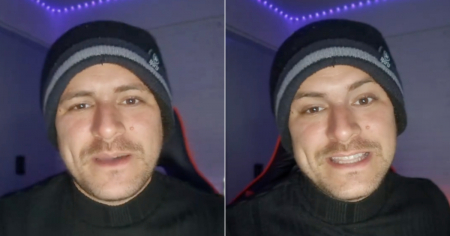
The Cuban YouTuber Frank El Makina shared a new video in which he lists "things about Cuba that Uruguayans do not understand, or at least are astonished when I mention them."
Among the examples he cited, he mentioned blackouts that last nearly a whole day. “The number one issue is blackouts lasting over 20 hours, literally, 20 hours of blackout at least where Claudia lives, there are days when the electricity is off for more than 20 hours,” said @frankelmakina.
He also spoke about the inadequate water service: "The water doesn't reach the taps, it doesn't reach the basin; there is no water, or at least there's a concern that water should come in, because the State is of course the owner of the water supply company and it is inefficient."
The creator also recalled the restrictions that were in place in Cuba until just a few years ago: “Until 2008, we didn’t have the right to own a passport, we couldn’t sell a house, nor could we sell a car.”
Regarding the school environment, he stated: "In schools, every day the children have to shout that they will be like Che, just imagine that, brother."
Frank also mentioned that the internet was only enabled in 2018 and that until 2012, Cubans were not allowed to enter state-controlled hotels on the island.
"I could honestly talk to you here for half an hour, but the video would end up being too long. Let me know in the comments below which one astonished you the most, if you knew anything about this, and if I missed any, please let me know in the comments," he concluded.
The video generated multiple comments on TikTok. Some users expressed surprise: “What’s happening in the schools is really shocking” or “The situation with electricity shocked me.” Others shared personal experiences: “We were almost without water, and it was crazy; we went through a few months of madness” or “During the special period, to get a hamburger, they asked for your ID and wrote down your number on a piece of paper so you wouldn’t line up again to buy another.”
También se recordó la diferencia de trato a turistas y nacionales: “Son dos Cuba, yo fui de paseo una semana y no nos faltaba nada, a los turistas los tratan de lujo”, escribió un internauta, mientras otra persona señaló que en su momento “tampoco podíamos ir a algunas playas donde había extranjeros y ni hablar con ellos”.
Among the most critical comments, a user summarized: “It’s very sad how they have destroyed a town… without electricity, water, controlling life is very sad… literally a leftist dictatorship.”
Frank's video is not an isolated case. Other Cubans have shared their experiences on social media comparing life on the island with that of Uruguay.
A few days ago, Frank himself recounted his first visit to a public hospital in Maldonado and stated: “Definitely, Uruguayans do not know what a hospital in poor conditions is.” The creator assured that the center seemed to him “a normal place,” “incredibly cleaner and more efficient” compared to Cuban hospitals, although some users responded by pointing out delays in appointments and issues of saturation in the Uruguayan healthcare system.
Another Cuban creator on TikTok, @nadyevF, shared her experience as a refugee applicant and recounted how she managed to work in Montevideo despite not initially having an identity card. She acknowledged that many migrants must accept informal jobs, but expressed gratitude for the opportunities in Uruguay: “These are honest jobs that provide food and a roof over one's head.” Her testimony sparked mixed reactions, with some celebrating her effort while others criticized the presence of foreigners in the labor market.
In the same vein, the Cuban Lisset Catalina (@lorenzolisset) went viral by sharing why she chose to emigrate with her family to Uruguay: safety, free education, and healthcare. “We’re going with a 9-year-old girl; we need to look for everything that is safer and more peaceful for us, Uruguay is the country,” she stated. Her story received an outpouring of welcome messages and support from Uruguayans.
These testimonies, primarily shared on TikTok, reveal a pattern: Cuban émigrés contrast the structural deficiencies of their country with the services and freedoms they find in Uruguay, sparking debates on social media both on the island and in the South American country.
Frequently asked questions about the situation in Cuba according to the YouTuber Frank El Makina
What are the main deficiencies faced by the population in Cuba according to Frank El Makina?
Frank El Makina highlights prolonged blackouts lasting over 20 hours, deficiencies in water service, and historical restrictions such as the inability to obtain a passport or sell property until 2008. He also mentions that internet access was only enabled in 2018 and that until 2012, Cubans could not enter state-controlled hotels.
How does the situation in Cuba affect the daily lives of its inhabitants?
Daily life in Cuba is marked by severe limitations. Cubans face blackouts that can last for almost an entire day, have to cook with firewood or charcoal due to the lack of electricity, and are confronted with restrictions in accessing basic goods and services, creating a life of constant uncertainty.
What differences do Cuban emigrants encounter upon arriving in countries like Uruguay?
Cuban émigrés highlight the improvement in quality of life upon arriving in Uruguay, where they find more efficient public services, access to citizens' rights, and job opportunities, although they also face challenges such as the high cost of living and social integration.
How does the political context influence living conditions in Cuba?
The situation in Cuba is the result of a centralized state control that has led to shortages in basic services, restrictions on freedoms, and a stagnant economy. The socialist regime has faced criticism for the deterioration of living conditions and for keeping the country in a prolonged state of precariousness.
Filed under: