
Related videos:
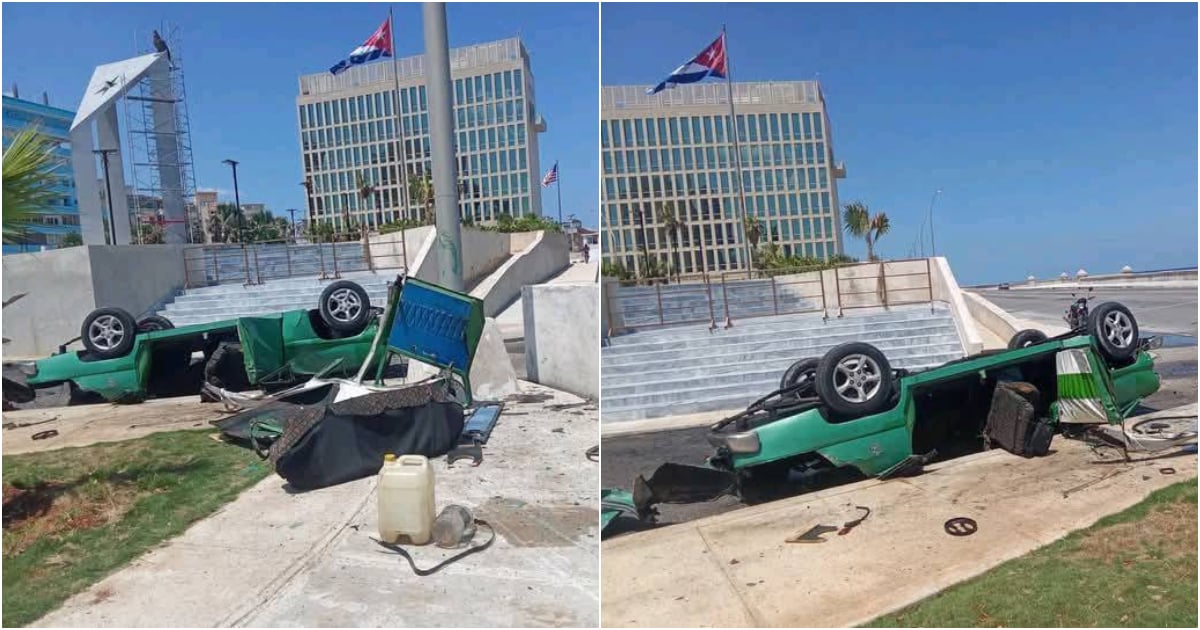
A car with eight occupants, including three minors, overturned on Sunday afternoon at a curve on the Malecón in Havana, near the "José Martí" Anti-Imperialist Tribune. This incident renews concerns about the high accident rate in that area and the lack of effective measures to prevent accidents.
This was announced on his Facebook profile by citizen Pedro Lizardo Garcés Escalona, who shared images of the incident.
For its part, the Facebook group, Stay Informed with El Cubano Fiel, associated with the Ministry of the Interior (Minint) of Cuba, reported that all individuals traveling in the vehicle were out of danger, based on information received from the Calixto García General Teaching Hospital.
According to reports shared on social media, the vehicle, an almendrón, lost control on a curve and ended up overturned on the road.
On the Facebook page of the user La Tijera, a commenter identified as Elvin Fiel, who assisted in the rescue, stated: “I transported them to the Juan Manuel Márquez (pediatric hospital), they are no longer in danger.”
For his part, a person who identified himself as a relative of those affected responded: "I am the brother of one of the individuals involved; my nieces were even coming, that is, my family. I am very grateful... may life bless you abundantly."
Later he confirmed: “The car lost control and all the occupants, including the children, are out of danger.”
Neighbors and drivers agree that the curve where the accident occurred is extremely dangerous, poorly designed, and has a history of similar accidents.
Some remember that traffic signs and warnings were even put up after previous accidents, yet that did not prevent new incidents.
According to reports from those who travel through the area, the curve lacks an adequate banking angle— the transverse incline given to the roadway in a curve— which makes overturning easier, compounded by poor signage and driver recklessness.
The combination turns that point of the Malecón into a critical stretch that continues to claim victims, despite the repeated warnings from the population.
On July 10, a light jeep and a white car violently collided in the same area, where the speed limit is set at 50 kilometers per hour, a measure established to reduce risks in that high-traffic section with slippery pavement.
This Sunday, a truck overturned on the Monumental highway before the Santa Fe bridge, in the municipality of Guanabacoa, with the exact causes of the incident still unknown.
A dramatic traffic accident that occurred on Saturday afternoon in the Las Guásimas area, Arroyo Naranjo municipality (Havana), resulted in significant material damage and left a motorcyclist injured, whose condition is still unknown.
According to social media posts and witnesses at the scene, the incident occurred when a private vehicle, a Hyundai Palisade (license plate P271494), one of the most modern SUVs from the South Korean manufacturer circulating in Cuba, allegedly failed to stop at a "Stop" sign and collided head-on with a motorcycle traveling on the main road.
On the same day, another incident occurred at the intersection of San Lázaro and Escobar streets, in the Centro Habana municipality, where witnesses claim that a small child was riding on the motorcycle involved, once again highlighting the risks faced by citizens on streets with unclear signage, drivers who do not respect right-of-way, and without an effective traffic control system.
A traffic accident that occurred on Friday afternoon in the municipality of Playa, at the intersection of 19th and 46th Streets, resulted in a car overturned in the middle of the street, causing great alarm among passersby and residents in the area.
Despite the implementation of control measures, road accidents are a critical problem in Cuba. The National Road Safety Commission reported that, by May 2025, there had been 3,035 accidents in Cuba, resulting in 2,670 injuries and 290 fatalities.
The government continues to blame human factors while avoiding addressing structural causes such as the deterioration of roads, the lack of proper signage, and the public transportation crisis, which forces many to use risky means of transport.
The consumption of alcoholic beverages and the violation of traffic laws also emerge as common causes of traffic accidents. Additionally, there is a need to reinforce both the mandatory breaks for professional drivers and the structural maintenance of bridges and road signage at high-risk areas.
These factors are compounded by the widespread deterioration of old cars still on the roads in Cuba, along with the poor condition of the highways, a combination that proves fatal and contributes to the increasingly deadly accidents reported in the country.
The Cuban government has acknowledged that 75% of the country's roads and circulation routes are in a condition ranging from fair to poor. This situation poses a significant challenge for the communist regime, as it directly impacts the quality of life of citizens and the provision of essential services.
Frequently Asked Questions about the Dangers of Roads in Cuba and the Recent Accident on the Malecón
What is the danger of the curve on the Malecón in Havana?
The curve at the Malecón in Havana, in front of the Anti-Imperialist Tribune, is considered extremely dangerous due to its poor design and lack of an adequate camber angle. This facilitates rollovers and has been the scene of multiple accidents. The combination of poor signage and the recklessness of some drivers exacerbates the situation.
What measures have been taken to prevent accidents in that area of the Malecón?
Although traffic signs and warnings have been installed following previous collisions, they have not been effective in preventing new incidents. The speed limit is 50 km/h, but the lack of an effective traffic control system and the poor condition of the roads continue to pose a significant risk.
What is the condition of the victims from the recent accident on the Malecón?
Fortunately, all the people who were traveling in the vehicle involved in the accident on the Malecón, including three minors, are out of danger. They were taken to the Juan Manuel Márquez Pediatric Hospital and the Calixto García Teaching General Hospital, where their condition was confirmed.
What factors contribute to the high traffic accident rate in Cuba?
The high traffic accident rate in Cuba is due to multiple factors: the deterioration of roads, the lack of proper signage, the crisis in public transportation, the age of vehicles, and the recklessness of drivers. The Cuban government tends to blame the human factor, but structural causes also play a crucial role in the frequent accidents.
Filed under: