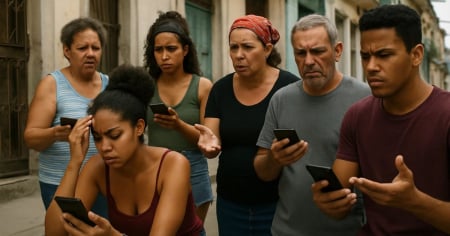
"First of all, I recharge by myself," said the TikToker @izy_111 after receiving a message that not only asked her to share her balance but also the helmet of her motorcycle. "This is completely outrageous, and I'm going to address it fully because it's just unacceptable."
The young Cuban living on the island has shared on TikTok the other side of a recurring complaint among emigrated Cubans: while many in the United States say they are tired of receiving requests for remittances from Cuba, she reported that, from within the island, she also receives requests that she considers abusive.
"Many people in the United States complain that family and friends ask them for money and things. I live in Cuba, and look at the message that just arrived for me today that left me shocked," she explained in a video shared by user @izy_111.
The young woman, clearly upset, shared her experience as part of a phenomenon that affects both emigrants and residents on the island: "Who told anyone that I'm going to lend them my motorcycle helmet? (...) People are really just a bunch of disrespectful individuals and they overstep their boundaries," she said.
She clarified that no one supports her or sends her recharges: “I recharge on my own through PayPal, the app where I receive money from TikTok, and I buy my recharge with the money I earn from TikTok. If this month I don’t make 20 pesos, I can’t recharge my phone.”
Beyond the annoyance of the specific request, what hurt her the most was the attitude of those who only reach out to her when they need something: "That's the most beautiful part of it all: they message you when they need something, but they never message you one day to say, 'Hey, my sister, does your daughter need anything? Does your grandmother have food for today? How is your grandmother feeling health-wise? Does she need any rehydration salts?'"
The post, as expected, triggered a wave of reactions in the comments. Users on TikTok supported their stance with messages like “What a boldness from people,” “They go too far,” or simply with emojis of anger and surprise. Others recalled the high price of the promotions: “So expensive, I paid 70 pesos for that promotion today.”
This testimony comes just after another similar case went viral, though from abroad. The Cuban @katygonzalezmiranda, residing in the United States, shared her experience after receiving a message with a direct demand: “I told you to give me a $20 top-up for my birthday, and you can't even do that.” Her response was clear: “I'm cleaning bathrooms for $13 an hour. I’m not giving my money away to anyone.”
The phenomenon is not new. In 2019, the Cuban Yashell Uranga, from Dallas, posted a viral video showing how he worked loading heavy tires: “To earn 20 or 30 dollars, which is the cost of a recharge for Cuba, it takes three hours sweating like a horse.”
Even in 2018, from Italy, the Santiago native Nairovis Brooks López had already warned in a video: “Understood, Cuban people? Don't ask me for any more top-ups,” demanding that no one knew if she had a job or was eating, and yet they still asked her for money to recharge phones.
Most recently, in April of this year, the Cuban @maydari6, also from the U.S., expressed a similar sentiment: “I am tired of people being so abusive,” she said in a viral TikTok where she asserted that she is not obligated to support anyone.
The video from @izy_111 has concluded. "Work for what’s yours, you have a background of two cubits. Then you go to the bars on Saturdays to have fun, while I have to stay here enduring people who disrespect me to earn a few pesos." This highlights a little-seen reality: that within Cuba itself, there are people who face pressures or thoughtless demands.
Frequently asked questions about recharge requests and assistance from Cuba
Why do some Cubans abroad complain about requests for remittances and assistance from Cuba?
Many Cubans living abroad express their frustration as they feel that requests for remittances and financial assistance are frequent and often made without consideration for the effort it takes to earn that money. The requests are perceived as abusive, as they often lack a genuine interest in the situation of those who are sending the assistance. The constant pressure and lack of gratitude have created a growing discontent among emigrants.
How do people in Cuba manage mobile recharges and other financial assistance?
In Cuba, some people rely on family and friends abroad to recharge their mobile phones and receive other financial assistance due to the difficult economic conditions on the island. However, there are individuals like the TikToker @izy_111 who manage their own recharges using platforms like PayPal, taking advantage of income generated through social media. This reflects a reality where not everyone in Cuba is entirely dependent on external help.
What impact do the constant requests from the island have on Cuban emigrants?
Constant requests from Cuba can cause significant emotional strain for emigrants, who feel a constant pressure to help their family and friends, often without receiving gratitude or recognition. The emotional and financial burden can lead to family conflicts and a decrease in the quality of life for emigrants, who also face their own challenges abroad. This situation has prompted many to express their exhaustion and to discuss the limits of their support.
What are the perspectives on financial assistance to families in Cuba?
Economic assistance to family members in Cuba is a complex issue that generates diverse viewpoints. While some emigrants feel that providing help has become an unfair obligation, others continue to support their loved ones out of a strong emotional commitment. This dilemma reflects the tension between family expectations and the economic reality of emigrants, who must balance their desire to help with their ability to do so without jeopardizing their own well-being.
Filed under: