
Related videos:
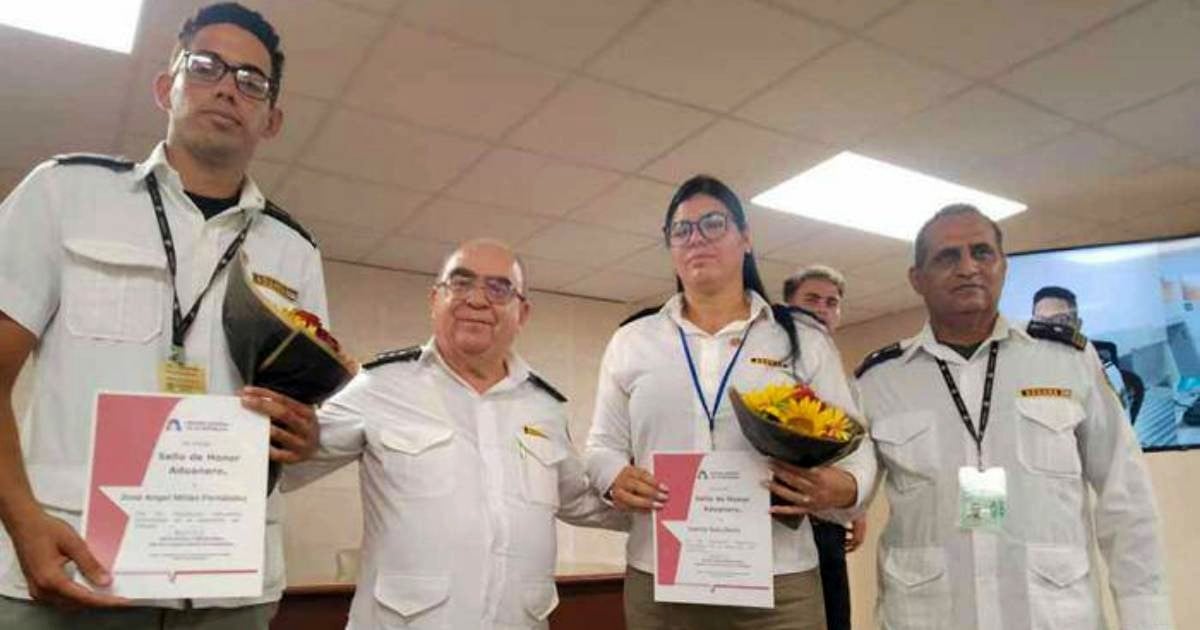
Two customs officers were honored in Havana after preventing the entry into the country of 90 packages of black powder from Miami and several drug trafficking attempts at José Martí International Airport, according to the Cuban Television News.
The recognition ceremony took place at the monumental complex Bosque de los Mártires of the State Security and concluded with the presentation of the Customs Honor Seal to Camila Solá Denis and José Ángel Milián Fernández.
The most striking case occurred on August 8, when Solá, an X-ray specialist at terminal 2 of the airport, detected the explosive substance on a flight arriving from Miami. Although the authorities did not specify its final destination, state television warned that "it could be for fireworks or sabotage."
For his part, Milián managed to identify three drug trafficking attempts in August, including methamphetamines hidden in scented candles and containers of playdough coming from Mexico, as well as cocaine in the luggage of a passenger arriving from Jamaica, according to the television report.
During the tribute, the head of the General Customs of the Republic, Nelson Cordovés Reyes, stated that the workers of the institution are "an impenetrable shield of the Revolution", linking airport control duties with political rhetoric.
Although the official recognition highlights the work of young customs officials, the narrative accompanying these cases turns each finding into a political act. In practice, the extreme surveillance at Cuban airports coexists with passengers' fear of being used as involuntary “mules” and with uncertainty about the extent to which these operations are a genuine effort against drug trafficking or a necessity to reinforce the image of a state that is perpetually under siege.
However, these cases add to a long list of attempts to smuggle drugs into Cuba using increasingly ingenious methods. In recent months, Customs has reported
The authorities insist that these discoveries demonstrate the effectiveness of X-ray technology and staff training. However, details about detainees or implicated networks are rarely provided, leaving the public with only the official narrative that reinforces the “zero tolerance” stance against drugs.
Frequently Asked Questions about Customs Control and Drug Trafficking in Cuba
What recognition did the Cuban customs officials receive for their work?
Cuban customs officers Camila Solá Denis and José Ángel Milián Fernández received the Customs Honor Seal. This recognition was awarded for detecting black powder and several attempts at drug trafficking at José Martí International Airport in Havana, highlighting their work in the security of the Cuban state.
How did Cuban customs detect the gunpowder and drugs at the airport?
The detection was achieved thanks to X-ray technology and the training of customs personnel. Camila Solá Denis, an X-ray specialist, identified black powder on a flight from Miami, while José Ángel Milián Fernández uncovered hidden narcotics in scented candles and containers of modeling clay, among other sophisticated methods used by traffickers.
What methods do traffickers use to smuggle drugs into Cuba?
Smugglers are using increasingly clever methods to introduce drugs into Cuba, such as hiding them in scented candles, containers of modeling clay, tuna cans, disposable diapers, electric showers, and water engines. They also employ "blind mules," individuals who unknowingly transport drugs, which poses a significant challenge for customs authorities.
What is the stance of the Cuban government on drug trafficking?
The Cuban government maintains a stance of "zero tolerance" towards drug trafficking. Authorities have intensified controls at the country's entry points and have strengthened their security measures with advanced technology and staff training to tackle the growing problem of drug trafficking on the island.
How does drug trafficking affect the Cuban population?
The drug trafficking in Cuba has raised concerns about its devastating effects on the health of young people, especially with the use of synthetic drugs like "El Químico." The economic and social crisis in the country has worsened the problem, and authorities have intensified their campaign against drug trafficking to protect the population.
Filed under: