
Related videos:
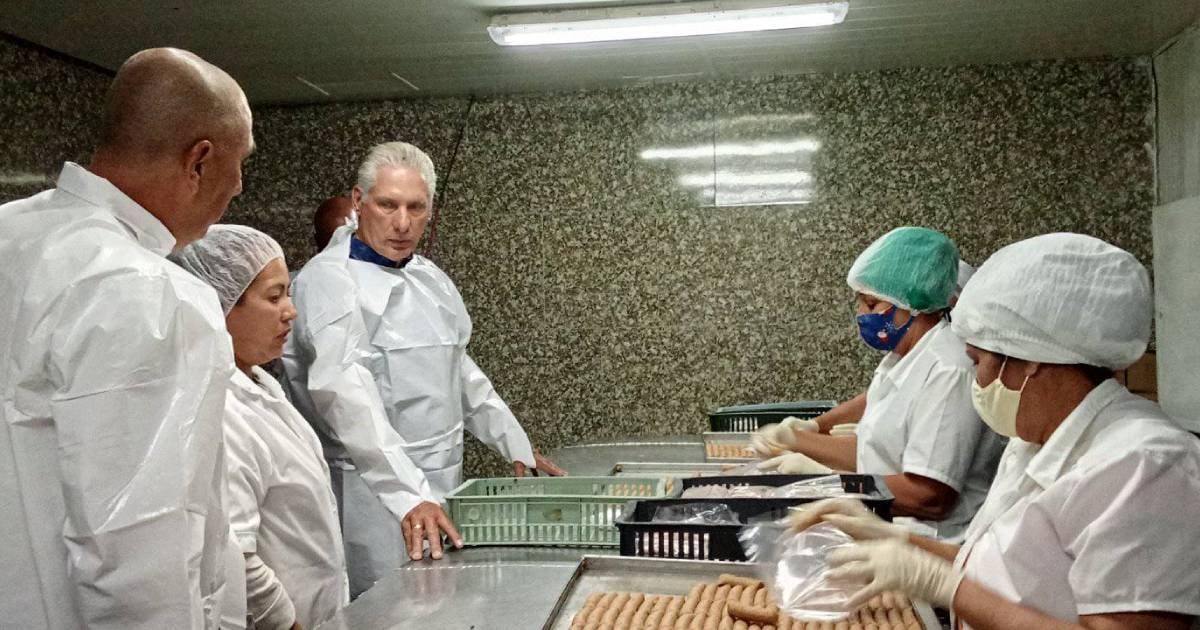
Miguel Díaz-Canel reemerged this Tuesday in the province of Las Tunas, where he oversaw the production of croquettes and other fish products at the fishing company Pescatun.
The official press featured the president among trays of hamburgers and fish products, highlighting the "exceeding productive achievements" of the industry, which claims to have produced over 70 tons monthly and surpassed its target by 42 tons so far this year.
The president also expressed interest in the wages and living conditions of workers, as well as the fate of the productions, which are partly intended for domestic consumption and export.
However, the presidential visit sparked a wave of critical comments from residents of Las Tunas on social media. Many pointed out in a post on Facebook by the state-run newspaper 26 de Las Tunas that the tour only showcased "made-up" areas, far removed from the real issues facing the province.
What a pity, he only goes where they take him and doesn't see the real conditions. They probably took him to the renovated room in the hospital, but not to the Microbiology lab, which is falling apart, denounced a user.
Others called for the leader to get out of the car and visit forgotten neighborhoods. “Most of the issues faced by everyday people are not resolved by visiting places that have already been fixed, but by going to where things are still not right”, wrote an internet user.
Residents also complained about the lack of drinking water in parts of the city, children drinking from contaminated wells, overflowing septic tanks, and municipalities without solutions for power outages. “No wonder there was electricity, since it’s never like that in Amancio… in short, the hypocrisy,” another commenter sarcastically noted.
The visit this Tuesday was not Díaz-Canel's first visit to Las Tunas in 2025. In April, during a tour of the municipalities of Jobabo and Colombia, the leader openly acknowledged corruption, drug trafficking, failures in water supply, issues with banking services, and inadequate political response from local authorities.
At that moment, he urged not to be “overwhelmed” by the problems, despite acknowledging irregularities in state contracts, deficiencies in the electrical system, and communities that, even with solar panels, still had no water.
The official press, in contrast, emphasized irrelevant details such as that in a nursing home “the food was quite good” and “the care, wonderful,” or that a polytechnic “had everything”, highlighting the disconnect between the official discourse and the daily lives of Cubans.
In Granma, buffaloes that the people do not see
Before arriving in Las Tunas, Díaz-Canel visited the “Ernesto Che Guevara” unit in Bayamo, dedicated to the breeding and reproduction of buffalo, a resilient species that is a good producer of meat and milk. The management of the agricultural enterprise stated that they have managed to halt the decline and currently have 650 head of cattle.
But the information generated more skepticism than hope. For many Cubans, the meat of that animal exists only in reports from state television, as it rarely reaches the tables of the population.
Meanwhile, while the official press celebrates factories that exceed their production targets and companies that are "recovering," the daily reality for Cubans is still marked by deteriorating hospitals, neighborhoods without water, power outages, and food that never appears in the stores.
Díaz-Canel's visits, rather than bringing the power closer to the people's issues, reinforce the perception of staged tours for propaganda, where what is presented is far from the reality that most people experience.
Filed under: