
Related videos:
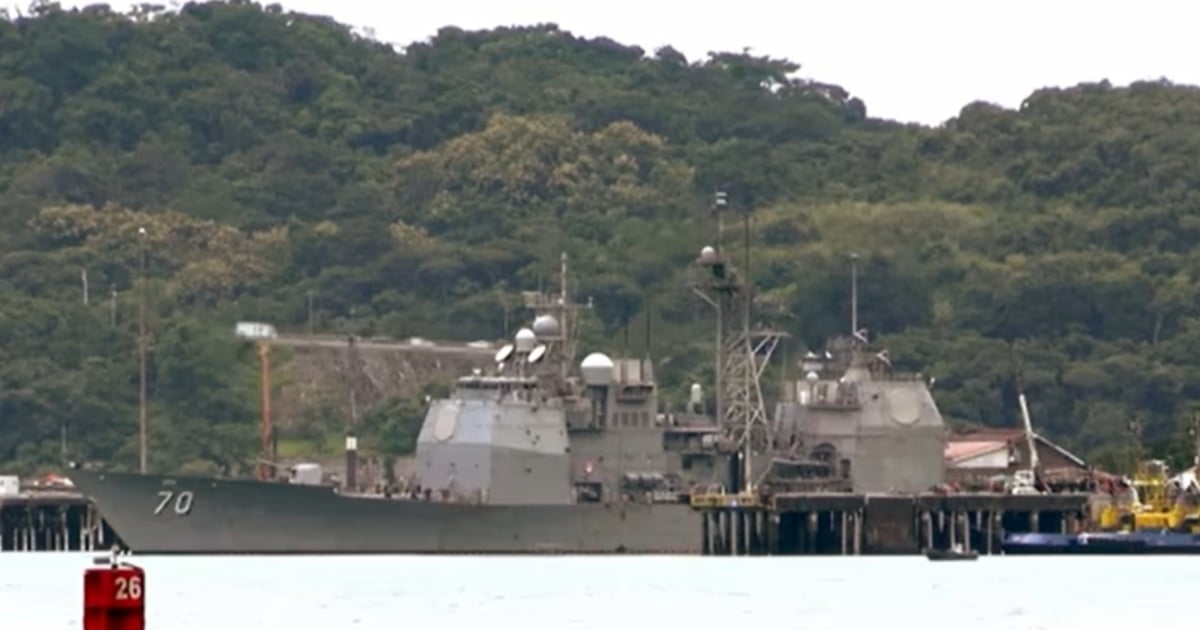
The guided missile cruiser of the United States Navy, USS Lake Erie (CG 70), transited the Panama Canal on Friday night and entered the Caribbean as part of the military reinforcement that Washington is deploying in the region, amidst rising tensions with Venezuela and under the pretext of anti-drug operations.
According to the agency AFP, the ship passed through the canal locks around 9:30 PM local time, after spending two days at Rodman port, and was spotted by local residents as it headed toward the Atlantic.
The arrival of the Lake Erie adds to a significant U.S. military presence in the South Caribbean, which currently includes three destroyers, two landing ships, an amphibious assault ship, a cruiser, and a littoral combat ship, with a total of over 4,500 personnel deployed.
Recently, the Pentagon accused Venezuelan President Nicolás Maduro of leading a drug cartel and has doubled the reward for his capture to 50 million dollars. However, he has not made any public threats to invade Venezuela.
The destroyers are accompanied by detachments from the Coast Guard and police personnel, ready to make arrests during drug interdiction operations.
The Venezuelan government responded by condemning the U.S. maneuver as a threat to its sovereignty.
In response, Caracas mobilized 15,000 security forces along the border with Colombia, announced maritime patrols with drones and warships, and strengthened civil defense training throughout the country.
This military movement underscores Washington's strategy to intensify its presence in international waters of the Caribbean and the Pacific, projecting power in the region while maintaining its official goal: combating drug trafficking.
The Maduro regime began a mass recruitment drive for the Bolivarian Militia across the country this Friday, following the deployment of eight warships by the United States in Caribbean and Pacific waters.
Defense Minister Vladimir Padrino López stated that the FANB will remain deployed throughout the territory “to combat criminal gangs, drug trafficking, and terrorism,” following the approach of U.S. vessels to Venezuelan shores.
Frequently Asked Questions about the U.S. Military Deployment in the Caribbean and Tensions with Venezuela
Why is the USS Lake Erie in the Caribbean?
The USS Lake Erie is in the Caribbean as part of the United States' military reinforcement in the region, officially framed within counter-drug operations. This deployment has also been interpreted as a pressure move against the regime of Nicolás Maduro in Venezuela.
What is the United States seeking with this military deployment near Venezuela?
The United States claims that the military deployment aims to combat drug trafficking in the region, pointing to the Maduro regime as a "narcoterrorist cartel." However, the scale of the operation has been viewed as direct pressure on the Venezuelan government, amid accusations that Maduro leads the Cartel of the Suns.
How has Venezuela responded to the US deployment?
Venezuela has responded by labeling the U.S. movement as a threat to its sovereignty. The Maduro government has mobilized 15,000 security personnel at the border with Colombia, ordered maritime patrols, and intensified civil defense training. It has also reported to the UN the presence of U.S. vessels in the Caribbean.
What is the stance of other countries in the region regarding the military deployment of the U.S.?
Countries like Cuba have denounced the U.S. military deployment as a threat to regional peace. The Cuban government and other allies of Venezuela have described U.S. operations as an excuse for intervention and have called for respect for the sovereignty of countries in Latin America and the Caribbean.
Filed under: