
Related videos:
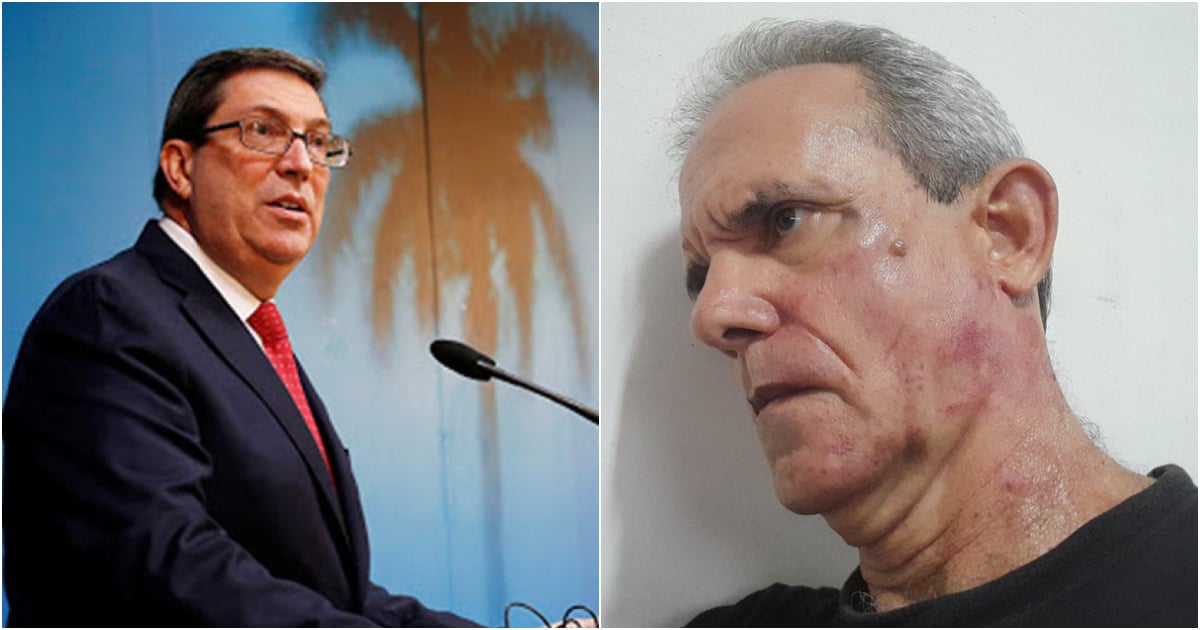
The Minister of Foreign Affairs, Bruno Rodríguez Parrilla, asserted on social media that the Cuban revolution has put an end to disappearances and torture on the island, a claim challenged by the practices that the regime continues to employ against opposing activists.
On numerous occasions, police and State Security authorities arrest citizens while violating their own criminal procedure laws and keep them in an unknown location from family and friends for hours.
The Chancellor posted on his account on X that the “right to life” is the core of the Cuban political system and that the country is committed to combating forced disappearances, as they are a serious violation of human rights.
However, such a statement contrasts with the reports of the arbitrary detention on August 26 in Havana of the activist Yamilka Laffita, known on social media as Lara Crofs.
The activist was intercepted by agents of the National Revolutionary Police while traveling in a vehicle, after leaving the home of the writer and comedian Jorge Fernández Era, in the Antonio Guiteras neighborhood.
Witnesses reported on social media that after the arrest, their whereabouts were unknown, leading to public outcry demanding their release.
Hours later, Laffita herself confirmed on her Facebook profile that she had been released, but she reported that the arrest was violent and that she sustained an injury to her right foot.
Fernández described the State Security officers who assaulted him on July 18 as “fascists”, in the Zanja Unit, in Central Havana, to which he was taken shortly after leaving his home to carry out his usual peaceful protest in Central Park.
In this regard, he recounted the episode of physical aggression and death threats he was a victim of. He also reported that the complaint he attempted to file against his aggressors at the police station in the municipality of Diez de Octubre was not accepted, as he was told it was a case of minor injuries, despite having "a medical certificate in hand, issued at the Miguel Enríquez hospital."
"Nothing, the bruises on the face, ribs, and back are just collateral damage: someone tell Lieutenant Colonel Yoán to put in more effort next time and take out an eye," he ironized.
In mid-August, the Complaint Center of the Foundation for Pan-American Democracy (FDP) raised concerns about the enforced disappearance of the Cuban political prisoner Mario Alberto Hernández Leyva, after more than 48 hours without any information about his whereabouts.
Hernández Leyva is part of the Opposition Movement for a New Republic (MONR), a group opposing the Cuban political system.
In January 2023, the Cuban opposition leader and doctor Oscar Elías Biscet was arrested as he was leaving his home, located in the municipality of Diez de Octubre in the Cuban capital, on the 10th anniversary of the founding of Project Emilia, of which he is the founding leader.
His wife, Elsa Morejón, explained that several hours after his detention by two patrol cars and plainclothes officers, she did not know where he was and that they even cut off her internet access to prevent her from spreading the news of Biscet's arrest.
A similar report occurred in April 2022, when the Cuban opposition figure Carlos Ernesto Díaz González, known on social media as Ktivo Disidente, went missing after he protested alone along the Boulevard of San Rafael in Centro Habana and was arrested.
The contrast between the official rhetoric and recent events highlights the gap between the regime's international discourse and the reality experienced by opponents within Cuba.
Frequently asked questions about reports of repression and disappearances in Cuba
What did Bruno Rodríguez say about the disappearances and torture in Cuba?
Bruno Rodríguez stated that the Cuban revolution put an end to disappearances and torture, asserting that the right to life is at the heart of the Cuban political system. However, this statement contrasts with recent reports of arbitrary detentions and enforced disappearances of regime opponents.
What recent incidents contrast with the Cuban government's statements on human rights?
Despite the claims of the Cuban government, there have been reports of arbitrary detentions and enforced disappearances of activists, such as the cases of Yamilka Laffita and Mario Alberto Hernández Leyva. These allegations highlight the repression and harassment faced by opponents in Cuba.
How has the international community reacted to the reports of repression in Cuba?
The international community has expressed concern over human rights violations in Cuba, especially following the protests on July 11, 2021. Despite this, the regime has maintained its stance of denial regarding the accusations while continuing the repression against activists and opponents.
What consequences do activists who criticize the Cuban regime face?
Activists in Cuba face threats, harassment, and arbitrary detentions. Cases like that of Yamilka Laffita highlight the constant risk of repression, including surveillance and physical aggression by state security forces.
Filed under: