
Related videos:
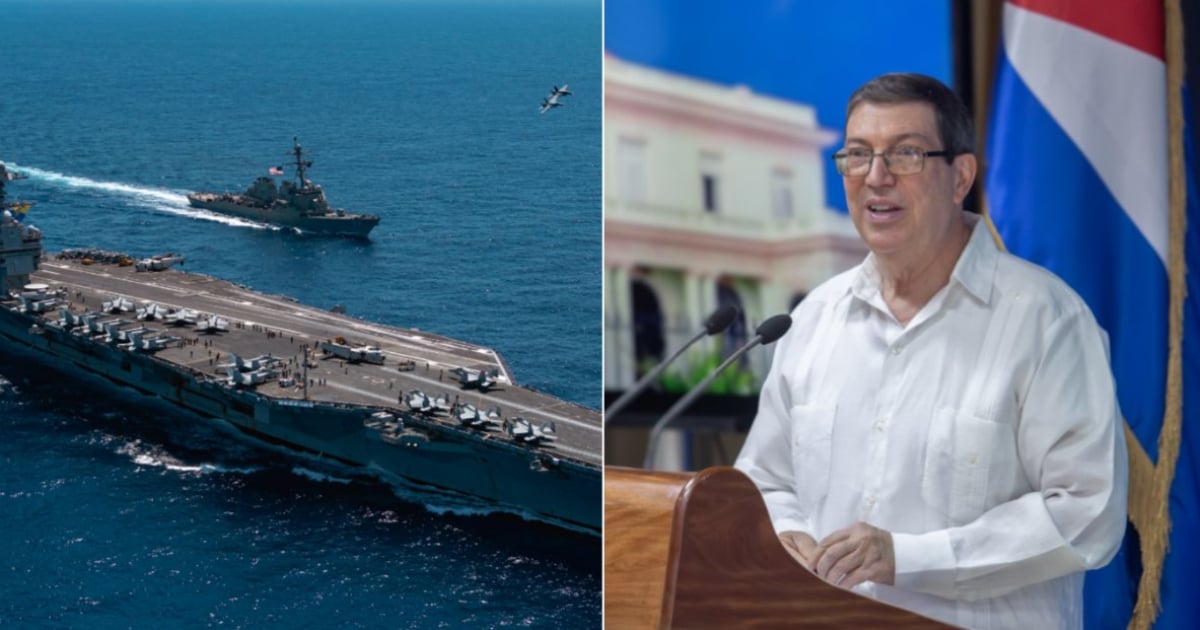
The Cuban government denounced the presence of U.S. military ships in Caribbean waters, describing it as a direct threat to regional peace.
Through statements on social media, this Tuesday high-ranking officials of the regime accused Washington of promoting a military escalation for interventionist purposes, directly pointing to Secretary of State Marco Rubio as one of the key figures behind this strategy.
Bruno Rodríguez claims that there is a "serious danger" to the region
The Minister of Foreign Affairs, Bruno Rodríguez Parrilla, stated on his X account that the deployment of American ships to the Caribbean represents a "serious threat to regional peace" and insists that it is part of a policy of domination over Latin America.
"The deployment of more military ships by the United States to the Caribbean poses a serious danger to regional peace and seeks to reestablish its dominance in Our America under the absurd pretext of combating drug trafficking," wrote Rodríguez, criticizing the American political figures who support this military operation.
"Responding to the agenda of corrupt politicians like the Secretary of State," he added without naming names, but in direct reference to Marco Rubio, one of the most active proponents of the naval deployment in the area.
Morales Ojeda strengthens support for Maduro and rejects "Yankee threats."
The Secretary of Organization of the Central Committee of the Communist Party of Cuba, Roberto Morales Ojeda, also reacted on social media, reaffirming Havana's support for the government of Nicolás Maduro.
In his message on X, Morales Ojeda expressed: “We reiterate our firm support and ongoing solidarity with President Nicolás Maduro, @PartidoPSUV, and the Civic-Military Union of the Bolivarian Republic of Venezuela. No threat from Yankee imperialism will bend that brave people, heirs of Bolívar and Chávez.”
The senior official of the Cuban regime characterized the current situation as part of an ideological offensive driven by the United States.
"Fascist and far-right thinking is resurging, with constant threats to peace. The shameless Yankee threats to Venezuela and President Maduro confirm this," he stated.
Regional context: The U.S. deploys naval forces off the coast of Venezuela
The United States has intensified its military presence in the Caribbean in recent days with the deployment of three guided missile destroyers, a fast attack nuclear submarine, and a missile cruiser.
The Pentagon has stated that this operation is part of the fight against drug trafficking, but both Cuba and Venezuela interpret it as a maneuver for pressure and intimidation.
During the XIII Extraordinary Summit of ALBA-TCP, held in Havana, the Cuban leader Miguel Díaz-Canel condemned this U.S. military movement and described it as an "imperial show of force."
In their view, the Trump administration has a supposed hidden intention behind this military deployment, which would serve to carry out "covert actions" under Title 50 of the U.S. Code.
"The deployment of military naval units to the south of the Caribbean, under the command of Southern Command, involves up to 4,000 personnel and is presented as a deterrent action, based on the false and disproportionate argument of combating drug trafficking cartels," the president stated.
Marco Rubio defends the military offensive
Marco Rubio stated that the United States is "on the offensive" against drug cartels, and justified the deployment as part of a national security strategy.
“For the first time in the modern era, we are truly on the offensive against the organized cartels that are pumping poison—deadly poison—into our cities, and this is a team effort,” he stated during a cabinet meeting at the White House.
The U.S. government insists that it will not allow Venezuela to become a "criminal sanctuary," and has doubled the reward for the capture of Nicolás Maduro, whom it accuses of leading the Cartel of the Suns.
Frequently Asked Questions about Tension between Cuba, the U.S., and Military Presence in the Caribbean
Why does Cuba denounce the presence of U.S. military ships in the Caribbean?
Cuba believes that the deployment of U.S. military ships to the Caribbean poses a "serious danger to regional peace." According to Foreign Minister Bruno Rodríguez, this action aims to reestablish U.S. dominance in Latin America under the pretext of combating drug trafficking. From the Cuban perspective, this situation is seen as an interventionist threat and part of a political agenda of domination.
What is the United States' stance on its military presence in the Caribbean?
The United States justifies its military presence in the Caribbean as part of a strategy to combat drug trafficking. The deployment includes destroyers, a nuclear submarine, and a missile cruiser, and is part of a broader operation to address organized crime. However, both Cuba and Venezuela interpret these actions as a maneuver of pressure and intimidation.
What role does Marco Rubio play in the current tension between Cuba and the U.S.?
Marco Rubio, as U.S. Secretary of State, has been identified by Cuba as one of the key architects of the military strategy in the Caribbean. Rubio defends the military deployment as a necessary measure to combat drug trafficking and protect the national security of the United States. However, the Cuban regime accuses Rubio of having a corrupt agenda and of using the drug war as an excuse to militarize the region.
How has Cuba reacted to the increase in the reward for the capture of Nicolás Maduro?
Cuba has strongly criticized the United States' decision to increase the reward for the capture of Nicolás Maduro. The Cuban government views this measure as an act of aggression and accuses the U.S. of acting as a "global judge" to justify unilateral and illegal actions against Venezuela. Havana maintains its unconditional support for Maduro, reinforcing the political and strategic alliance with the Venezuelan government.
Filed under: