
Related videos:
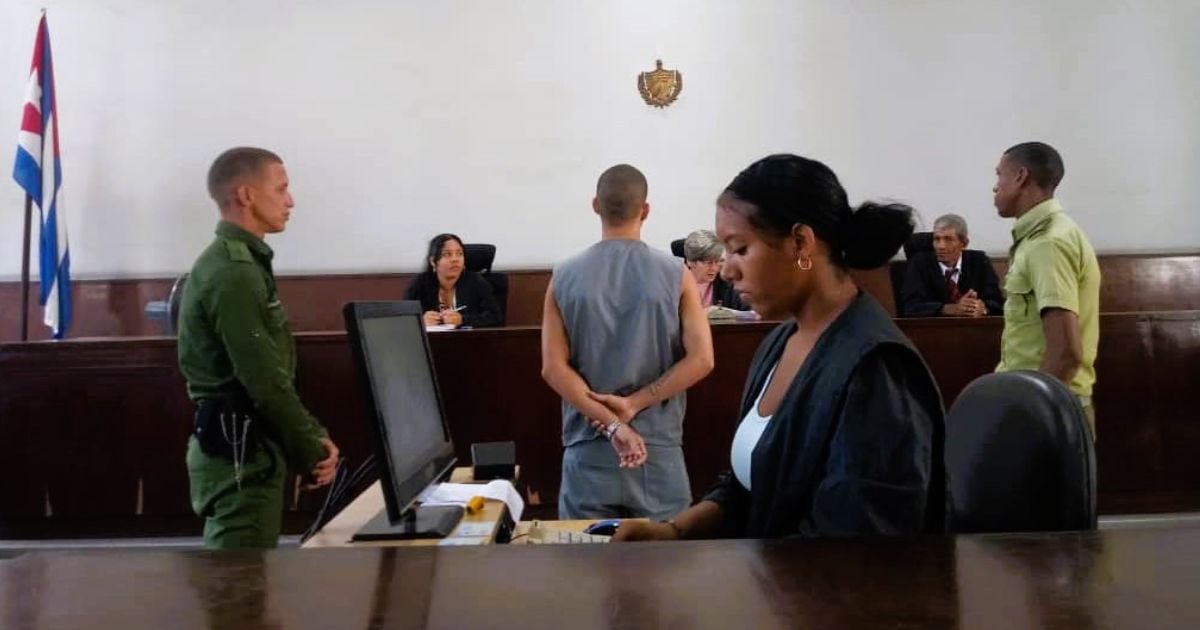
The family of a Cuban citizen sentenced to 13 years in prison in Santiago de Cuba for international drug trafficking reported that fundamental rights and procedural guarantees were violated during the judicial process.
The provincial court reported on Facebook that the accused, who has been residing in Suriname since 2022, was arrested at Antonio Maceo International Airport, where authorities discovered 300 grams of high-purity cocaine hidden in a bicycle seat that was part of his luggage.
The prosecution admitted that "the 33-year-old defendant had received goods in his luggage from a person in Suriname," and additionally "for these actions he received 84 dollars and was supposed to deliver the goods to a person upon his arrival in the national territory, whose identity was not known."
And he then clarified: "Anyone who agrees to bring shipments and brings drugs is responsible for them, which is why the court considered the defendant an author according to article 20.1.2 subsection a) of the Penal Code."
Nonetheless, the note emphasizes that an "exemplary" trial was conducted, a statement that seems illogical given that "the court took into account that this person had not been previously monitored for involvement with drugs, maintained appropriate social conduct, and had no criminal record."
However, in the comments on the official publication regarding the case, the convict's family demanded the reopening of the process, arguing that evidence and witnesses that demonstrated the defendant's lack of knowledge about the substance found were denied.
Her sister Yaidarys Rodríguez Avilés expressed that the version published by the court was “incomplete and biased” and reminded that her brother returned to Cuba amidst a difficult economic situation.
"I didn't have enough money to pay for my ticket and had to sell part of my luggage. It was the first time I was leaving the country, I had no experience or malicious intentions," he wrote.
According to what was said, the accused thoroughly examined each item received, including the saddle, and witnesses confirmed that he was unaware of the existence of drugs inside it.
Rodríguez noted that during the trial, no witnesses or evidence were accepted that could have demonstrated his brother's diligence, and he added that even Customs agents stated that the drug was so well concealed that even experts could not have detected it in a superficial inspection.
"My brother was a victim of a setup and the desire to make an exemplary trial," he concluded.
Another sister, Yaliannis Reyes, described the process as “a total injustice.”
"We demand that the trial be made public from beginning to end, because it was shown there that he had no intention of trafficking. They did not take into account the pain of a mother, of a daughter who is now heartbroken. We demand justice and that the laws and rights be upheld," she denounced.
The mother, Eneida Avilés Castillo, stated that she feels devastated: "How saddened I am in my heart to see with my own eyes the injustices that have been committed against my son, condemning him to 13 years without taking into account that he was just deceived. He entered Cuba a few days before losing his immigration status because he did not want to become an émigré. I agree that the real drug criminals should be punished, but not in this manner, destroying innocent families."
The stepfather, Juan Rafael Rodríguez Diéguez, a teacher by profession, also spoke in defense of the accused.
"In this process, fundamental evidence was denied, the principle of equality before the law was undermined, and the presumption of innocence was violated. There was a conviction without demonstrating intent or a conscious willingness to commit any crime," he noted.
Rodríguez cited Articles 54 and 55 of the Constitution and Article 95 of the Penal Code, arguing that the trial did not meet the minimum guarantees of due process.
In a second intervention, Yaidarys Rodríguez Avilés questioned the interpretation of the Penal Code applied by the court.
"To condemn someone as the author, it must be proven that they acted directly and knowingly. In this case, neither knowledge nor intention to traffic was demonstrated. The sentence is disproportionate and lacking in solid foundations," he stated.
Yaliannis Reyes insisted on the emotional impact that the sentence has caused: “You cannot imagine the psychological and moral damage that this injustice has caused my brother and our family. How do I explain to my children that their uncle was sentenced to 13 years without any basis or grounds? We want justice for the accused in case 90 of 2025.”
The family members collectively demanded a review of the process, the admission of all evidence and testimonies that were excluded, and the full publication of the trial, in order for “society to know the complete truth and not just a partial version that favors the official narrative.”
Recently, the People's Supreme Court of Cuba issued a serious warning about the increase in the consumption and trafficking of synthetic drugs on the island, particularly in Havana.
Furthermore, it passed a ruling that toughens the criminal penalties for those who possess or distribute these highly toxic substances.
The Supreme Court clarified that it will no longer be necessary for a defendant to possess one pound (460 grams) of drugs to be prosecuted under the "relatively large quantities" provision of the Penal Code.
In the case of synthetic cannabinoids, it will be sufficient to demonstrate, through toxicology and forensic expert assessments, that the substance is highly toxic, how many doses could be derived from the confiscated material, and the potential harm to public health.
For illegal possession, the classification will be under Article 236, paragraph a), with penalties ranging from one to three years in prison or fines of up to one thousand units, similar to what occurs with substances as potent as cocaine.
Frequently Asked Questions about Drug Trafficking Sentences in Cuba
What are the main complaints from the family of the convicted individual in the trial in Santiago de Cuba for drug trafficking?
The family of the condemned claims that fundamental rights and procedural guarantees were violated during the judicial process. They allege that evidence and witnesses demonstrating the accused's lack of knowledge regarding the substance found were denied, and they also consider the trial to be "exemplary" and biased.
What arguments does the defense present regarding the accused's lack of intent in drug trafficking?
The defense of the accused argues that he was unaware of the existence of drugs in his luggage and that he thoroughly checked each item received. Witnesses stated that the drugs were hidden so well that even experts could not detect their presence during a superficial inspection.
What additional measures have been implemented in Cuba against drug trafficking?
In Cuba, judicial measures against drug trafficking have intensified, including "exemplary" trials and severe sentences. These measures are part of a national effort to prevent and combat crime, corruption, drugs, and social indiscipline, promoted by the Cuban regime.
How does the economic situation in Cuba affect the rise in drug trafficking cases?
The critical economic situation in Cuba, characterized by inflation, scarcity, and unemployment, has led many to engage in illicit activities such as drug trafficking. The punitive approach of the regime does not address the structural causes that drive citizens toward these illegal activities.
Filed under: