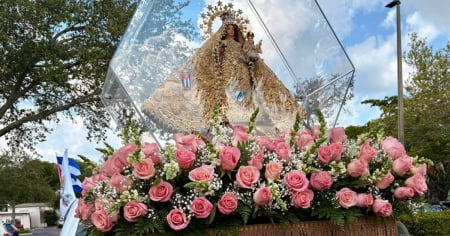
Hundreds of Cubans in Miami gathered this Sunday at the Ermita de la Caridad to honor the Patroness of Cuba on the eve of her festival, bringing sunflowers, other types of flowers, and lit candles in an atmosphere of deep religious and patriotic fervor.
The ceremony, broadcast live on Facebook, showcased the steady arrival of pilgrims who placed their offerings before the image of the Virgin.
In the vicinity, a wall stood out with the phrase "God: Homeland and Life," written in large letters alongside the Cuban and American flags, a reminder of the connection between faith, freedom, and nation, as well as the emigrants' desire to finally see the country free from tyrannical regimes.
During the celebration, a priest invited the attendees to present their supplications and wishes to the Virgin of Charity.
In his words, he especially prayed for the sick, the imprisoned, emigrants, and those who endure the hardships of daily life, emphasizing that "Mary is the best path that leads us to God, for she is the mother of God, but also our mother."
The community prayers included the Our Father and the Hail Mary, followed by the final blessing.
"May God bless you and the Virgin accompany you," said the celebrant, while encouraging those present to see the Virgin as a mother of hope and a beacon of freedom.
"Let us meditate on what we feel in our hearts, and in this moment of silence, let us present that which today, along with our flowers, we wish to offer to our mother, the Virgin of Charity, so that she, as a caring mother, mother of hope, mother of freedom, beacon of light in our lives, may guide us to Jesus," he insisted.
For the Cuban diaspora, the Virgin of Charity is not only a religious symbol but also an emblem of cultural identity and resilience.
Each year, thousands of devotees in Miami renew the tradition that connects the Island and the exile around the Virgen Morena, reaffirming that her image accompanies Cubans wherever they may be.
In Spain, the Cuban community in Madrid celebrated the Virgin of Charity of Cobre, patroness of Cuba, with a series of religious and charitable activities that brought together dozens of worshippers.
And from Santiago de Cuba, Archbishop Mons. Dionisio García Ibáñez reminded this Sunday that the Virgin of Charity of Copper has been a symbol of unity and comfort during the most tragic moments in the history of the nation.
Frequently Asked Questions about the Devotion to Our Lady of Charity of Copper in Miami
Why is the Virgin of Charity of El Cobre so important to Cubans?
The Virgin of Charity of Cobre is a symbol of cultural identity, resistance, and hope for Cubans. Her veneration transcends the religious, uniting Catholics and practitioners of Afro-Cuban religions. Cubans see her as a spiritual guide, especially in times of crisis and hardship. The Virgin is also known as the "Mambi Virgin" due to her historical connection with Cuba's independence struggles.
How do Cubans in Miami celebrate the Virgin of Charity of Cobre?
Cubans in Miami celebrate the Virgin with religious ceremonies, processions, and cultural activities. Every year, thousands of devotees gather at the Ermita de la Caridad, bringing flowers, candles, and offerings. The celebrations include masses, communal prayers, and expressions of religious fervor, highlighting the connection between faith and the desire for freedom for their homeland.
What messages are conveyed during the celebrations for Our Lady of Charity in Miami?
During the celebrations, messages of hope, freedom, and unity are shared. Religious leaders invite attendees to present their pleas and desires to the Virgin, specifically asking for the sick, the imprisoned, migrants, and those who suffer in Cuba. The prayers reflect the wish to see the island free from oppressive regimes and the importance of keeping faith and hope alive.
What is the meaning of the motto "God: Homeland and Life" in the context of these celebrations?
The motto "God: Homeland and Life" represents the intersection of faith with the desire for freedom and justice for Cuba. This motto, visible during the celebrations, reflects the longing of the Cuban diaspora to see a free and united Cuba, where religious faith becomes a driving force for social change and cultural resistance.
Filed under: