
Related videos:
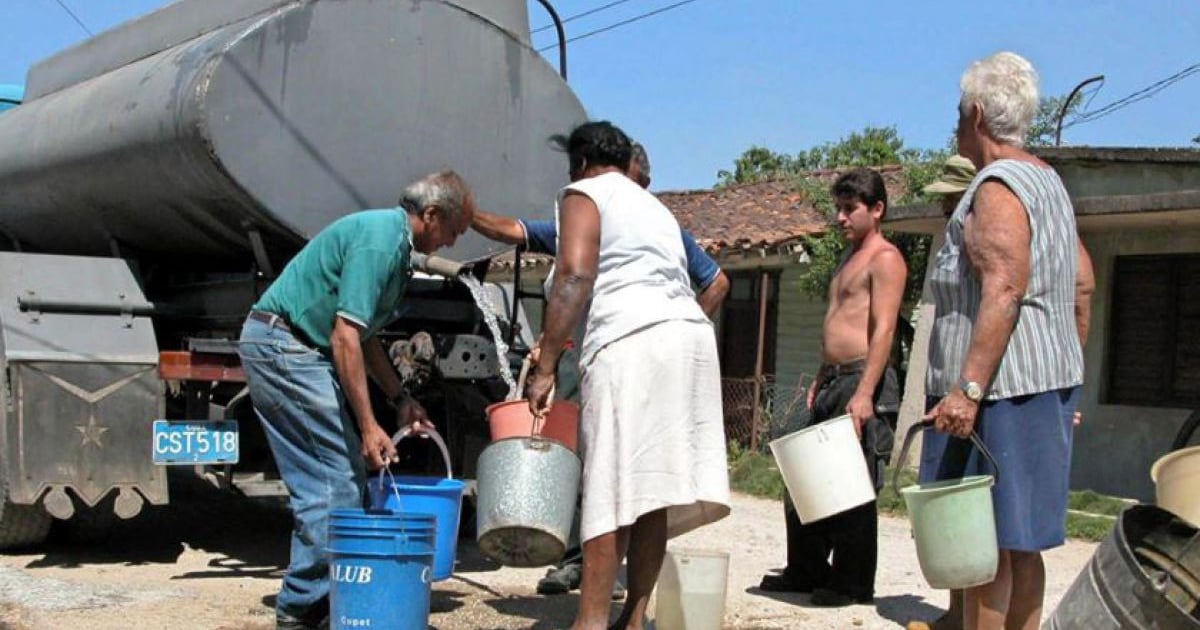
The president of the National Institute of Hydraulic Resources (INRH), Antonio Rodríguez Rodríguez, acknowledged this Tuesday that around one million people in Cuba are facing daily challenges in water supply, due to the energy crisis, lack of material resources, and a persistent drought.
During his appearance before the Commission of Industry, Construction, and Energy of the Cuban Parliament, in the context of the fifth ordinary session of the tenth legislature of the National Assembly, Rodríguez acknowledged that the situation is "complex" and that the limitations extend throughout the country.
“We are making progress on projects, but with limitations,” he stated, in remarks reported by the newspaper Granma.
The official specified that about 300,000 people are without water due to equipment breakdowns, but the total number of those affected rises to one million Cubans, including interruptions caused by power outages, lack of fuel, or failures in the distribution system.
In coordination with the Electric Union, the INRH attempted to protect 486 essential pumping stations, but they were only able to ensure 37%. This was because energizing all those stations would lead to increased outages in other areas of the country.
Rodríguez also acknowledged that the available fuel represents less than 40% of what the hydraulic system needs, and that there are significant limitations with cement, which impacts both new projects and urgent repairs.
In terms of climate, the situation is also not favorable. The official warned that May, traditionally a rainy month, recorded only 41% of the historical average, and that forecasts for July indicate sparse rainfall, especially in the eastern part of the country.
Santiago de Cuba faces the most complex situation, warned Rodríguez.
An emergency project was carried out at the Gota Blanca dam in that province, which supplies the provincial capital, with the support of the Revolutionary Armed Forces.
It also highlighted measures in other areas, such as the use of a floating intake in Gibara (Holguín) and the positive experience in Caimanera (Guantánamo), where service was ensured for 116 days.
Despite the overall deterioration of the system, the INRH claims that over six billion pesos were invested in hydraulic works in 2024, and that a similar course will be followed in 2025.
In parallel, the Union of Military Industries is working on the repair of 100 hydraulic pumps to address the most urgent technical failures.
Rodríguez also warned about water theft and the lack of community control. As a solution, he mentioned the case of Mataguá (Villa Clara), where a delegate took direct control of a distribution area with positive results.
Regarding the energy transition, 766 solar pumping systems have been installed, of which 697 are already operational, benefiting over 445,000 residents.
However, many civic proposals still need to be postponed, especially those that require cement or fuel, and even the cleaning of non-priority pits has been temporarily suspended.
Meanwhile, hundreds of thousands of families in Cuba are facing prolonged power outages, irregular access to drinking water, and a hydraulic system that fails to meet the minimal demands of the population.
Frequently Asked Questions about the Water Crisis in Cuba
How many Cubans are affected by the lack of water?
Approximately one million Cubans face daily disruptions in water supply due to the energy crisis, lack of material resources, and the ongoing drought in the country.
What is the main cause of the water crisis in Cuba?
The water crisis in Cuba is mainly due to the intense drought, combined with equipment breakdowns and the energy deficit affecting the supply stations. This situation has been worsened by lack of maintenance and insufficient resources for urgent repairs.
What measures is the Cuban government taking to address the water crisis?
The Cuban government has implemented some measures to mitigate the water crisis, such as the installation of solar pumping systems and the repair of hydraulic pumps. However, the actions have been limited and have not managed to resolve the critical situation, leaving hundreds of thousands of Cubans with irregular access to drinking water.
What is the impact of the electrical crisis on water supply in Cuba?
The electricity crisis in Cuba directly affects water supply, as 70% of the issues with water provision are linked to power outages and lack of electrical energy. Without electricity, the hydraulic infrastructure cannot operate properly, further complicating access to potable water for the population.
Filed under: