
Related videos:
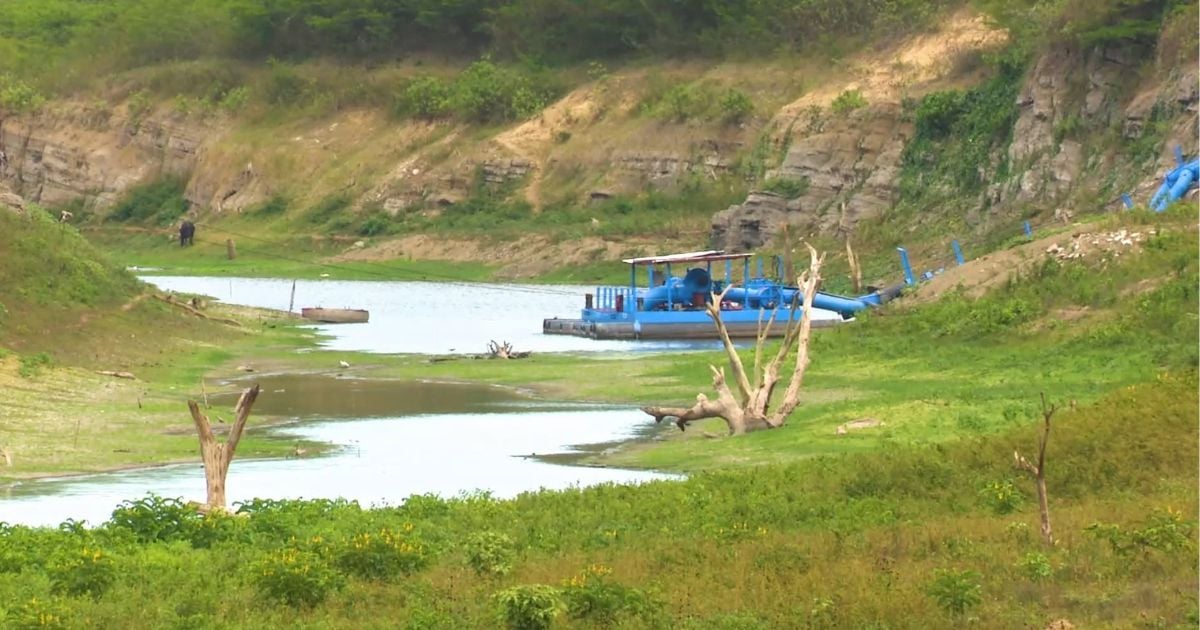
The aerial images shared on social media reveal the severity of the drought that is hitting Santiago de Cuba, where the reservoirs appear almost empty and water is scarcer than it has been in years.
According to a post by the Prensa Latina correspondent in Santiago de Cuba on Facebook, the photo gallery displays depressed reservoirs, reduced waterways, and land overrun by vegetation in areas where there were once flows.
Additionally, it was reported that the province is facing one of the worst droughts in decades. The main reservoirs that supply more than 80% of the capital city store only 23.3 million cubic meters of water, which represents 15.6% of their total capacity.
Currently, the northwestern system supplies about 1,380 liters per second to the population, compared to an actual demand of 2,300 liters per second.
This deficit has extended the distribution cycles of drinking water in Santiago communities to more than 30 days, turning the crisis into a daily struggle.
In response to the magnitude of the problem, local authorities and executives from the National Institute of Hydraulic Resources activated emergency plans that include support with water tankers, pumping from alternative wells, and investment in the Campo de Tiro pumping station.
The drought in Santiago de Cuba, more than a future threat, is a reality that tests the resilience of the population, the capacity of institutional response, and the solidarity among communities that face scarcity with forced resignation.
In various communities, there is an irony in the saying that "we have to wait for Columbus to see running water", a phrase turned into popular sarcasm in the face of desperation.
The regime has recently acknowledged that the drought has caused a spike in water theft and diversion, while residents of Santiago are struggling to survive with increasingly long delivery cycles and precarious services.
At the same time, images of families that run after a water truck to fill buckets have become the everyday portrait of the city.
The structural deterioration has also been highlighted in reports indicating that the hydraulic system is collapsed and lacks the capacity to ensure minimum distribution, even in cases where there are specific reserves.
This is compounded by uncertainty regarding predictions, as even the forecasted rains fail to alleviate the accumulated deficit in the reservoirs.
Frequently Asked Questions about the Water Crisis in Santiago de Cuba
What is the current situation of the drought in Santiago de Cuba?
Santiago de Cuba is facing one of the worst droughts in decades, with reservoirs nearly empty and a significant deficit in the water supply. This has caused the population to endure extremely long water distribution cycles, exceeding 30 days, and in some areas, up to 85 days without service.
What measures are the authorities taking to address the water crisis in Santiago de Cuba?
Local authorities have implemented emergency plans that include the use of tank trucks, pumping from alternative wells, and investment in pumping stations. However, these measures have not been sufficient to alleviate the population's despair, which continues to face irregular access to drinking water.
How is the water crisis affecting daily life in Santiago de Cuba?
The lack of water in Santiago de Cuba has turned access to water into a daily struggle for survival. The population is forced to rely on water trucks that do not guarantee a regular supply, and many have to carry water over long distances. The crisis has also impacted sectors such as agriculture and health, increasing social unrest.
What is the forecast for the water supply in Santiago de Cuba?
There is no clear forecast for when the water service in Santiago de Cuba will stabilize. Authorities have acknowledged that the situation is critical and that they rely on improvements in rainfall and infrastructure to enhance the water supply to the population.
Filed under: