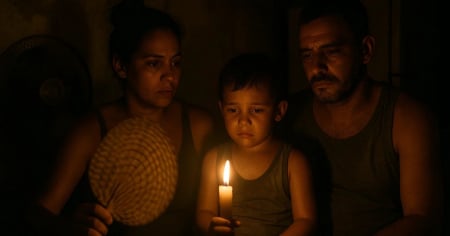
In Cuba, when electricity returns after a blackout, there is no time for celebrations. This is well understood by the user of TikTok who identifies as @rossy_guajira_natural, who shared a video that starkly and humorously depicts the anxiety of millions of Cubans when "the power comes back."
“Here I am early, without combing my hair, without changing my clothes, without brushing my teeth, because if he leaves, it's worse. You have to make the most of every second”, she confesses amidst nervous laughter, while simultaneously turning on the washing machine, placing rice on the stove, seasoning beans for her daughter, and even using a chipped bar of soap as a substitute for the detergent that's run out in her village.
The scene, characterized by improvisation and haste, illustrates what it means to live in a country where the most basic tasks depend on a few minutes of electricity. “I usually need to be an octopus, but now more than ever because we've been without power for 48 hours,” explains the woman, who even stops in the middle of the rush to grab a coffee and attend to a friend who asked her for a facial.
A daily drama in a country shrouded in darkness
Rossy's testimony arrives amid the worst energy crisis in recent years, as Cuba experiences its fifth general blackout in less than a year and faces increasingly prolonged power outages with no defined schedule.
The most recent collapse occurred on September 10, when the unexpected shutdown of the Antonio Guiteras thermoelectric plant in Matanzas left the entire island in darkness. Just a few days earlier, another failure had disconnected the electrical system from Las Tunas to Guantánamo, impacting millions of people.
The figures reveal the extent of the disaster: deficits of more than 1,800 MW in September, power plants over 40 years old without capital maintenance, and a demand that significantly exceeds generation capacity. The management of the Electric Union has acknowledged that the system operates under conditions of “critical instability.”
The "normalization of abnormality"
What was for Rossy a hectic domestic rush is already the routine of survival for millions of Cubans: cooking at dawn, washing dishes in the dark, cleaning with improvised soaps, sleeping without a fan, and losing food due to lack of refrigeration.
The engineer and entrepreneur Yulieta Hernández recently described it as the “normalization of the abnormality”, in a country where blackouts are not power outages, but interruptions of life.
In that Cuba, every return of electricity is a race against time to wash, cook, clean, ventilate, and even attempt to have a moment of normalcy. A race that never ends, because everyone knows that the power can go out again at any moment.
Frequently Asked Questions about the Energy Crisis in Cuba
Why are power outages so frequent in Cuba?
The blackouts in Cuba are due to a lack of fuel, breakdowns in the thermoelectric plants, and insufficient maintenance of the energy infrastructure. This situation has resulted in a generation deficit exceeding 1,500 MW during peak hours. Additionally, the country's power plants are in poor condition, and maintenance work is piling up, exacerbating the collapse of the national electrical system.
How does the energy crisis affect daily life in Cuba?
The energy crisis in Cuba severely affects the daily lives of its citizens, forcing them to reorganize their routines around electricity availability. Many basic tasks such as cooking, washing, or refrigerating food depend on the few minutes of electricity that are available. Prolonged blackouts also lead to food spoilage and a lack of cold water, impacting the health and well-being of families.
What strategies do Cubans use to cope with blackouts?
To cope with the blackouts, many Cubans have developed "emergency kits" that include rechargeable fans, portable chargers, and LED lamps. In addition, some use generators and charcoal stoves to continue with their daily activities. They also turn to social media to find basic goods and organize small businesses due to the lack of resources.
What is the reaction of the Cuban population to the energy crisis?
The Cuban population has displayed a mix of resignation, indignation, and solidarity in response to the energy crisis. Many citizens share their experiences on social media, documenting daily hardships and offering practical advice to cope with the situation. However, there are also criticisms of the government for the lack of effective solutions and the ongoing deterioration of living conditions on the island.
Filed under: