
Related videos:
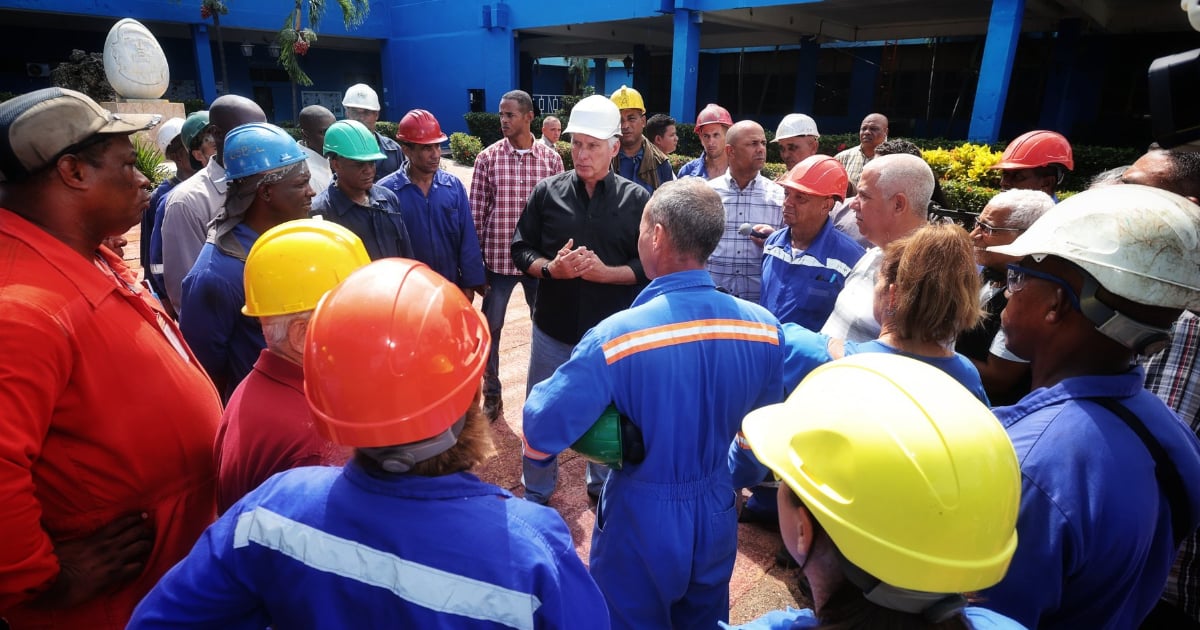
The president Miguel Díaz-Canel visited today the thermoelectric plants located in the municipalities of Mariel (Artemisa) and Santa Cruz del Norte (Mayabeque) to promote the recovery of the National Electric System amid prolonged blackouts and growing concerns about the effectiveness of government measures to stabilize electricity generation.
The visit began at the Máximo Gómez power plant in Mariel, where unit 5 is set to synchronize within the next few hours with 65 megawatts, while blocks 6 and 8 generate 94 and 60 megawatts, respectively, reported the Presidency of Cuba through its profile on X.
The plant manager, Roberto Pigueiras, explained to Díaz-Canel the maintenance processes and the use of spare parts produced by the national industry.
The leader insisted that all of the country's resources must be geared towards the recovery of the SEN and , in addition to a salary that, although deemed insufficient, exceeds 22,000 pesos.
Later, Díaz-Canel arrived at the Ernesto Guevara thermoelectric plant in Santa Cruz del Norte. There, he learned about the major maintenance being conducted on unit 2, whose turbine and boiler are under repair, with a synchronization date scheduled for October 30 and an expected increase in power of up to 85 megawatts.
The other two units currently generate 55 and 48 megawatts and must be taken offline gradually for cleaning operations, another report from the Presidency emphasized on the same social network.
The executives reported that measures have been taken to curb the workforce exodus, such as salary increases, provision of food, transportation, and hygiene products.
The leader emphasized the "response" of the workers and expressed confidence that "with everyone's effort, we will overcome the current situation."
The ruler was accompanied on the tour by the Minister of Energy and Mines, Vicente de la O Levy, and the General Director of the Electric Union, Alfredo López.
However, the official strategy—based on partial repairs, some major maintenance, and the promotion of photovoltaic solar parks—still fails to provide guarantees of stability for a system that has accumulated years of technological obsolescence and lacks significant structural investments.
On the streets, discontent is growing due to power outages that exceed 20 hours a day in several areas.
Power outages continue to impact the daily lives of millions of Cuban families. In its daily report, the Electric Union (UNE) pointed out this Friday that the generation capacity deficit the day before reached 1,826 megawatts (MW) during peak evening hours, and the crisis shows no signs of relief.
The entity estimated that during tonight's peak hours, national demand will be around 3,450 MW, while the available generation capacity will only reach 1,760 MW.
The day before, Díaz-Canel and Prime Minister Manuel Marrero led a meeting with leaders from all provinces and the Special Municipality of Isla de la Juventud to discuss the severe electricity and water supply crisis affecting the Cuban population.
In the videoconference meeting from the Palace of the Revolution, it was assured that, despite the circumstances, "we will move forward", and it was emphasized that the government team is "projecting the future."
Díaz-Canel called to “improve the electrical scheduling” so that power outages are distributed more fairly across the country, acknowledging that there are “disproportions” between provinces, municipalities, and towns.
Additionally, the Cuban government decided to free from their usual jobs the constituency delegates so they can fully dedicate themselves to directly addressing the needs of the population, amidst the energy crisis and water supply issues that have sparked protests in several regions of the country.
This community communication offensive, with political leaders engaging at street level, is taking place in a context of growing social discontent and an increase in mass protests.
For his part, the Minister of Energy and Mines acknowledged that the National Electric System (SEN) is experiencing a critical moment, exacerbated by the shutdown of several plants such as Felton and one unit from Mariel.
He announced that “Felton should be starting on Saturday,” but admitted that the country continues to face significant impacts during the nighttime peak.
Frequently Asked Questions about the Energy Crisis in Cuba and Díaz-Canel's Visits to Thermal Power Plants
What is the current situation of the National Electro-Energy System (SEN) in Cuba?
The National Electro-Energetic System of Cuba is facing a severe crisis, characterized by prolonged blackouts exceeding 20 hours a day in several regions of the country. This situation is the result of years of technological obsolescence, a lack of significant structural investment, and inefficient management of the electrical system.
What measures is the Cuban government taking to address the energy crisis?
The Cuban government, under the leadership of Miguel Díaz-Canel, has chosen a strategy based on partial repairs and the promotion of solar photovoltaic parks, although these measures have not ensured the stability of the system. Additionally, salary increases and food deliveries have been made to workers in the electric sector to curb labor migration.
What results has the government obtained from visits to the thermoelectric plants?
The visits of President Miguel Díaz-Canel to the thermoelectric plants have aimed to promote the recovery of capacities in the National Electroenergetic System. However, these actions have not managed to resolve the crisis, and the system remains unable to meet the country's energy demand, accumulating significant deficits during peak consumption periods.
What has been the response of the population to the prolonged blackouts in Cuba?
The Cuban population has expressed increasing discontent over prolonged blackouts, which has sparked protests in various regions of the country. The frustration stems from the lack of electricity, loss of food, damage to appliances, and the negative impact on the daily lives of citizens.
Filed under: