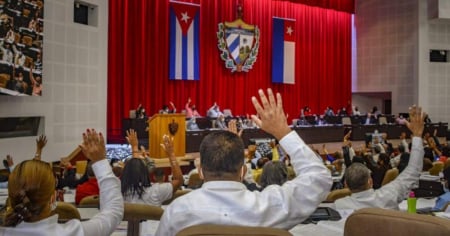
The Cuban government decided to free the district delegates from their usual jobs so they can fully dedicate themselves to directly assisting the population, amid a deep energy crisis and water supply issues that have sparked increasing protests in various regions of the country.
This community communication offensive, with political leaders engaging with the public on the ground, occurs in a context of growing social discontent and an increase in massive protests.
During a videoconference led by the ruler Miguel Díaz-Canel and the Prime Minister Manuel Marrero Cruz, the seriousness of the national situation was acknowledged.
From the Palace of the Revolution, both leaders exchanged views with authorities from all provinces and the Special Municipality of Isla de la Juventud, and discussed the impacts caused by the collapse of the National Electric System and the shortage of drinking water.
Marrero emphasized the need to strengthen work in the communities and highlighted the importance of "talking directly with people." The communist leader believes that this is the most effective method in times like these.
"The municipal directors must be alongside the delegates so that they can enter the neighborhoods providing information to the population," he said.
In cities like Havana and Santiago de Cuba, the authorities have mobilized the delegates for community tasks, freeing them from their work obligations. The measure aims to strengthen communication with citizens, who are demanding answers in light of the deterioration of basic services.
Yudelkis Ortiz Barceló, the first secretary of the Communist Party in Granma, stated that "nothing surpasses direct contact with the people," emphasizing the importance of maintaining connections within communities by providing clear and straightforward information "where there is a larger population gathering."
In recent days, there have been citizen demonstrations in areas of the capital, as well as in places in eastern Cuba like Gibara, where residents have started to publicly express their dissatisfaction with the inefficiency of the regime.
Despite the complex situation, Díaz-Canel and Marrero insisted that the country has the capacity to overcome the crisis and assured that their government team is "projecting the future", although they did not provide details about short, medium, or long-term solutions.
Frequently Asked Questions about the Crisis in Cuba and the Mobilization of Delegates
Why has the Cuban government released constituency delegates from their regular jobs?
The Cuban government has released the district delegates from their regular jobs so they can fully dedicate themselves to serving the population amid an energy crisis and water supply shortages. This measure aims to strengthen communication with citizens, who are demanding answers regarding the decline in basic services.
What is the current situation of the electrical system in Cuba?
The National Electric Power System of Cuba is in a critical moment, worsened by the shutdown of several important plants. Although repairs have been announced, the country continues to face significant challenges during peak night hours. The lack of strategic investments in the sector has deepened the electrical crisis.
What has caused the increase in protests in Cuba?
Protests in Cuba have increased due to the regime's inefficiency in addressing basic issues such as blackouts and shortages of water and food. Despite censorship and repression, the population has begun to demand their rights, reflecting a growing social discontent.
What measures is the Cuban government taking to address the energy crisis?
The Cuban government has acknowledged the seriousness of the energy crisis and has announced some repairs in power plants, but it has not provided concrete short-term solutions. The absence of a clear plan and the prioritization of investments in the tourism sector have worsened the situation.
How has the Cuban government responded to the demands of the population during the protests?
The Cuban government has chosen to disqualify the protesters and label them as "antisocial" and "delinquents", rather than addressing their demands. This response reflects a disconnection between the ruling elite and the citizens, who are facing one of the most severe crises in decades.
Filed under: