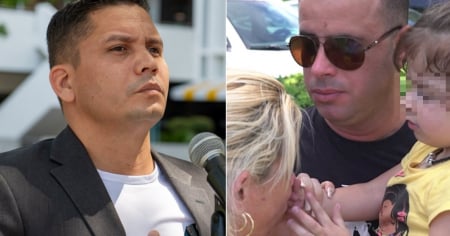
Deivy Alemán Oropesa, who returned to Cuba to avoid forced deportation, is experiencing the hardest moments of his life away from his wife and sick daughter.
"Being away from my daughter and my wife right now, and leaving her unprotected, so to speak… this is really hard, really difficult," says Deivy Alemán Oropesa, his voice trembling in a testimony recorded from his home in Palmira, Cienfuegos, where he is trying to adapt to a reality that feels foreign to him.
The Cuban, who lived in Orlando, Florida, self-deported on September 14 to avoid being arrested and deported by Immigration and Customs Enforcement (ICE), which would have barred him from returning to the United States for at least five years.
In a video shared by journalist Alexis Boentes, Deivy explained that his family in Cuba understood that he needed to be with his daughter, who requires constant medical attention due to her delicate health condition.
He assures that he is doing everything possible to reunite with his family. "I have hope, and my wife does too, that I will be able to join her soon. And there we are, fighting and doing things," he said. He also expressed how challenging his readjustment to life in Cuba has been: "It’s complicated to adapt; it’s completely different. The way of life one had there... here is very different. It’s really hard to adjust.”
A case that has shocked the Cuban community
The story of Deivy Alemán came to public attention after it was revealed that ICE had given him only a few days to leave the country, or he would be arrested and forcibly deported.
Last Sunday, September 14, their family had a heart-wrenching farewell at Miami airport, where cameras captured the youngest daughter crying as she watched her father leave.
His wife, Yisel Miguel Sarduy, has shared several videos and messages requesting help from the authorities, stating that her daughter “needs him very much” and that the separation could severely impact her health.
During his stay in the United States, Deivy was the primary financial supporter of the household. The youngest, an American citizen, has undergone three open-heart surgeries and needs a transplant. The I-130 petition filed by his wife with USCIS is still being processed, with the hope that it will allow for his return as soon as possible.
Lawyer Rosaly Chaviano explained that Alemán was under immigration supervision (form I-220B), and pointed out that current policies "practically do not take humanitarian factors into account, not even when there are minor U.S. citizens involved."
In statements to Univisión, journalist Javier Díaz described the case as a clear example of how the system disregards even migrants with exemplary conduct: “If you have a deportation order, they will deport you.”
Meanwhile, from Palmira, this Cuban father sends a clear message: "I just want to be with my daughter again, as I always have. I did things the right way. I love that country. I just want a chance to return."
Frequently Asked Questions about the Self-Deportation of Deivy Alemán Oropesa
Why did Deivy Alemán Oropesa decide to self-deport?
Deivy Alemán Oropesa decided to self-deport to avoid being detained and forcibly deported by Immigration and Customs Enforcement (ICE). By leaving voluntarily, he hopes to be able to return to the U.S. in the future, as a forced deportation would prevent him from returning for at least five years.
What impact does this decision have on your family?
The decision made by Deivy Alemán has left his wife and daughter, who needs constant medical attention due to a heart condition, without their main economic and emotional support. Deivy's daughter has already undergone three open-heart surgeries and requires a transplant, making his presence crucial for the family.
What role does the I-130 petition play in the case of Deivy Alemán?
The I-130 petition, filed by your wife, is part of the family reunification process and could allow you to return to the U.S. in the future. The family hopes this process will be expedited so that Deivy can reunite with his family as soon as possible, especially considering the medical situation of his daughter.
Why is ICE's action in this case being criticized?
The actions of ICE have been criticized for not adequately considering humanitarian factors, such as the critical health of Deivy's daughter and his exemplary behavior during his time in the U.S. The current immigration policy is not prioritizing these factors, which has led to outrage and questions about the lack of sensitivity in the system.
Filed under: