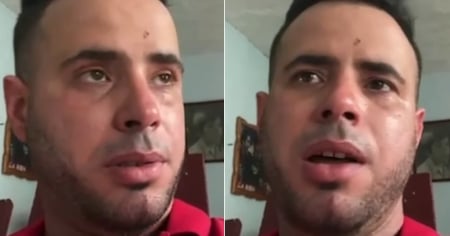
“God, help me make this goodbye short,” wrote Yisel Miguel Sarduy on Facebook as she shared the last images with her husband this Sunday, the Cuban Deivy Alemán Oropesa, forced to leave the United States following an ICE order.
In the videos posted by the mother, her daughter is seen playing at the airport just moments before a goodbye that would impact the entire family, following her father's decision to voluntarily leave the country as ordered by ICE (Immigration and Customs Enforcement) to avoid prolonged detention and forced deportation.
The journalist Javier Díaz, from Noticias Univisión, broadcasted the most difficult moments. “Very sad images, the Cuban Deivy Alemán Oropesa this Sunday, September 14, decides to return to Cuba voluntarily, which would technically be considered self-deportation, as the government told him he had until today to leave the country,” he recounted.
This man leaves behind his wife, his little one —a two-year-old girl who needs a heart transplant— and Yisel's older daughter, both now facing the uncertainty of how to support themselves financially in the United States.
The cameras captured the moment when Alemán, accompanied by his wife and daughters, arrived at Miami International Airport and, after an emotional farewell hug, passed through the TSA security checkpoint.
“Once that control was passed, there was no turning back,” Díaz noted.
From Cuba, he will have to wait for the family reunification process and a migration pardon, supported by the application submitted by his wife, a U.S. citizen, to the U.S. Citizenship and Immigration Services (USCIS).
The decision to leave was not easy. The day before, Díaz had described the family's drama: “Very few migrants in this situation would make the decision to leave the country of their own accord. This Cuban migrant arrived in the United States seven years ago with a suitcase full of dreams and now has to leave without knowing when he will be able to return,” he said in a report shared on Facebook.
Alemán explained that he chose this voluntary exit to avoid immigration jail. "There, they told me that I needed to have a plane ticket, or they would keep me in detention and deport me from there," he recounted.
In 2017, he was in ICE custody for over a year, an experience he claims he does not want to repeat.
The situation is hitting her family hard. The mother had to stop working to care for her after an open-heart surgery, while the girl is now waiting for a transplant as her only option for survival.
"I practically see myself living on the street, because how can I take care of the child and pay the rent?" Yisel said very distressed.
In the last few hours, the mother shared a series of videos that touched the hearts of hundreds of users on social media.
In one, the little girl is seen crying inconsolably as she watches her father pack his things into the car. “How do I explain to her that tomorrow he won't be able to take her with him?”, Yisel wrote.
The departure of Deivy Alemán Oropesa adds to the recent cases of Cubans who, under the pressure of ICE, have chosen to self-deport to avoid prolonged detentions.
But few portray the human dimension of forced exile as starkly as this farewell, sealed with hugs and tears at an airport in Miami.
Frequently asked questions about the self-deportation of Deivy Alemán Oropesa
Why did Deivy Alemán Oropesa self-deport from the United States?
Deivy Alemán Oropesa decided to self-deport to avoid immigration detention and forced deportation. He received a departure order from the Immigration and Customs Enforcement (ICE) and chose to leave voluntarily before the deadline set by the authorities.
What are the consequences of Deivy Alemán Oropesa's self-deportation for his family?
The self-deportation of Alemán Oropesa leaves his wife and daughters, including a two-year-old girl who needs a heart transplant, in a situation of economic and emotional uncertainty. Yisel Miguel Sarduy, his wife, is facing the challenge of caring for her ill daughter without the financial support of Alemán, who was the main provider for the family.
Are there any possibilities that Deivy Alemán Oropesa will return to the United States?
The hope for Alemán Oropesa's return lies in the family reunification process and a possible migratory pardon. His wife, a U.S. citizen, has submitted a petition to the U.S. Citizenship and Immigration Services (USCIS) to facilitate his return, although the process is uncertain and may be lengthy.
How does the tightening of immigration policies affect Cuban migrants in the U.S.?
The tightening of immigration policies in the U.S. has increased the arrests and deportations of Cuban migrants, including those with no criminal records and with active legal proceedings. Many face detentions during routine appointments with ICE, creating fear and uncertainty in the migrant community.
Filed under: