
Related videos:
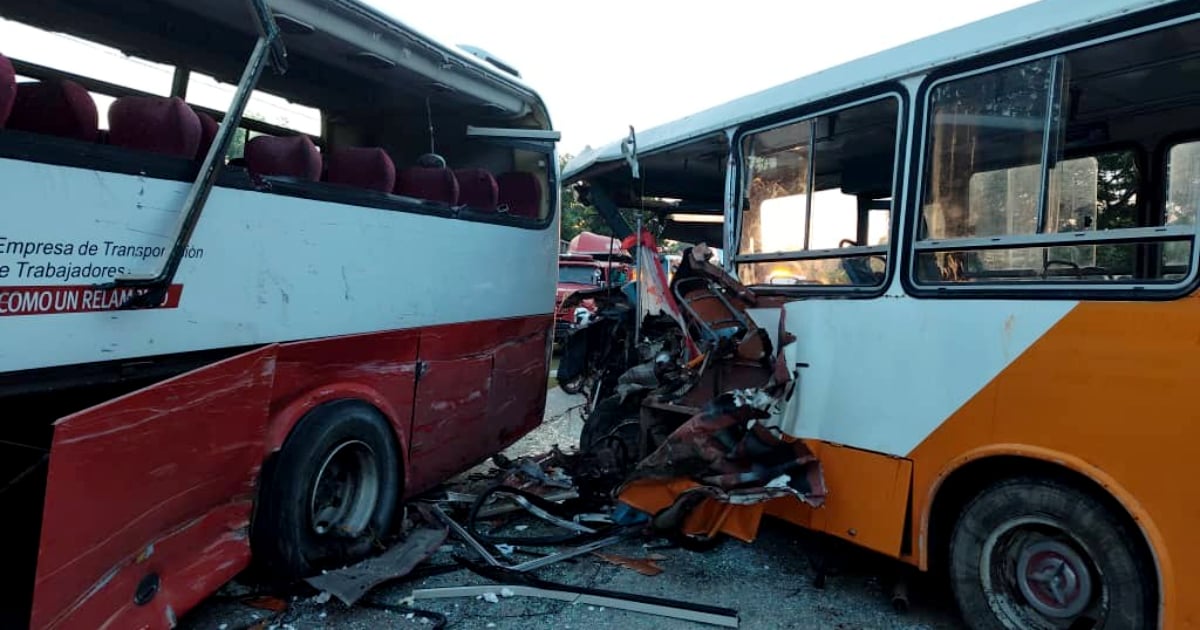
A horse-drawn cart was involved in the massive accident that occurred this Monday in the municipality of Ranchuelo, Villa Clara, where two buses collided, resulting in 49 people injured, including nine minors.
According to statements from Lieutenant Colonel Heriberto López, head of the Provincial Traffic Unit, the incident occurred on the road to Esperanza, just two kilometers from the popular council of the same name, and involved a Yutong bus (license plate 121284), a Diana bus (license plate 027011) and an animal-drawn cart that was on the road.
According to initial investigations, the Yutong bus was en route to pick up workers from Farmacuba in Esperanza when it collided with the Diana, which belonged to the Ranchuelo base and was covering the San Juan–Santa Clara route.
The presence of the cart on the road may have influenced the dynamics of the accident, although the exact causes are still being investigated by experts from the Ministry of the Interior (MININT).
So far, there are no reported fatalities, although two adults remain in critical condition. Forty adults are being treated at the "Arnaldo Milián Castro" Provincial Hospital, and nine minors are receiving care at the "José Luis Miranda" Pediatric Hospital.
At the accident site, the main authorities of the province are mobilized, including Susely Morfa González, the first secretary of the Communist Party in Villa Clara, and Milaxy Yanet Sánchez Armas, the governor of the territory. Medical Emergency Integrated System forces, firefighters, and traffic agents are also operating there.
Authorities continue to work to clarify the events and assess responsibilities.
The horse-drawn carts, a constant threat on the Cuban roads
The early morning of Monday, September 22, 2025, marked a new tragic episode on Cuban roads, when a horse-drawn cart was involved in a massive accident between two buses in the municipality of Ranchuelo, Villa Clara.
The accident, which occurred on the road to Esperanza, resulted in 49 people injured, including nine minors. Four individuals —including a teenager— were reported to be in serious or critical condition.
Although investigations are still ongoing, authorities have confirmed that the cart was on the road at the time of the collision, which has reignited national concern about the danger posed by these animal-drawn vehicles, especially when they are on the move without lighting signals or during nighttime.
Only five months earlier, on April 18, 2025, a young motorist suffered serious injuries after colliding with a cart in the La Pedrona community, in Mayarí, Holguín. The impact was so severe that the horse pulling the vehicle died instantly.
The motorcycle driver, identified as Ernesto, had to be taken to the provincial hospital due to the severity of his injuries. The incident caused a stir on social media and brought to light the lack of clear regulations for this type of transport.
A year earlier, on February 23, 2024, in the Guantanamo town of Macambo, a 16-year-old teenager lost his life after being struck while traveling in a cart. Witnesses stated that the car involved was speeding and under the influence of alcohol.
However, the tragedy also sparked a community debate about the cart driver's responsibility and the safety of the vehicle, which was operating without lights on a dark road.
The chain of accidents does not end there. On October 24, 2023, in Cienfuegos, three members of a family were injured when their cart was struck by a bus from ETEP on a bridge over the Damují River.
The woman traveling in the horse-drawn vehicle had to undergo surgery, while the horse lay on the ground with serious injuries.
These events, occurring in various parts of the country, reveal a common pattern: the dangerous coexistence of motor vehicles and animal transportation on roads lacking proper signage and conditions suitable for both systems.
While authorities investigate, rural communities continue to bear the cost of outdated infrastructure and inadequate regulation.
Filed under: