
Related videos:
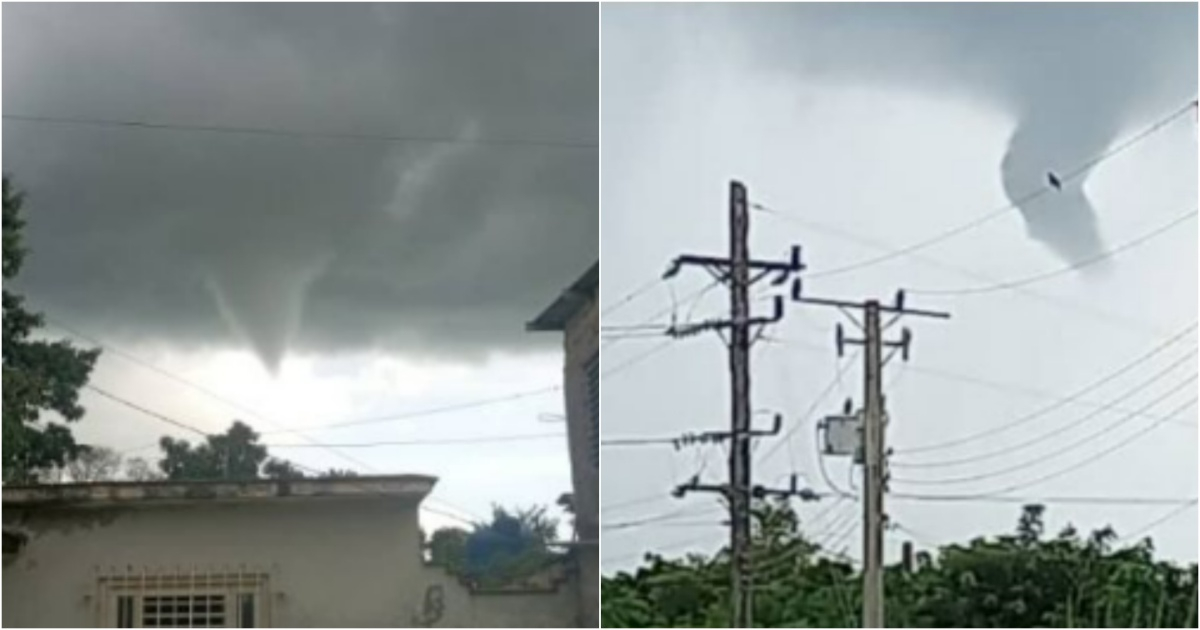
A waterspout, commonly known as "tail of a cloud," was observed this Saturday in the municipality of Cruces.
“A waterspout in the heights has been sighted from various points in Cruces, heading toward Mal Tiempo. According to witnesses, it did not come down completely, so it is inferred that there are no damages,” reported the Facebook profile Tiempo a su Favor, which shared images of the phenomenon.
The sighting of this waterspout adds to a series of similar phenomena that have surprised Cubans in recent months, in line with the instability of weather conditions.
At the end of August, one was spotted in the southern area of Guanajay, Artemisa, without causing surface damage.
Days ago, a waterspout on the Malecón in Havana caused panic among passersby and drivers, who were astonished to see how the phenomenon formed very close to the shore.
In Artemisa, reports have also increased: first with a waterspout near Güira de Melena and shortly after with another one recorded in Alquízar, also without impacts on land.
Meteorologists agree that such formations are common during the hot and humid season, when the atmosphere shows significant instability and abundant convection.
Frequently Asked Questions about Waterspouts in Cuba
What is a waterspout and how does it differ from a tornado?
An upper-level vortex is a meteorological phenomenon that forms at high altitudes in the atmosphere, without touching the ground. Unlike tornadoes, which make contact with the earth and can cause significant damage, upper-level vortices are less destructive and develop under conditions of high atmospheric instability, without becoming a direct threat unless they evolve into land-based tornadoes.
Why are more waterspouts being observed at altitude in Cuba lately?
The increase in the frequency of waterspouts in Cuba is due to the growing atmospheric instability in the region, especially during the summer season. High humidity, heat, and convection conditions in the atmosphere favor the formation of these phenomena. Additionally, climate change may be intensifying extreme weather activity on the island.
What have been some recent sightings of waterspouts in Cuba?
Recently, tornadoes have been sighted at high altitudes in several locations in Cuba, including Cruces in Cienfuegos, Guanajay, and Güira de Melena in Artemisa, and over the Malecón in Havana. Despite their frequency, these phenomena have not caused any damage, as they have not made landfall.
What precautions should Cubans take in light of the increase in extreme weather events?
It is important for Cubans to pay attention to weather reports and be prepared for severe weather conditions. This includes avoiding exposure during thunderstorms, not crossing flooded areas, and ensuring that homes are prepared to withstand strong winds. Preparation is key to minimizing risks during atmospheric instability.
Filed under: