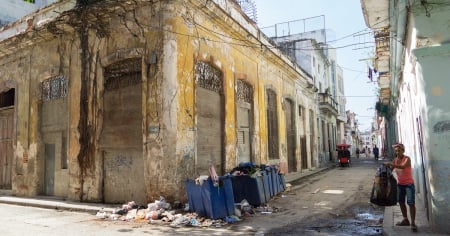
The Cuban leader Miguel Díaz-Canel harshly criticized on Monday the lack of citizen participation in several neighborhoods of Havana during a sanitation event called by the regime to tackle the serious accumulation of trash affecting the capital.
During a follow-up meeting with high-ranking State officials, the Government, and the Communist Party, Díaz-Canel specifically named municipalities where, he said, garbage was not collected and the population was not mobilized to participate in the "voluntary work."
"It is true that there was a good response from state institutions, but there are neighborhoods where no one came out to work on garbage collection," stated the president.
“In Diez de Octubre, one of the areas where waste management is most challenging, nothing was done. There were places in Playa where no action was taken. In La Lisa, which is also quite problematic, no one showed up either. Don’t we have constituency delegates in those places? Are there no political coordinators? Then let them all come to account for this, with names and surnames,” he ordered.
More than 35,000 cubic meters of trash were collected this weekend in Havana as part of the sanitation operation, which included state workers, local residents, Army recruits, and members of the National Revolutionary Police. However, over a thousand areas remain uncleaned, according to official figures.
The regime only collected trash in about 300 districts, which represents a minimal fraction of the city. Díaz-Canel admitted that there is no sustainable plan to address the issue and called for the "systematization" of such actions.
“We put in an effort this weekend, but we are not going to solve everything. People have already seen a reaction. Now everyone is wondering how it will be sustained. Well, we will sustain it if we all work together,” he said on Sunday.
The collapse in waste collection in Havana has been reported by citizens and experts, who warn about the health risks in a city of over two million inhabitants. Despite the operations, the accumulation of waste continues and there are no structural solutions in sight.
Frequently Asked Questions about the Garbage Collection Crisis in Havana
What is the reason behind the accumulation of garbage in Havana?
The accumulation of garbage in Havana is due to the lack of a sustainable waste collection plan, the shortage of collection trucks, the lack of fuel, and the inefficiency in state management. Additionally, the collection infrastructure is deteriorated, which exacerbates the problem. The government has attempted to alleviate the situation with cleaning campaigns, but these are not enough to tackle a problem that has persisted for decades.
What measures has the Cuban government taken to address the garbage crisis in the capital?
The Cuban government has organized sanitation campaigns that include the mobilization of state workers, army recruits, and police to collect the accumulated garbage. However, there is no long-term structural plan to resolve the crisis. The Cuban leader, Miguel Díaz-Canel, has called for citizen participation and volunteer work as temporary solutions, but these actions have not effectively resolved the problem.
What are the consequences of the accumulation of trash in Havana?
The accumulation of waste in Havana poses serious health risks, such as the proliferation of mosquito-borne diseases and other vectors. The trash piled up in streets, vacant lots, and corners, especially during the rains, creates breeding grounds for infection and worsens the living conditions for residents. Furthermore, the situation has sparked social discontent, leading to protests and criticism of the government's management.
What has been the response of the population to the waste crisis in Havana?
The population has shown increasing discontent with the government's management of the garbage crisis in Havana. Many citizens have expressed their frustration on social media and have participated in protests to demand effective solutions. The criticisms focus on the lack of a sustainable plan from the government and the unsanitary conditions in which people are forced to live.
Filed under: