The Cuban leader Miguel Díaz-Canel admitted this Sunday that the garbage collection in Havana does not have a sustainable support plan.
"We made an effort this weekend, but we are not going to resolve everything. We need to keep going. People have already seen a reaction. Now everyone is wondering how it will be sustained. Well, we will sustain it if we all work together. Every day we need to systematize, and every so often, we need to do an exercise like this," declared Díaz-Canel.
The ruling official assured that with his strategy, the sanitary conditions in Havana will be "better than they were last week".
This weekend, the regime mobilized state workers, recruits, and police to clean a city that has been suffering from the accumulation of waste for years. However, the leader himself acknowledged that the call was insufficient.
"A large part has mobilized, but some have not shown up and believe that others are the ones who should solve the problem."
The problem with waste collection is not just in the capital. It is due to multiple factors, among which the lack of fuel and poor waste management in the country stand out.
Far from offering structural solutions, Díaz-Canel appealed to popular initiative. “I believe that people, inspired by the example of Havana, will do their part in each territory as well,” he said.
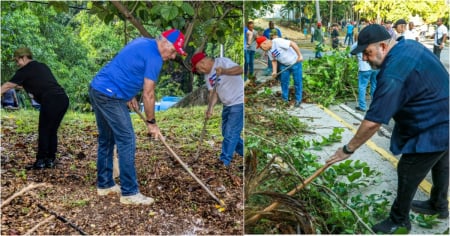
The statements occurred during a day when the leader and the Prime Minister, Manuel Marrero, “joined” the cleaning efforts in areas adjacent to the Palace of the Revolution, surrounded by officials and cameras.
Despite the media attention surrounding the operation, the situation remains critical. For years, citizens have been reporting on social media the mountains of garbage that accumulate in corners, vacant lots, and doorways in Havana and other cities across the country.
When it rains, waste floats through the streets, entering homes, hospitals, and schools. In September, even the Minister of Science, Technology, and the Environment, Armando Rodríguez Batista, acknowledged the extent of the sanitary collapse. “This garbage is not contained: it is scattered all over Havana,” he wrote on Facebook.
"The mountains of trash, silent witnesses of our inertia, were piling up in corners, lots, and margins," stated the head of CITMA, adding that the issue is of a "health, environmental, social, and spiritual" nature. In his opinion, it is not enough to rely on trucks and makeshift brigades; a profound change is necessary.
Frequently Asked Questions about Waste Management in Havana
What is the current situation of garbage collection in Havana?
The waste collection situation in Havana is critical. Despite the mobilization of state workers, recruits, and police to clean the city, Miguel Díaz-Canel himself has acknowledged that there is no sustainable plan to address this issue. The accumulation of waste is a long-standing problem that affects both the capital and other cities in Cuba.
What factors contribute to the waste crisis in Cuba?
The waste crisis in Cuba is due to multiple factors, including a lack of fuel, poor waste management, and a shortage of trucks and spare parts. Additionally, there is a significant deficit of garbage containers, which further complicates the situation. The absence of structural solutions from the government exacerbates the problem, while the population reports the state's inefficiency in waste management.
What measures has the Cuban government taken to address the garbage crisis?
The Cuban government has mobilized state workers, recruits, and police to participate in cleaning campaigns. However, these measures have been insufficient to resolve the problem sustainably. The regime appeals to popular initiative and hopes that the population will take an active role in cleaning their communities, but has not provided effective structural solutions to address the waste crisis.
How has the Cuban population reacted to the government's handling of the garbage crisis?
The reaction of the Cuban population has been one of criticism and discontent. Many citizens blame the government for the lack of planning and efficiency in waste management. On social media, Cubans have expressed their frustration over the deterioration of the health situation and the lack of real solutions from the regime, while the authorities seem more interested in propaganda than in resolving the crisis.
Filed under: