
Related videos:
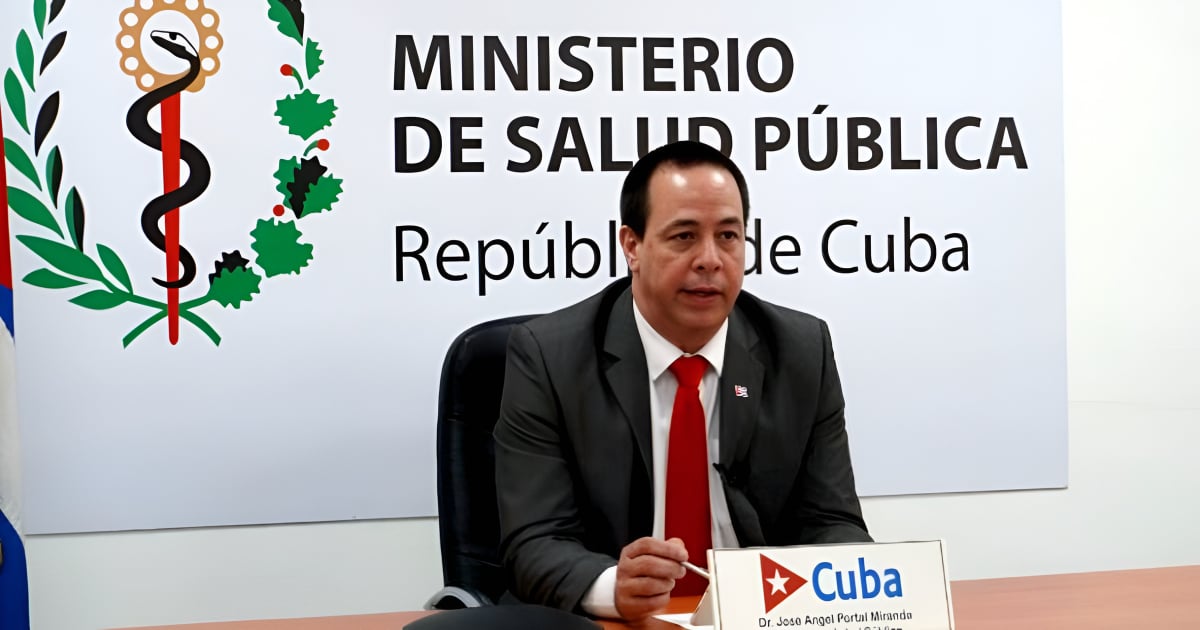
It is not enough to say that the Cuban healthcare system is in crisis: there are those responsible. One of the most visible figures—who bases his legitimacy precisely on medical discourse—is José Ángel Portal Miranda, Minister of Public Health since July 21, 2018.
Under their management, the deterioration has not been an accident: it has been governed, allowed, and legitimized. This report aims to provide a thorough assessment of the facts, assign responsibilities, and illustrate how their administration has directly and indirectly contributed to the healthcare collapse, the vulnerability of the population, and international medical exploitation.
From recognition to structural collapse
In July 2025, before the Health and Sports Commission of the National Assembly, Portal Miranda admitted that Cuba is experiencing an “unprecedented structural crisis”, that the coverage of the basic medicine supply is around 30%, and that recovery depends on external financing.
In that same appearance, he pointed out that infant mortality reached 8.2 per thousand live births and maternal mortality reached 56.3 per 100,000 births — notable setbacks in indicators that had been a revolutionary hallmark for decades.
The minister announced 13 strategic actions with 33 goals and indicators, but was clear: “not all will show immediate results.” In other words: he acknowledged the seriousness of the problem, but admitted to not having an immediate solution. This alone reveals ineffectiveness, passivity, or complicity.
Empty pharmacies, promises of exports
Portal Miranda has acknowledged several times that the pharmaceutical shortage will not be resolved anytime soon. In 2024, he told lawmakers that the lack of medications in the state pharmacy network would continue.
The sudden harshness of Portal Miranda contrasted with his and his team's repeated promises regarding investments and commitments to produce more medications.
Meanwhile, in international forums and through striking speeches, it offers vaccines, biotechnological products, and technical cooperation, as if Cuba had surplus resources to donate, when a large part of its territory is facing shortages.
This dichotomy between external donations and internal crisis is an unjustifiable contradiction, and further evidence of the disconnect between the regime's elites and the population who—beyond indicating the normalization of inequality in Cuba—highlights the immorality and indifference of leaders more concerned with generating income through exports than addressing the needs of citizens.
Mosquitoes, emerging viruses, and urban unhealthiness
The health pressure is not limited to chronic diseases or access to medications: Cuba has witnessed a resurgence of arboviruses and emerging viruses. The MINSAP reported more than 400 confirmed cases of the Oropouche virus from its detection in May until August.
This official figure asserts that the virus has reached all provinces and demonstrates how precarious epidemiological control is.
Dengue is also active in several areas, respiratory epidemics are multiplying, and gastrointestinal outbreaks arise due to urban unhealthiness, the deterioration of sewage systems, contaminated water, and the accumulation of uncollected garbage.
This is compounded by the re-emergence of chikungunya cases, another arbovirus transmitted by the Aedes aegypti mosquito, which raises alarms in vulnerable provinces.
Many Cubans live surrounded by conditions that, in any other country, would be addressed with protocols and immediate mobilization. When the national healthcare system operates as a system of vulnerability (more reactive than preventive), it not only exposes itself to epidemics: it normalizes preventable death.
Medical export: Underlying exploitation with an official name
One of the cornerstones of the international legitimacy of the Cuban regime is the export of medical services.
But under the leadership of Portal Miranda, that activity has shown traits of modern slavery, as reported by UN rapporteurs who identify "signs of forced labor" in those programs.
In 2025, the minister himself admitted that medical passports of doctors on international missions were retained by brigade leadership "so that they would not get lost."
That official confession confirms what exiled doctors and activists have denounced: the collaborators receive a fraction of what the contracting countries pay, with controlled mobility, enforced dependence, and restrictive working conditions.
Various investigations conducted by independent media and non-governmental organizations assert that the regime retains up to 70% of the salaries of doctors on missions, which some describe as an exploitative workforce model.
This mass exportation not only violates the labor rights of professionals but also leaves the MINSAP institutions within the country neglected, as many hospitals and polyclinics face chronic staff shortages due to the mandatory or voluntary sending of doctors abroad.
The population, therefore, pays the cost of the export strategy with a more precarious public health service, more queues, more negligence, and less access to specialized treatments and medications.
Avoidable deaths, daily suffering, and institutional collapse
In the daily lives of thousands of Cubans, illness has become an unappealable sentence. In a poorly ventilated waiting room, a mother holds her feverish child, waiting for an antibiotic or antipyretic that will not arrive.
In the capital, a pregnant woman loses her life due to alleged medical negligence (these cases are almost never investigated and often remain just "alleged"). In any neighborhood, an elderly man with hypertension stops taking his medication because the pills have been missing from pharmacies for months.
They are preventable deaths. Pain that should not exist.
Mental patients roam the streets of Cuba without treatment, or are cared for at home in inhumane conditions. Psychiatric centers are true hells from which dozens of complaints arise about the deplorable conditions they provide, as well as mistreatment and abuse of patients.
Hospitals, once showcased as exemplars of the Cuban model, are now crumbling buildings. There are rooms infested with cockroaches, unusable bathrooms, out-of-service equipment, lack of water, lack of supplies, and a shortage of doctors. The ambulance service is reduced to a minimum and in many areas, urgent transfers depend on favors or unofficial payments.
Doctors and nurses, overwhelmed by stress and lacking basic conditions, are doing what they can. But the professional exodus is massive: every month, dozens of specialists leave the system, either emigrating or being sent abroad on "missions" that deplete the national workforce. The result is fragmented, chaotic care, often negligent.
In centers where lives should be saved, the patient is no longer a priority, but rather an additional burden in a collapsed system. Complaints are piling up. Some professionals say it bluntly: “this is no longer a hospital, it's a pigsty.”
Those who can, pay. They pay for a private consultation, for an injection, for treatment, for a catheter, for cataract surgery supplies, for a syringe, sutures, or sterile bandages. They pay a messenger, a nurse, or a doctor who no longer receives a salary from the state because the state salary is insufficient. Those who cannot, wait. And sometimes they die.
The plight of renal patients is emblematic. In 2024, the newspaper El País documented the case of a girl who needed hemodialysis: her desperate mother received a brutal recommendation: “If you want your daughter to live, you have to take her out of the country.” Cuban civil society knows this mantra well and has witnessed several dramatic cases that confirm it.
That phrase sums up the current state of healthcare in Cuba: a system that can no longer care, can no longer heal, can no longer protect. And those who suffer the consequences do not appear in the minister's speeches, official reports, or manipulated statistics.
They are the faces of collapse: a vulnerable population trapped between scarcity, poor management, corruption, and resignation.
The responsibility of Díaz-Canel
The maintenance of Portal Miranda at the forefront of the Ministry of Public Health (MINSAP) is not a coincidence, but a political decision.
The ultimate responsible party for this health catastrophe is the leader Miguel Díaz-Canel, who appointed him and continues to keep him in the position, despite the devastating results.
The minister's continued presence represents not only a display of impunity but also a message of continuity: public health in Cuba will continue to be managed as a political resource, not as a citizen's right.
An urgent change that begins with accountability
For Cubans, the question is no longer whether the healthcare system is in crisis: it is who will take responsibility and how to change it. José Ángel Portal Miranda has been a key figure during Díaz-Canel's administration and a necessary accomplice in the deterioration.
More than speeches, Cuba needs a radical reform of its healthcare system: policies of transparency, independent auditing, reinvestment of exported medical revenues, recovery of the pharmaceutical industry, labor rights for healthcare professionals, prioritized preventive care, and accountability for those who currently profit from the suffering of others.
Only this way can the disaster start to be reversed. The country can no longer afford to have a minister in charge who, aware of the catastrophe, manages and legitimizes it. Nor can it continue with a ruler, a “continuity,” a failed system, and a regime that prioritizes its interest in maintaining power over the well-being of the citizens.
Filed under: