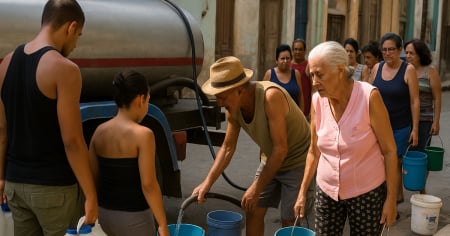
More than five months without receiving a single drop of water from the hydraulic networks. That is the harsh reality facing several communities in the city of Holguín, one of the most affected by the intense drought currently impacting Cuba.
In statements to Telecristal, the delegate of Hydraulic Resources in the province, Juan Mario Echevarría, acknowledged the seriousness of the situation.
"This year has been the most challenging for water supply to the population. There are areas that have gone more than five months without receiving service due to the hydraulic networks," the official stated.
Recent rains in the eastern part of the country benefited the reservoirs of Moa and Mayarí, but the same did not happen with the sources that directly supply the provincial capital. "The city is facing a particularly delicate situation," Echevarría emphasized, adding that the scarce rainfall is compounded by technical and logistical issues.
The delegate of Hydraulic Resources explained that, although the connections to provide service to some areas are already in place, failures in the generators have prevented the necessary pumping operations from being carried out.
"It took us six hours to pump the water from the Cacoyugüín reservoir to the treatment plant, and we cannot guarantee electricity to work continuously during that period," he stated.
As if that weren't enough, the main generator is broken. Technicians are trying to fix it, but success is not guaranteed, and there is no predicted date for resuming water pumping as it should be.
Díaz-Canel promises to prioritize those affected
As the water crisis spreads across much of the country, Miguel Díaz-Canel assured on Monday that the government will prioritize water supply in the most affected areas.
Who has been without water for 30 days? That person needs to be prioritized. We are normalizing this and then it will be given to everyone, but first, we must provide water to those most affected,” he said during a follow-up meeting held in Havana with high-ranking regime officials.
In the Cuban capital, more than 156,000 people continue to be affected by the water shortage. Vice President Inés María Chapman stated that the crisis is due to both failures in the distribution cycle and the collapse of supply through tanker trucks.
Between October 3 and 6, this number was reduced by more than 111,000 people thanks to the addition of 119 water trucks, 47 more than were previously available.
Chapman stated that the water deficit shows a “tendency towards progressive reduction,” due to repairs on the main pipelines in the country and improvements in pumping systems, although issues persist in many regions of eastern Cuba.
Million-dollar investment without details
The regime claims that more than 300 hydraulic infrastructure projects are being carried out across the country, with an investment exceeding five billion Cuban pesos, although it has not provided details about the benefiting territories or the specific use of those resources.
The president of the National Institute of Hydraulic Resources (INRH), Antonio Rodríguez Rodríguez, acknowledged that more than 400,000 families still lack regular access to water, especially in the provinces of Holguín, Ciego de Ávila, Las Tunas, and Camagüey.
Important reservoirs, such as Gilbert and Gota Blanca (Santiago de Cuba), as well as Faustino Pérez and La Yaya (Guantánamo), have shown some recovery, but storage levels remain insufficient to reverse the deterioration of the national supply system.
Frequently asked questions about the water crisis in Holguín and other regions of Cuba
Why have the communities in Holguín been without water for more than five months?
The lack of water in Holguín is due to a combination of intense drought, technical failures, and logistical issues. The rains have been insufficient to replenish the sources that supply water to the city, and failures in the generators hinder the pumping of water from the reservoirs to the treatment plants. This has left many communities without service for over five months.
What measures has the Cuban government announced to address the water crisis?
The Cuban government has promised to prioritize water supply in the most affected areas, starting with those that have been without service the longest. Additionally, more than 300 hydraulic infrastructure projects are being carried out, although no specific details have been provided regarding resource use or timelines for resolution. Vice President Inés María Chapman has assured that the water deficit is showing a trend towards gradual reduction.
What is the current situation of the water supply in other provinces of Cuba?
In addition to Holguín, provinces such as Santiago de Cuba, Las Tunas, Guantánamo, and Ciego de Ávila are facing serious difficulties in water supply. In Santiago de Cuba, the distribution cycle can exceed 30 days, with reservoirs at minimal levels. Deficiencies in infrastructure, lack of electricity, and ongoing blackouts further complicate the situation in these regions.
How is the electrical crisis affecting water distribution in Cuba?
The electrical crisis in Cuba is responsible for approximately 70% of the issues with water supply. Power outages and voltage drops hinder the continuous operation of water pumps, impacting distribution capacity throughout the country. Without electricity, the pumping system halts, exacerbating the already complicated water situation.
Filed under: