
Related videos:
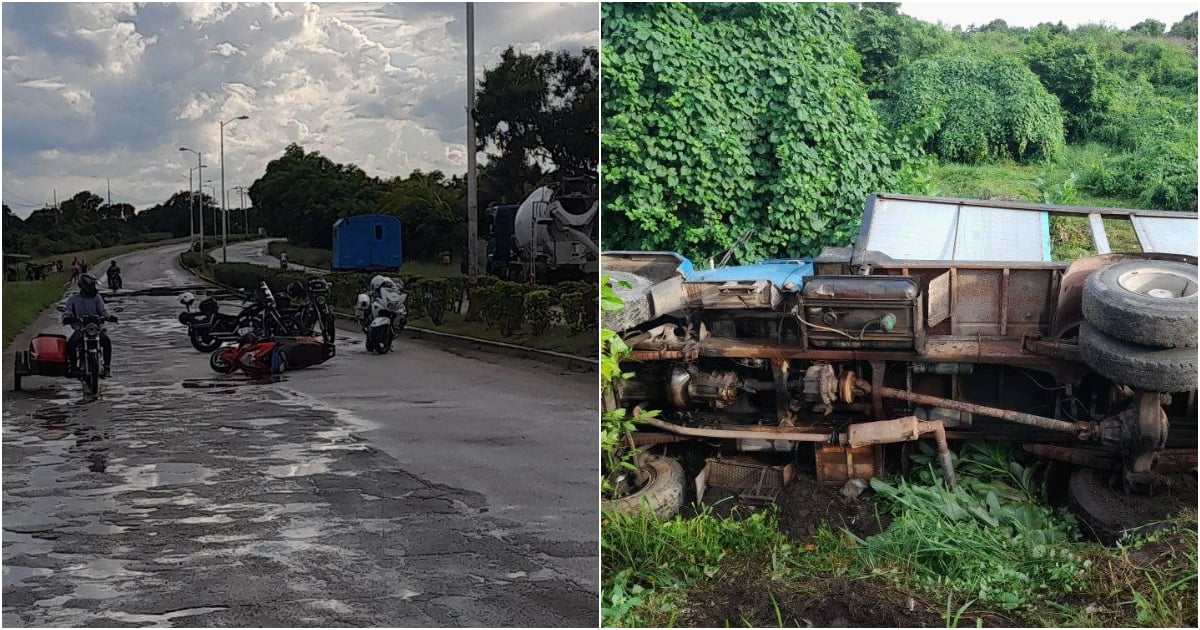
An accident on Thursday afternoon on the Holguín bypass left one person dead after a truck overturned while avoiding a motorcycle that had entered its lane, according to eyewitness accounts on social media.
According to the shared reports, the motorcycle would have invaded the path of a truck, whose driver swerved to avoid hitting it, lost control, and ended up overturning off the road, the group reported on Facebook ACCIDENTES BUSES & CAMIONES for more experience and fewer victims!
The truck driver sustained minor injuries, but the motorcycle driver died minutes later, confirmed neighbors from the area of Cayo de Mayabe, where the victim reportedly lived.
Users who witnessed or commented on the incident pointed to poor road conditions and a lack of traffic education as recurring factors in traffic accidents.
"That street is full of holes; it's no wonder anyone has an accident," wrote one of the internet users.
Other witnesses pointed out the recklessness of inexperienced or unlicensed drivers, as well as the presence of scooters, tricycles, and cars on the city's main avenues. "In Holguín, there is no respect on the road," lamented another user.
The accident highlights the increasing number of traffic incidents in Cuba, particularly in urban areas where heavy vehicles, electric motorcycles, and animal transportation converge without proper regulation or road maintenance.
Traffic incidents involving vulnerable vehicles such as bike taxis, motorcycles, and electric tricycles have become very frequent in the country as the use of these modes of transportation has increased.
On Sunday, a head-on collision between two motorcycles in the Holguin town of Tacajó resulted in the death of the driver of one of the vehicles and injuries to the two passengers in the other.
Last Friday, another traffic accident occurred in Holguín, in the town of Santa Teresa, leaving 10 people injured.
At the end of September, the fall of an electric tricycle from the Viaducto bridge in Matanzas resulted in eight injuries, including two minors.
Days earlier, the collision of two motorcycles in Centro Habana, in the capital of the country, resulted in the death of one person and serious injuries to several others.
In a similar incident reported in Santiago de Cuba, the driver of a motorcycle carrying three people, including a baby just a few months old, failed to stop at a stop sign and collided with another motorcycle. The child and the mother were immediately taken to a hospital for medical attention.
On September 27, a truck collided with a motorcycle on the Vía Blanca, near the exit of Barrio Obrero in Havana.
Previously, on September 12, an accident in the community of Boca de Miel, in Baracoa, resulted in the death of the Guantanamo cardiologist Edy Abreu Guzmán, aged 58.
Although he initially survived the collision while riding his motorcycle, he passed away days later at the local hospital due to the aftermath of the incident.
The Cuban government has acknowledged that 75% of the country's roads and circulation routes are in a technical condition that ranges from fair to poor.
Such a situation presents a significant challenge for the communist regime, as it directly impacts the quality of life of citizens and the provision of essential services.
Recently, residents of Sagua la Grande, in the province of Villa Clara, reported on social media the critical condition of a stretch of road that looks as if it has been shaken by an earthquake, but it is merely a reflection of the neglect of infrastructure on the island.
Frequently Asked Questions about Traffic Accidents and Motorcycles in Cuba
What are the most common causes of traffic accidents in Cuba?
The most common causes of traffic accidents in Cuba include the lack of road maintenance, the outdated condition of vehicles, and human errors. The human factor is responsible for 91% of accidents, according to official reports. Recklessness while driving, lack of road safety education, and poor infrastructure are recurring factors in road incidents.
Why are accidents involving motorbikes so frequent in Cuba?
Accidents involving motorbikes are common due to the increase in their use as a transportation solution amid the public transport crisis and the fuel shortage. These vehicles are often found in poor maintenance conditions, and their drivers frequently lack sufficient experience and proper traffic education. Furthermore, motorbikes are more vulnerable in collisions with heavy vehicles.
What risks are associated with the use of electric scooters in Cuba?
Electric scooters in Cuba pose significant fire risks due to technical deficiencies, low-quality batteries, and inadequate handling. Overloading systems and informal repairs escalate the danger, resulting in numerous fires in recent years, some with fatal consequences.
What is the current condition of the roads and traffic routes in Cuba?
The Cuban government has acknowledged that 75% of the country's roads and thoroughfares are in a condition ranging from fair to poor. This represents a significant challenge that impacts the quality of life of citizens and the provision of essential services. The poor condition of the pavement contributes to the high incidence of traffic accidents.
Filed under: