
Related videos:
The Cuban singer-songwriter Silvio Rodríguez has once again sparked controversy by publicly expressing his support for the former Argentine president Cristina Fernández de Kirchner, who was recently sentenced to six years in prison for corruption in the Vialidad case and sanctioned by the United States for her ties to bribery schemes and embezzlement of public funds.
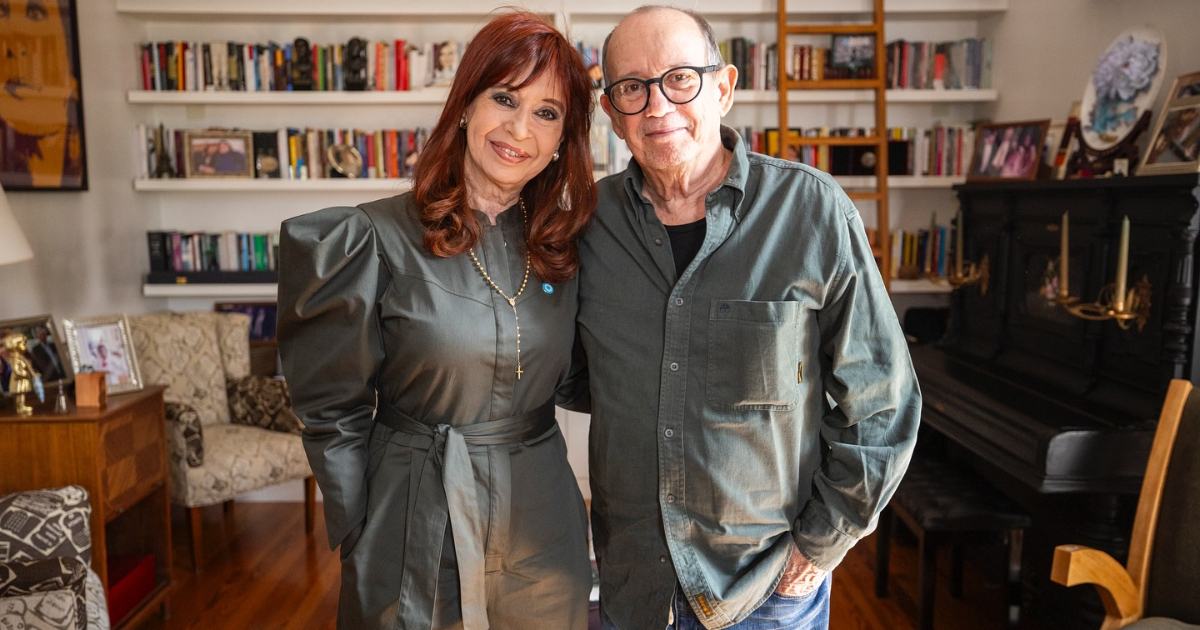
In a post shared by the former president herself, Fernández expressed her gratitude for the visit from the Cuban troubadour and his wife, the flutist and clarinetist Niurka González, to her home in Buenos Aires.
"Thank you, Silvio, for the visit, for your support, and for your solidarity," wrote the former president alongside a photograph of the meeting, in which she is smiling next to the artist, during his tour of Latin America.
Rodríguez's gesture, regarded as one of the main cultural symbols of Cuban officialdom, is not surprising given his political trajectory. True to the revolutionary discourse and the narrative of “judicial harassment” against progressive leaders, the musician has defended ideologically aligned figures on several occasions, even when they face accusations of corruption or abuse of power.
Néstor Kirchner was the man who was able to give back to Argentines more than hope; I would say, dignity. He was the president who stood alongside the Madres de Plaza de Mayo, because he was the one who took a stand to begin to rebuild what liberalism had undone for Argentines. I find it important to show support for Cristina, who represents him, and I want you to know that my heart and my ideas - what I have defended all my life through my songs - are with you,” said the singer-songwriter in November 2010, during a tour of the southern country.
Her new display of support for Fernández de Kirchner, convicted and barred from holding public office, is seen as a natural extension of that political affinity.
The connection between both characters is based on a shared vision of power and politics: a populist rhetoric that positions itself as the voice of the dispossessed while ignoring the institutional and ethical consequences of their governments.
In the case of Fernández de Kirchner, the Argentine courts determined her involvement in a scheme of rigged public works contracts during her presidency (2007–2015), which resulted in the historic sentence confirmed by the Supreme Court last June.
Rodríguez's visit occurs in a context where the figure of Fernández de Kirchner is under significant scrutiny both within and outside Argentina, even from segments of the regional left, who see her case as an example of the moral and political decline of certain Latin American leaderships.
While the troubadour continues his tour with concerts at the Movistar Arena in Buenos Aires, his gesture towards the former president reopens the debate on the limits of political solidarity and moral complicity.
In that sense, it contrasts with the outrage expressed in March 2025 by the musician during the celebration of the XXV Festival del Habano, appalled by the stark contrast between the luxuries of an elite within the Cuban regime and the exponentially increasing poverty on the island.
"Various signs suggest that there is a gradual disappearance of the sense of national dignity. I feel it in the daily actions of citizens. I sense it in the carnivalization of the statue of the nation and the tomb of the unknown mambí (...) ¿How far have we come for these things to happen, for the sacred to be trivialized, for disrespect to be shown to the memory of a human being, to their family, to the people who love them?", wrote the musician.
Because beyond art and songs, the encounter between Silvio Rodríguez and Fernández de Kirchner symbolizes the embrace between two narratives that, in the name of just causes, have ended up defending those who betrayed the trust of their people.
Corruption and enrichment within the Kirchner family
Silvio's support for Cristina cannot be understood without recalling the judicial and financial history that has accompanied the Kirchner surname since the years when Néstor Kirchner governed the province of Santa Cruz.
During that period (1991–2003), the couple accumulated a disproportionate real estate fortune in relation to their declared income. Through family businesses such as Hotesur S.A. and Los Sauces S.A., the Kirchners built a hotel empire in El Calafate, their hometown, which eventually became one of the pillars of the corruption network attributed to the couple by the Argentine justice system.
Among the most emblematic properties are the hotels Alto Calafate, Las Dunas, and Los Sauces (Casa Patagónica), which were used as vehicles to channel public funding through simulated contracts for accommodation and rental.
Judicial investigations revealed that construction companies benefiting from state contracts, particularly Austral Construcciones, owned by businessman Lázaro Báez—a personal friend and partner of Néstor Kirchner—were paying millions for rooms that were never occupied.
According to the Financial Information Unit (UIF) and the Anti-Corruption Office (OA), between 2008 and 2015 these operations totaled 25 million dollars, concealing illegal returns from public contracts.
In parallel, the Vialidad case, in which Cristina Fernández was sentenced to six years in prison and a lifetime disqualification, established that the damage to the Argentine state from the manipulation of public works exceeded 535 million dollars.
The wealth growth of the Kirchners also raised suspicions: when Néstor assumed the presidency in 2003, he declared an asset worth nearly 7 million pesos; by the time of his death in 2010, his fortune and that of his wife exceeded 60 million pesos, equivalent to more than 12 million dollars at that time.
Although the Hotesur and Los Sauces cases were closed in 2021, the Chamber of Cassation ordered their reopening two years later, considering that there was consistent evidence of money laundering and illicit association. In total, the illicit benefits attributed to the Kirchner environment are estimated to exceed 600 million dollars.
This web of corruption, which began in the provincial years and was consolidated during their presidencies, constitutes the core of the political and moral discredit that weighs on the Kirchner family, despite attempts to portray it as judicial or media persecution.
Filed under: