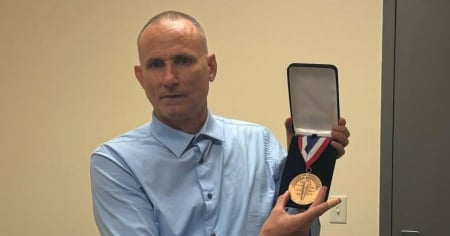
Luis Enrique Ferrer García, brother of opposition leader José Daniel Ferrer García, who left Cuba this Monday heading to the United States, in forced exile by the regime of Havana, asked the Cubans in Miami to welcome him.
Minutes after Ferrer boarded the plane in Santiago de Cuba that took him to Miami with his family, his brother invited Cubans in Miami to welcome him at Terminal D of the city's international airport (MIA), where he is expected to arrive around one in the afternoon.
In statements to Martí Noticias from the MIA, the brother of the founder and leader of the Patriotic Union of Cuba (UNPACU) discussed the circumstances surrounding the dissident's departure, highlighting the regime's clear intentions to prevent advance knowledge of when he would arrive in the U.S.
"They put him on the plane, practically taking him to the airport 15 minutes before, or 20 minutes at most, before the flight was set to take off. They do all this because they have been deceiving us since last week, saying he was coming, then he wasn’t, trying to prevent us from being able to announce it with enough time and ensuring that there would be many people, many patriots waiting for him at the airport," he stated.
"At this moment, they are already on the plane, that is, they are on their way here, José Daniel, his entire family, accompanied by two officials from the State Department, who very bravely, sent by the State Department, headed by our Marco Rubio, and by Mike Hammer, who is in charge of the embassy in Cuba, has done an incredible job in support of the Cuban people," he emphasized.
Luis Enrique pointed out that U.S. officials traveled to Santiago de Cuba and "said they would not return to the United States until they came back on the same flight as José Daniel and his family."
Forced exile
Ferrer flew this Monday from Santiago de Cuba to Miami, following a long negotiation process that culminated in his forced exile. The opposition figure accepted the exile imposed by the regime of the island as a condition for his release from prison. Shortly before noon on this October 13, he traveled to Florida accompanied by his wife, Dr. Nelva Ismarays Ortega Tamayo, and other family members.
A consular team from the United States Embassy in Cuba accompanied Ferrer and his family amid a significant presence of State Security agents.
"From Mar Verde prison to Santiago de Cuba airport. My brave brother has been exiled. May our Lord accompany you on your flight toward FREEDOM with the purpose of continuing the struggle until we achieve the deserved FREEDOM for all our POLITICAL PRISONERS and our beloved land," wrote Ana Belkis Ferrer García, sister of the opposition figure, on social media.
The arrival of the UNPACU leader in the United States marks the end of one of the longest chapters of political persecution on the island and occurs after more than four years of harassment and detention by the Cuban regime.
Ferrer’s departure was announced weeks after he confirmed—in a letter dated September 10, 2025—his decision to accept exile as a means to protect his family, amid ongoing pressures from the political police.
In the letter, circulated from prison, he denounced the government's attempts to "discredit the struggle for freedom" and to manipulate his case as part of potential negotiations between Cuba, the United States, and the Catholic Church.
"I am ready to die, but not to live without honor, without dignity," he stated at that moment, describing a landscape of isolation, psychological torture, and political blackmail.
The international community had watched their situation with concern and pointed out the Cuban authorities for systematic violations of human rights.
Statement from the regime in Havana
At the same time that José Daniel Ferrer García's exile flight was departing, the Cuban regime issued an official statement confirming the departure of the opposition leader from the country, heading to the United States, accompanied by members of his family.
The Ministry of Foreign Affairs claimed that his departure occurred "following a formal request from that government's administration and the express acceptance of Ferrer García, within the framework of the formal procedures and compliance with the law that exist between both countries."
The statement attempted to portray the event as a legal act resulting from ordinary legal procedures, when in reality the opponent was exiled from the country and has earned the admiration of the people for displaying an indomitable stance against the regime for years.
The MINREX stated that the procedure was evaluated by the Cuban Prosecutor's Office, taking into account "the legal situation" of Ferrer, "the observance of due process," and "specific circumstances of the case."
He also mentioned the application of "legal powers" by the institutions, without specifying the legal figure used to authorize the departure of a Cuban citizen from the country under precautionary measures.
Ferrer had received an early release in January 2025, while serving a sentence of four years and six months in prison. But in April, just three months later, the regime revoked that "benefit", arguing that he had violated the conditions imposed by the court, as stipulated in the Cuban Penal Execution Law.
Since then, he had been held in provisional detention, charged with an alleged new offense, of which no details were provided in the statement.
After years of human rights violations, systematic repression, and extreme prison conditions, international human rights observers and advocates regard Ferrer's departure from the country as a covert exile.
His forced exile symbolizes both the vulnerability of opponents within Cuba and the persistence of a struggle that Ferrer will now continue from abroad.
Frequently Asked Questions about the Exile of José Daniel Ferrer
Why was José Daniel Ferrer exiled from Cuba?
José Daniel Ferrer was exiled from Cuba after a long negotiation process that culminated in his forced exile by the Cuban regime. This measure was taken under extreme pressure from the regime, which the opponent accepted to protect his family, after years of repression, unjust imprisonment, torture, and violations of his human rights.
What has been José Daniel Ferrer's trajectory as an opponent of the Cuban regime?
José Daniel Ferrer has been a persistent face in the Cuban dissidence since the 1990s. He founded the Patriotic Union of Cuba (UNPACU) in 2011, becoming one of the main opposition leaders. His activism has led him to suffer multiple arrests, torture, and harassment by the Cuban regime, standing out for his defense of a peaceful transition to democracy and the freedom of political prisoners.
What has motivated José Daniel Ferrer's exile?
José Daniel Ferrer's exile was motivated by the need to protect his family from the systematic persecution of the Cuban regime. Ferrer accepted exile under extreme pressure, after years of unjust imprisonment, torture, and human rights violations. His departure from the country is seen as a strategy to continue his fight from abroad, without renouncing his principles of honor and dignity.
How has the international community reacted to the exile of José Daniel Ferrer?
The international community has reacted with concern and condemnation to the exile of José Daniel Ferrer. Human rights organizations and governments, such as that of the United States, have denounced the treatment received by Ferrer and have demanded his immediate release. His case has generated a wave of international solidarity, highlighting the ongoing political repression in Cuba.
Filed under: