
Related videos:
A passenger attempting to board a flight from Cancún to Havana was detained for carrying cocaine hidden in a false bottom of their luggage.
The discovery was made by the National Guard in coordination with specialized canine teams, as part of surveillance operations at Cancun International Airport, Quintana Roo.
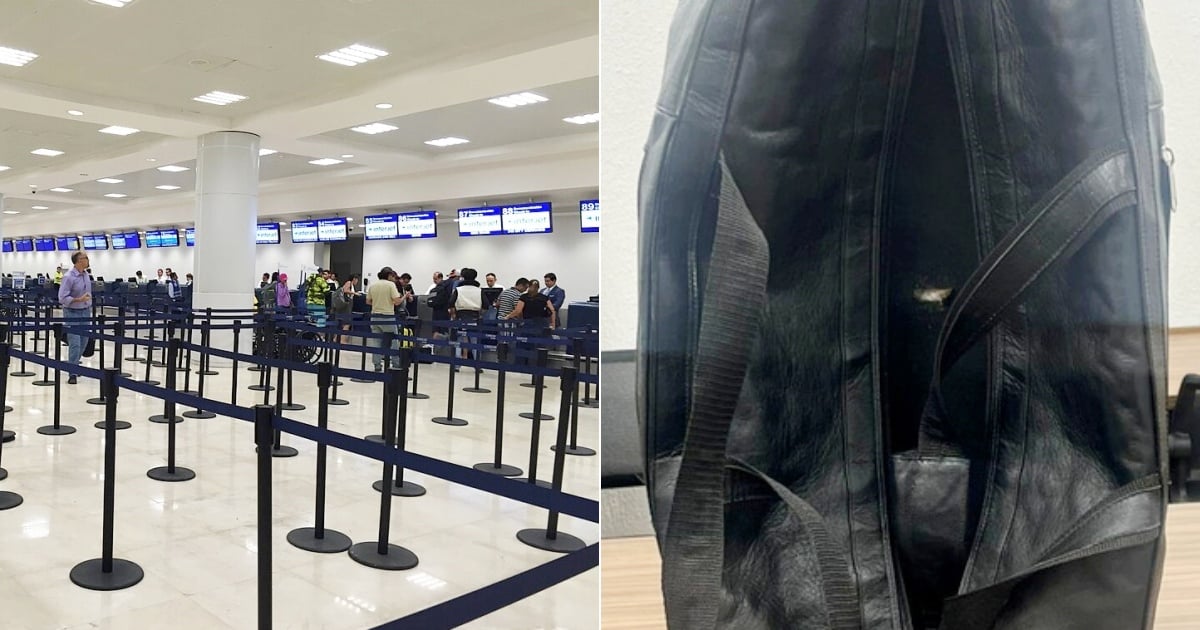
The arrest occurred when members of the National Guard, in accordance with the National Security Strategy of the Government of Mexico, were alerted by personnel from the X-ray area about irregularities detected in a leather suitcase.
The luggage was on the carousel in the waiting area and belonged to a passenger who was about to board a flight to Havana.
In response to the alert, the agents launched an inspection operation with the support of a canine pair trained in narcotics detection.
According to the official statement, the dog “indicated positively for the presence of a white powder, characteristic of cocaine”.
During the detailed inspection of the suitcase, the agents located "a false bottom that contained a package", which was subjected to testing with specialized equipment to identify illicit substances.
The results confirmed that it was cocaine hydrochloride.
The passenger was arrested on the spot. His rights were read to him in accordance with the Charter of Rights that Assist Individuals in Detention, and his entry was formalized in the National Detention Register.
Both he and the seized luggage and narcotics were made available to the Federal Public Ministry Agency, which will determine their legal status and any potential commission of health-related offenses.
The National Guard emphasized that this type of operation "confirms their commitment to the citizens to inhibit the transfer and distribution of all kinds of substances that may affect the health of the population."
So far, the identity and nationality of the detainee have not been disclosed, nor has the exact weight of the seized substance been reported.
The case highlights the ongoing attempts at drug trafficking by air, including through commercial flights to the island.
The investigation is now in the hands of the Attorney General's Office (FGR), which will be responsible for determining the corresponding criminal liabilities.
The introduction of drugs in Cuba is on the rise
This case adds to a long list of attempts to smuggle drugs into Cuba using increasingly ingenious methods.
In recent months, Customs has reported on hidden substances in electric showers, water motors, cans of tuna, religious figures like Eleguá, garments soaked with liquid cocaine, gummies, and even inside the bodies of travelers.
The authorities insist that these findings demonstrate the effectiveness of X-ray technology and the training of personnel. However, details about detainees or involved networks are rarely provided, leaving the public with the official version that reinforces the “zero tolerance” message towards drugs.
Recently, a team from the Spanish police arrived in Havana to train Customs personnel in the fight against drug trafficking.
This collaboration is part of a bilateral agreement and aims to enhance Cuba's capabilities in detecting and combating drug trafficking, including cocaine, heroin, cannabis, and synthetic drugs.
Frequently Asked Questions about Drug Trafficking at Airports to Cuba
¿Cómo se detectó la droga en el equipaje del viajero con destino a La Habana?
The drugs were detected thanks to X-ray technology and the use of a trained canine team specializing in narcotics detection. The National Guard, in coordination with these methods, located a hidden compartment in the passenger's luggage that contained cocaine. This discovery reaffirms the importance of security checks at airports to prevent drug trafficking.
What measures are being taken in Cuba to combat drug trafficking at the airports?
Cuban authorities have intensified customs controls and staff training to combat drug trafficking. They have implemented advanced technology such as X-rays and trained dogs to detect illegal substances. Furthermore, they have established international collaborations, such as training provided by the Spanish police, to enhance detection capabilities and effectively tackle drug trafficking.
What are some methods used to smuggle drugs on flights to Cuba?
The methods used to smuggle drugs on flights to Cuba are becoming increasingly ingenious. Drugs have been found hidden in cans of tuna, religious figurines, electric showers, water motors, clothing soaked with liquid cocaine, and even within the bodies of travelers. These methods showcase the creativity of drug traffickers and the need for stringent customs controls.
What consequences do those arrested for drug trafficking in Cuba face?
Those arrested for drug trafficking in Cuba face severe legal consequences. Penalties can include up to 30 years in prison, life imprisonment, or even the death penalty in aggravated cases. Cuban law is strict in these matters, and the regime maintains a "zero tolerance" policy towards drug trafficking.
Filed under: