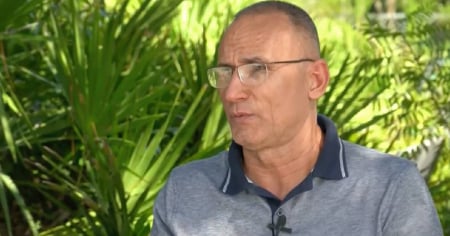
The Cuban opposition leader José Daniel Ferrer García, founder of the Patriotic Union of Cuba (UNPACU), gave an exclusive interview this Thursday to CiberCuba in which he detailed the circumstances of his forced departure from the country and the conditions he set before accepting exile.
Ferrer explained that at the end of June, Major Julio Fonseca from State Security proposed to facilitate his exit from the country if he was willing. "I told him yes, that I would leave because I need to start a new kind of struggle, but I set some conditions for leaving Cuba," recounted the opposition figure.
Among those conditions, Ferrer mentioned six points that he demanded from the regime:
- That he would not be sanctioned for the alleged crimes he was accused of by the State, as otherwise he would remain in Cuba to serve the sentence.
- That they would process the divorce from his first wife, from whom he had been separated for 13 years but was still legally married.
- Marrying your current partner, Nelva Ismarays Ortega, before leaving the country, without having to sign a document in which you committed to accepting the "socialist legality."
- The delivery of Nelva's Medicine degree, legalized. That document had been denied to her for political reasons.
- That the UNPACU houses in Altamira would be handed over to the activists he selected.
- The delivery of the passports for his wife, his son, and his own, as his wife was "regulated" for being a doctor and for being his partner.
Ferrer stated that the regime refused to comply with several of those points, especially regarding the UNPACU housing. “I told them I wouldn't leave if they didn't respect that. In the end, they took a house from me,” he said.
He explained that the Cuban authorities justified their actions by stating that the properties were not registered in his name, but rather in the names of activists who had left the country. “They said that legally the houses did not belong to me and that they had been generous in allowing us to use them for five years,” he recounted.
Finally, he ceded one of the houses, but emphasized that it was only temporary. "It will be just for a time, because one day we will return to Cuba to democratize it and reclaim our humble properties," he said.
According to Ferrer, two of the houses in Santiago de Cuba were left in the hands of a former political prisoner from UNPACU and his wife's relatives, who support the cause for freedom on the island, while the third was confiscated by the government.
"They promised me, and it was reflected in a document, that that house would be used for social purposes in the community. I’ve already learned that a couple lives there, and one of them is the son of a lieutenant colonel from MININT. That’s the 'social purpose' they assigned to it," Ferrer stated.
The opposition member added that he has never wanted to own property in Cuba, and that his only concern was to protect the workspaces of the activists.
Regarding their marriage, he explained that he and Nelva refused to marry on the dates proposed by the regime.
"They wanted us to get married on August 13th (the birthday of the late dictator Fidel Castro). Can you imagine? I won't get married on August 13th or July 26th. I decided we would get married whenever we pleased in Miami," she assured.
The exile of Ferrer and his family
On October 13, the arrival of José Daniel Ferrer and his family in Miami was reported, after being exiled by the Cuban regime following more than four years of detention and harassment.
The opponent arrived at Miami International Airport (MIA) accompanied by his wife and son, where he was welcomed by a group of supporters, journalists, and the Cuban-American congressmen Carlos Giménez and Mario Díaz-Balart, who expressed their support.
The exile of Ferrer marks the end of one of the longest chapters of political persecution in Cuba and highlights the repression faced by opponents.
In a letter dated September 10, written from prison, the opposition leader had already warned that he would only agree to leave the country in order to protect his family, without renouncing his struggle for freedom.
From the United States, José Daniel Ferrer has reiterated his commitment to the fight for democracy in Cuba and stated that his departure does not represent a surrender, but rather a new phase in the defense of human rights.
Frequently Asked Questions about the Exile of José Daniel Ferrer
Why did José Daniel Ferrer decide to leave Cuba?
José Daniel Ferrer decided to leave Cuba to protect his family from the extreme pressures of the Cuban regime. For years, Ferrer has faced beatings, torture, and death threats, and his family has been the target of persecution. The decision, although painful, was driven by the need to ensure the safety of his loved ones and to continue his fight from exile.
What conditions did José Daniel Ferrer set for his departure from Cuba?
Ferrer demanded several conditions before accepting exile, including: that he would not be sanctioned for the alleged crimes attributed to him, processing the divorce from his first wife, marrying his current partner without signing a document acknowledging "socialist legality," the return of his wife's medical degree, that the houses of UNPACU remain under the control of its activists, and the return of his family's passports. However, the regime refused to comply with several of these conditions.
What happened to UNPACU's properties in Cuba?
The Cuban regime confiscated one of UNPACU's properties, justifying that they were not registered in Ferrer's name but rather in the names of activists who had left the country. Although Ferrer managed to ensure that two of the houses remained in the hands of a former political prisoner and relatives of his wife, the third was taken by the government and, according to Ferrer, is being used for personal purposes by the son of a lieutenant colonel of MININT.
How was José Daniel Ferrer received in the United States?
José Daniel Ferrer was welcomed in Miami by supporters, journalists, and Cuban-American congressmen such as Carlos Giménez and Mario Díaz-Balart. His arrival marks the beginning of a new phase in his struggle for democracy in Cuba, from exile. Ferrer has stated that his departure from the country is not a surrender, but a strategy to continue his activism for the island's freedom.
Filed under: