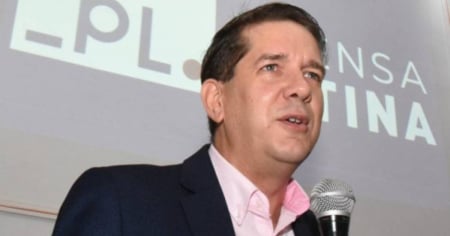
The Cuban opposition leader José Daniel Ferrer, head of the Patriotic Union of Cuba (UNPACU), promised to return to the island “on a boat, with a white rose and the verses of Martí,” before the fall of Castroism. He made this statement during a press conference broadcasted by the YouTube channel Prisoners Defenders International, which was also attended by former political prisoner Luis Robles.
"I will board a boat, out of order, and if no one wants to return, I will return alone", stated Ferrer from Miami, just days after his exile. "I will take with me a white rose, the verses of Martí, and a satellite phone to say: 'I am arriving at the Havana seawall. If you don't hear from me later, I am in prison or I have been murdered'".
The opposition leader, released after more than four years of imprisonment and torture at Mar Verde prison, asserted that his departure from Cuba was not voluntary. “I did not flee from pain or from blows. I left for effectiveness, to continue the struggle with more strength,” he explained.
Ferrer recounted that in recent months he was subjected to beatings and humiliation to force him to accept a "dialogue" with the United States in exchange for relief for the regime, something he —he said— categorically refused.
His departure from the country was one of the most closely monitored operations in recent years. A video leaked by State Security showed the moment when he boarded the American Airlines flight at Antonio Maceo Airport in Santiago de Cuba, accompanied by regime agents. The images attempted to present his departure as a “voluntary” act, but Ferrer and his family describe it as “a forced exile”.
In Miami, where he was greeted by activists and officials from the exile community, Ferrer spoke of "mixed feelings", feeling joy at being reunited with his wife and children, and sadness for the prisoners who remain in Cuba.
"The regime's prisons are a hell," he said. His wife, Dr. Nelva Ismarays Ortega, cried as she recalled the elderly and children they cared for in Santiago. "It hurts us to have left them behind. They asked us: 'And now who will help us?'" she stated.
Luis Robles: From the Cartel in Havana to Testimony in Freedom
The conference also marked the return of Luis Robles Elizástegui to public life, the young man sentenced to five years in prison for silently holding a sign that called for “freedom for Denis Solís and political prisoners.” Robles spoke with calmness, but carrying the weight of four and a half years of harsh imprisonment.
"Silence makes you an accomplice to wrongdoing", he said. "I decided to break the fear because someone had to do it. No one deserves to be punished for expressing an opinion or dreaming of a different country."
Robles reported that in Cuban prisons “prisoners are tortured, they live in hunger, and lack medical attention.” He also shared that the regime still holds his brother, Landy Fernández, as a “hostage of the State,” according to their mother, Yindra Elizastigui Jardines.
Amid tears, the woman sought asylum in Spain and reported the persecution of her entire family. “The silence of relatives also kills. If we don't speak up, we become complicit,” she warned.
Ferrer: "The repressive machinery is the only thing that works in Cuba."
During the broadcast, Ferrer asserted that “the only thing that continues to operate in Cuba is the repressive machinery.” He denounced that the political police continue to instill fear and paralysis in millions of Cubans and harshly criticized the European Union for maintaining “a complacent policy” toward the Havana regime.
“Crimes committed by the extreme left cannot be justified just as those of the extreme right cannot be justified,” he stated. He also described as “shameful” the tourism that “goes to Cuba to enjoy without considering the suffering of the people,” and said that foreigners should show solidarity with the Damas de Blanco or with the families of political prisoners if they choose to travel to the island.
The former political prisoner stated that, despite the torture, he was not broken. “They beat me, dragged me, forced me to eat rotten soup through a funnel. They tried to humiliate me, but I survived to continue fighting,” he recounted with a firm voice. “I came out to reorganize the struggle, not to rest. I will return before the tyranny falls, even if it's just a week before, to see my people free.”
In his final message, Ferrer called for unity between the exiles and the activists on the island: “If we join forces, the tyranny won’t last a week. We must create the necessary synergy so that they have no rest.”
His promise to return by boat — an image loaded with symbolism for a country that has seen thousands depart by sea — now transforms into a new chapter in its story of resilience.
From Miami, José Daniel Ferrer states he is ready to continue the fight for a "free, democratic, and just Cuba", convinced that, before Castro's regime falls, he will "set foot on the Malecón in Havana again".
Frequently Asked Questions about José Daniel Ferrer's Exile and His Fight Against the Cuban Regime
Why did José Daniel Ferrer decide to go into exile?
José Daniel Ferrer accepted forced exile to protect his family from the reprisals of the Cuban regime, after facing beatings, torture, and constant threats while imprisoned. His departure was not voluntary, but rather the result of extreme pressures and part of a strategy to continue his fight for the freedom of Cuba from abroad.
What is the symbolism behind Ferrer's promise to return to Cuba in a small boat?
José Daniel Ferrer's promise to return to Cuba "in a small boat, with a white rose and Martí's verses" is a symbolically charged image that alludes to the history of resistance and the struggle for freedom in Cuba. It represents his commitment to return to see Cuba free from the Castro regime, evoking the patriotic spirit of historical figures like José Martí, who fought for the independence and civil rights of the Cuban people.
How was José Daniel Ferrer's departure from Cuba?
The exit of José Daniel Ferrer from Cuba took place under strict security measures, with a heavy police presence at the Santiago de Cuba airport. It was a forced exile, presented by the regime as a voluntary act, although Ferrer and his family describe it as an expulsion from the country. The process included his transfer from the Mar Verde prison to the airport, where he was escorted by State Security agents.
What complaints has Ferrer made about the conditions in Cuban prisons?
José Daniel Ferrer has denounced that Cuban prisons are a "hell," where inmates face torture, hunger, and lack of medical care. He reported being subjected to beatings, humiliation, and inhumane conditions during his incarceration in Mar Verde prison, where he also became a victim of psychological torture and pressure to discredit his fight for the freedom of Cuba.
Filed under: