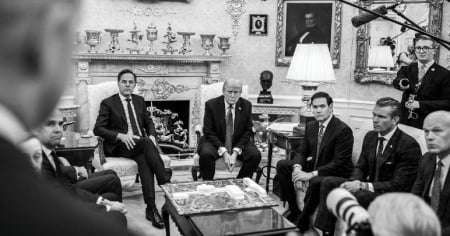
A day marked by confusion and contradictory messages once again heightened the political and military tension between the United States and Venezuela, after a report from The Wall Street Journal claimed that the U.S. Air Force had deployed B-1 Lancer bombers near Venezuelan airspace, only to be publicly denied by President Donald Trump.
According to the American newspaper, the bombers took off from Dyess Air Force Base in Texas and conducted a patrol flight near the Venezuelan border, remaining in international airspace.
Quoting Pentagon officials, the report indicated that this was a "show of force" following recent military maneuvers by Caracas off its coasts. The publication added that Washington was examining future missions as part of a campaign against alleged drug traffickers operating between Venezuela and Colombia.
However, hours later, Trump himself denied the report. "No, it's false," the president responded to reporters at the White House, according to Reuters.
Although he denied the military deployment, he added that his government was “very dissatisfied with Venezuela”, leaving the door open for new diplomatic actions or pressure in the coming days.
The clash of narratives reflects a moment of high uncertainty in the relations between Washington and Caracas, marked by years of sanctions, accusations of drug trafficking, and rhetorical clashes.
In the meantime, there has been no immediate official reaction from Caracas. Analysts consulted by international media agree that, regardless of the authenticity of the flight, the news has helped to revive the tension that persists between both countries, which ultimately affects the stability of the Caribbean and the perception of regional security.
Filed under: