
Related videos:
As the annual voting in the United Nations General Assembly on the resolution against the U.S. embargo approaches, the Cuban regime has activated its most disciplined propaganda machinery.
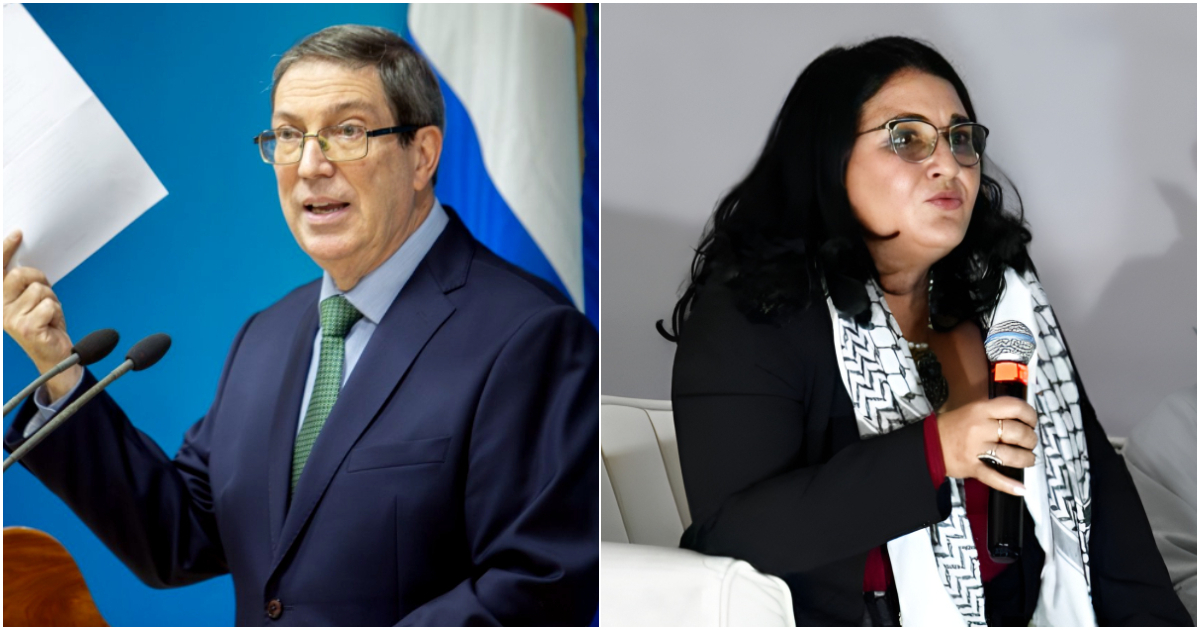
In a week, Bruno Rodríguez Parrilla, Miguel Díaz-Canel, prominent spokespeople for the regime on the evening news, and finally, Johana Tablada de la Torre —the most media-visible face of Cuban diplomacy— have repeated the same narrative: Cuba is a victim of the “most brutal economic blockade in the world,” and Washington, under the “influence of Marco Rubio,” is attempting to “torture a noble people.”
But behind the speeches, hashtags, and accusations, the data tells another story: Cuba is not blocked; it trades with the United States and dozens of countries; it receives donations, investments, and soft loans; and its crisis does not stem from sanctions, but from its own insolvency, inefficiency, and internal repression.
A conference, a media offensive
The starting point of the offensive was the conference by Chancellor Bruno Rodríguez Parrilla on October 22.
For nearly two hours, the minister denounced an alleged "false campaign by the State Department" to pressure Latin American and European governments ahead of the UN vote.
Rodríguez Parrilla read excerpts from U.S. diplomatic documents and called the claim that Cuba is a threat to regional peace a "shameless lie."
This Thursday, the Cuban National Television News (NTV) devoted an extensive segment to amplifying its statements and "responding" to Deputy Secretary of State Christopher Landau, who had recalled that “in Cuba there is no blockade, but rather a failed system.”
The program, hosted by journalist Jorge Legañoa Alonso, accused Landau of "displaying Trump-style diplomacy" and stated that if the embargo did not exist, "there would be no blackouts or shortages."
But the broadcast was an exercise in misinformation: it omitted the actual volume of imports from the U.S., the steady flow of European and Canadian tourists, and Cuba's legal access to international trade.
The very script of the newscast collapses in the face of the official figures.
Active trade: The data that the news report did not show
According to the United States Department of Agriculture (USDA), Cuba imported over $204.9 million in food between January and May 2025, a 16.6% increase compared to the same period in 2024.
The most purchased products were chicken (15.7 million just in May), powdered milk, rice, pork, coffee, and sanitary products.
In 2024, total imports of food and agricultural products reached 301.7 million dollars, while in March of that year, purchases doubled compared to the previous year, exceeding 40 million per month.
Since 2001, under the exceptions of the Trade Sanctions Reform and Export Enhancement Act (TSREEA), Cuba has spent more than 8 billion dollars on American products, including food, medicines, and machinery.
That same flexibility is reflected in the trade of non-essential goods.
In the first seven months of 2024, the island spent 36 million dollars on cars imported from the U.S., and in August, it allocated 46 times more money to vehicles than to food.
The operations, authorized by the Treasury Department under special licenses for the private sector, are conducted through Mipymes—the only relatively dynamic segment of the Cuban economy.
That is to say: while the news broadcast denounces a blockade, the regime buys cars, chicken, and machinery from the country it claims is suffocating it.
Medications can indeed be imported
One of the most frequently mentioned arguments by Rodríguez Parrilla and Tablada de la Torre is that the "blockade" prevents the acquisition of medications.
However, in 2023 the U.S. Embassy in Havana publicly responded to those accusations. "Yes, medical supplies can be imported to Cuba from the U.S. The embargo allows for medical and humanitarian exports. The issue is not the law, but management."
According to data from the Department of Commerce, nearly 900 million dollars in medical exports to Cuba were approved that year, double the amount in 2021.
The supplies include hospital equipment, reagents, surgical inputs, and essential medicines, provided that the Cuban buyer pays in cash and without military intermediaries.
The regime, however, prefers to maintain the narrative of a total ban to shift its healthcare inefficiency into the political arena.
The shortage of medications in Cuban pharmacies and the widespread deterioration of the public health system in Cuba is not due to the Helms-Burton Act, but rather to the collapse of BioCubaFarma, the lack of foreign currency, the regime's investment priorities, and the exodus of medical personnel.
Targeted measures, not collective punishments
In his recent publication, Tablada de la Torre accused Washington of "imposing inhuman measures" and listed a long array of sanctions from 2025: visa restrictions, suspension of cultural exchanges, flight limitations, exclusion from Airbnb, among others.
But the list itself reveals its selective nature. Most of these sanctions are aimed at Cuban officials, military personnel, judges, and prosecutors involved in human rights violations, not at ordinary citizens.
Travel and visa restrictions are based on the Global Magnitsky Act, which allows for sanctions against individuals responsible for political repression or corruption.
The same applies to the measures against Cuban medical missions, which the State Department considers a form of human trafficking.
As is well known and has been demonstrated countless times through testimonies and documentary evidence, professionals are sent abroad under state contracts, with up to 80% of their salaries withheld and monitored by security agents.
Far from being a “charitable work,” the program generates millions in revenue for the Cuban government and violates multiple international labor standards.
Cuba can indeed trade with the world
Neither the Helms-Burton Act nor any other U.S. law prevents Cuba from trading with third countries. The island maintains commercial relations with over 70 nations, including China, Russia, Spain, Canada, Brazil, Mexico, Vietnam, and Algeria.
The embargo only prohibits U.S. companies (and their subsidiaries) from trading with the regime, except in humanitarian sectors.
The current setbacks are not a result of external sanctions, but rather of repeated non-payments. Chinese, Russian, and Spanish energy projects have stalled due to lack of payments.
The debt to the Paris Club exceeds 3 billion dollars, and the French government itself has acknowledged that Cuba has ceased to meet its commitments since 2019.
The country has an extreme credit risk rating, which means that no international bank provides credit to it. As a result, all purchases—even humanitarian ones—must be made in cash and at a premium.
That is the real "financial suffocation": the one the regime inflicts upon itself.
Why do sanctions exist?
Washington does not impose sanctions on a whim. The decisions made in recent years are based on specific and documented reasons.
- Support for terrorism and military ties with adversarial powers: Among other groups, Cuba has provided shelter to members of the Colombian ELN and has allowed the recruitment of Cuban mercenaries in the war in Ukraine. Its strategic alliance with Russia and China includes military training and cooperation in espionage and electronic intelligence.
- Internal repression and political prisoners: Personal sanctions affect judges, prosecutors, and officials involved in the trials of 11J and the arbitrary detention of opposition members.
- Trafficking and Labor Exploitation: The State Department keeps Cuba on its list of countries that do not meet minimum standards in the fight against human trafficking.
- Corruption and money laundering: The business structures of the military conglomerate GAESA accumulate foreign currency without oversight or public auditing.
- Support for civil society: Far from being a covert operation, U.S. assistance to independent media and Cuban NGOs is legal and is recorded in the federal budget.
In other words, the sanctions are reactive, not inherent: they arise as a response to violations and alliances of the regime, not as the source of its ills.
The Diplomacy of Victimhood
The speech by Tablada de la Torre and Rodríguez Parrilla aims to rebuild internal consensus around the external enemy.
In the face of the collapse of the electrical system, rampant inflation, and massive emigration, the regime needs to explain the disaster as an external aggression. That’s why every October, the script of the “genocidal blockade” resurfaces, along with selective testimonies and manipulated figures.
But reality contradicts this: Cuba imports, exports, receives tourists, maintains diplomatic relations with over 160 countries, and has benefited from debt forgiveness and investments. Its crisis is not a result of sanctions, but rather of the structural failure of its economic and political model.
While the MINREX denounces an "economic war," private Mipymes are importing cars, state stores are selling American chicken for dollars, and pharmacies are lacking medicines due to mismanagement, not a lack of permits.
"The embargo is a pretext."
The narrative of the blockade serves a political function, not an informative one. It allows the regime to justify shortages, cover up corruption, and maintain ideological control over an exhausted people.
But the facts are stubborn: Cuba is not blockaded, it is bankrupt. And not due to Washington's fault, but because of a state that bans competition, represses dissent, and does not pay its debts.
As a European diplomat recently summarized in Havana: “The embargo is a pretext; the real blockade is the one the government imposes on its own economy.”
A few days before the voting at the UN, Cuban diplomacy will once again excel in numbers, but will lose in credibility. Because each year that it repeats the same speech without results, it becomes clearer that the enemy is not in the White House, but in the Palace of the Revolution.
Filed under: