
Related videos:
The Cuban regime has intensified its narrative about the "blockade" by the United States, a term it repeatedly uses in its speeches and news reports as a universal explanation for the shortages, blackouts, and economic collapse in the country.
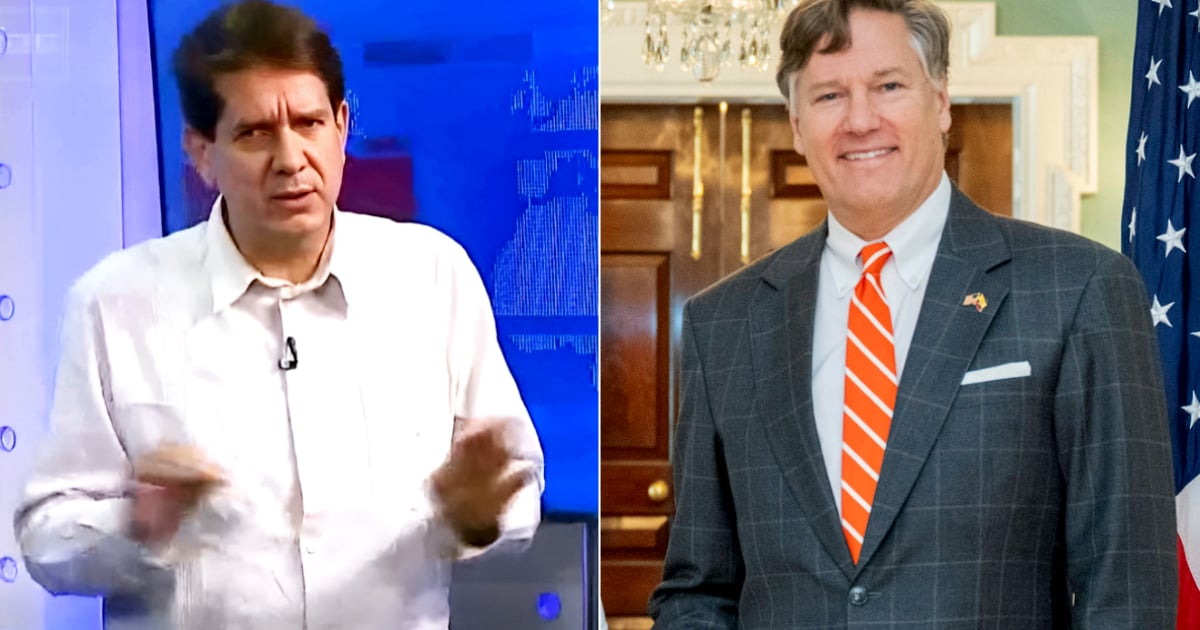
The propaganda offensive, reinforced this week by a special segment on the national news, aimed to discredit the words of Deputy Secretary of State Christopher Landau, who in response to Miguel Díaz-Canel stated that “there is no blockade” and that the true culprit of Cuban misery is the communist regime itself.
The television program, presented by the official journalist Jorge Legañoa Alonso, insisted that Washington's "economic strangulation" prevents Cuba from importing food, medicine, and fuel.
However, official data from U.S. agencies, international organizations, and independent sources demonstrate a completely different reality: Cuba actively trades with the United States, purchasing agricultural products, medicines, vehicles, machinery, and even receiving humanitarian donations in figures that contradict the narrative of isolation.
The trade that the news report did not show
Far from an absolute blockade, trade between the two countries has steadily grown. Just between January and May of 2025, Cuba imported food from the United States for more than 204.9 million dollars, according to data from the Department of Agriculture (USDA). This figure represents an increase of 16.6% compared to the same period the previous year.
Chicken remains the main imported product —with 15.7 million in May— but the list also includes rice, powdered milk, coffee, vegetable oil, processed meat products, and even humanitarian donations that surpassed 10.7 million dollars in the first five months of the year.
In March 2024, agricultural imports reached 40.6 million dollars, double the amount from March 2023, and total exports under the Trade Sanctions Reform and Export Enhancement Act (TSREEA) amounted to 112.9 million dollars in just the first quarter.
Since that law came into effect in 2001, Cuba has purchased over $7.8 billion in food and agricultural products from the United States.
These figures not only dismantle the myth of the "food blockade," but also confirm that Washington allows —and facilitates— direct exports to the island, provided they are paid for in cash and do not benefit sanctioned state entities.
Medicines: The Truth Behind the Myth
The state news outlet also insisted that the "blockade" prevents the importation of medicines, a claim that is equally false.
In July 2023, the U.S. Embassy in Havana reported that Washington had approved nearly $900 million in medical exports to Cuba since January of that year, and over $800 million in 2022, double that of 2021.
"Yes, it is possible to import medications to Cuba," the diplomatic mission then recalled, citing the licenses from the Department of Commerce and OFAC that authorize the sale of medical equipment, pharmaceuticals, and hospital supplies under humanitarian exceptions.
Official statements contradicted Foreign Minister Bruno Rodríguez Parrilla, who had claimed that "there is no possibility whatsoever" of purchasing medicines in the U.S. market.
The facts show the opposite: Cuba can and does purchase medical supplies of American origin, although its state distribution system and lack of foreign currency exacerbate the shortages in hospitals and pharmacies.
Machinery, energy, and industrial goods
Food and medicine imports are joined by other notable transactions: in 2024, Cuba imported used vehicles, agricultural machinery, electric generators, household appliances, and industrial parts from the United States for over 6.2 million dollars.
The Cuba-U.S. Economic and Commercial Council detailed that these purchases included generators, machinery for mixing or crushing minerals, electric stoves and ovens, as well as motorized vehicles.
These figures are particularly revealing because they dismantle another recurring argument of the official propaganda: that the embargo prevents the maintenance of the electrical and transportation infrastructure.
The data shows that the Cuban government has been able to acquire energy equipment, spare parts, and industrial machinery from the U.S. market, highlighting the internal inefficiency of the state system rather than an external imposition.
Cars before food
The disparity in spending priorities is even more striking. In August 2024, Cuba spent 46 times more on importing used cars than on buying food, according to data from the U.S. Department of Commerce.
Cuban Mipymes acquired vehicles for 8.68 million dollars, while food imports barely reached 176,000 dollars.
These operations were conducted under special licenses from the Treasury Department, which since 2023 allow the sale of vehicles, trucks, and agricultural machinery to private workers, excluding state-owned companies.
The country that Havana accuses of "blocking" it actually authorizes a growing volume of trade with its private sector, which the regime itself limits or burdens with high taxes.
Global data confirms that this is not an isolated incident. Between January and July 2024, Cuba spent 36 million dollars on vehicle imports from the U.S., four times more than in all of 2023.
This increase was made possible due to the relaxations of the embargo approved by the administration of Joe Biden, which described the sale of cars and machinery to private entrepreneurs as a "humanitarian" measure.
In contrast, food imports fell by 2.6% in July of that year, a decline attributed to internal price control policies that discouraged purchases. The scarcity, far from being caused by the embargo, is due to an inefficient economic structure and a lack of productive incentives within the island.
The political narrative and commercial reality
While Cuban television news describes an "embattled" economy, data from the U.S. government shows otherwise:
- Cuba is the 46th largest market for U.S. agricultural and food exports.
- Only in 2025, U.S. exports to Cuba have grown by more than 20% year-on-year.
- Humanitarian donations from the U.S.—food, medicine, and supplies—exceeded 36 million dollars in 2023 and continue to grow.
Neither the trade flow nor the humanitarian licenses align with the idea of a total “blockade.” What exists is a targeted embargo—a network of financial and commercial restrictions—designed to pressure the regime, not the Cuban people, and which contains multiple exceptions specifically to avoid humanitarian impact.
Cuba can indeed trade with the world
One of the weakest arguments of the official narrative is the idea that the U.S. "blockade" prevents Cuba from trading with the rest of the world. In reality, no law from the embargo prohibits third countries from freely trading with the island.
Russian, Chinese, European, or Latin American companies can — and in fact, have been doing so for decades — sell fuels, food, machinery, or pharmaceuticals to the Cuban regime.
The obstacle is not political or legal, but economic: the lack of liquidity and the inability to pay of the Cuban state itself.
China and Russia have maintained energy and technology cooperation agreements with Cuba for years, which include investments in thermoelectric plants, transportation, hospital equipment, and medical technology. However, many of these projects have stalled due to repeated non-payments and lack of credit guarantees.
European companies have also experienced delays of years in payments, despite the refinancing agreements reached following the partial cancellation of Cuba's debt in 2015.
In fact, international organizations such as the United Nations Conference on Trade and Development (UNCTAD) have reiterated that there is no prohibition preventing Cuba from buying or selling in the global market, as long as it adheres to international banking and payment regulations.
The problem is that Cuba does not pay, or pays late and poorly.
A country without credit: The other cause of shortages
The formal freedom of trade is countered by a devastating fact: Cuba is one of the countries with the lowest credit ratings in the world.
It has lacked access to international capital markets since the 1980s, when it unilaterally suspended payment on its external debt.
In 2015, the Paris Club forgave 8 billion dollars of the 11 billion owed, in exchange for annual payment commitments that the regime failed to honor again in 2019. Since then, their arrears have exceeded 3 billion dollars just with that group of creditors.
Russia has also forgiven debts totaling over 30 billion dollars, and China discretionarily maintains soft credit lines subject to geopolitical, rather than financial, interests.
Even ideological allies like Venezuela or Algeria have drastically reduced their support due to a lack of economic return.
The result is that Cuba cannot access international credit, and therefore must pay for everything upfront, increasing the cost of any imports. There are no banks that finance its purchases because the risk of default is too high.
That is why, although the regime insists on speaking of a "financial blockade," the truth is that the isolation has been caused by its own history of delinquency.
As a recent report from the Latin America Economic Observatory (OBELA) acknowledged, “the central problem of the Cuban economy is not external sanctions, but rather its structural financial viability: low productivity, unpayable debt, and lack of fiscal transparency.”
Conclusion: The narrative against the facts
Empirical evidence reveals an unmistakable pattern: the United States does not block Cuba; the Cuban state blocks the Cubans.
The embargo laws allow —and regulate— a trade that has exceeded 8 billion dollars in two decades, covering food, medicines, machinery, vehicles, and donations.
Meanwhile, the Díaz-Canel government continues to allocate millions for the importation of cars or tourism projects, while hospitals lack antibiotics and the markets are empty.
The propaganda of the “genocidal blockade” continues to be used as a political tool to justify a structural internal crisis: low productivity, corruption, state control, and lack of economic freedoms.
As Christopher Landau pointed out, "If there were really a blockade, how do Mexican oil, European tourists, and American cars get through?"
The numbers confirm it: the siege is not from Washington, but from the economic apparatus of Havana, which suffocates its own people while demanding international understanding for an embargo that, in practice, does not prevent it from buying, but rather from being held accountable.
Filed under: