
Related videos:
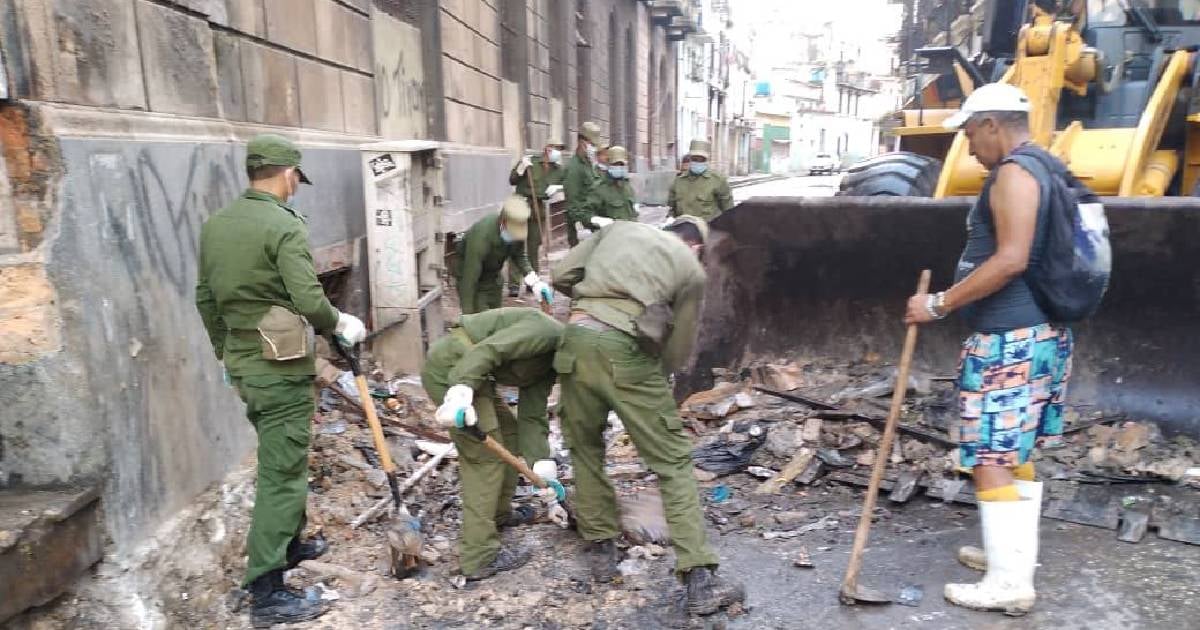
Soldiers, officers, and civilian workers of the Revolutionary Armed Forces (FAR) have been leading the garbage collection efforts in Havana for weeks, where the accumulation of waste keeps authorities on alert and worsens the city's health crisis.
The Municipal Assembly of the People's Power of Centro Habana highlighted through its profile on Facebook that personnel from the Western Army carried out a "hygienization operation" on Friday in the Colón Popular Council as part of the "Cleaning Operation", an initiative aimed at improving hygiene conditions in the capital.
According to the information, the military worked "tirelessly" alongside delegates and residents in a day described as "necessary to protect the health of the people."
He added that the president of the Colón Popular Council, Eduardo Reyes Barrueto, and other local leaders expressed their gratitude for the efforts of the contingent, in a context where communal services are overwhelmed and unable to respond to the extent of the accumulated waste.
The military deployment coincides with the launch of the “Operation Campana,” a pilot program for nighttime garbage collection in areas with underground electric service, specified the Municipal Assembly of the People's Power of Centro Habana in another post on the same social network.
Authorities hope to extend the model if it successfully alleviates the most critical issues, although they acknowledge that the shortage of equipment and fuel remains the primary obstacles to stabilizing the system.
The health situation in Havana has become one of the most sensitive issues in the country. President Miguel Díaz-Canel himself has led several emergency meetings since the beginning of October, demanding "control and discipline" in response to urban decay.
In one of those sessions, broadcasted by the state media, the president reprimanded that many state agencies have not engaged in the cleaning efforts and criticized the lack of timely response.
"The difficulties in Havana must be identified by name," he said then.
Despite the official narrative, the figures reveal the extent of the collapse. According to government data, as of October 26, more than 396,000 cubic meters of waste had been collected as part of the intensive sanitation campaign that began at the start of the month.
However, reports from local media and social networks indicate that improvised dumps and overflowing containers continue to define the everyday landscape in numerous municipalities.
In some peripheral neighborhoods, the Ministry of Transport has begun converting obsolete containers into "ampirroll" boxes (tipping cargo) and using animal traction for waste collection, an emergency measure that reflects the precariousness of the system.
The military's involvement in civilian tasks such as garbage collection, food distribution, or emergency management has become a constant in Cuba in recent years.
In this case, the militarization of communal services seems to have become institutionalized as a response to the urban decline of the capital, rather than as a temporary solution.
Meanwhile, trash continues to accumulate in streets, vacant lots, and sidewalks. For many Havana residents, the smell and mosquitoes have become part of their daily routine, while green uniforms replace municipal trucks in a city where cleanliness increasingly relies on military discipline rather than civil management.
Filed under: