
Related videos:
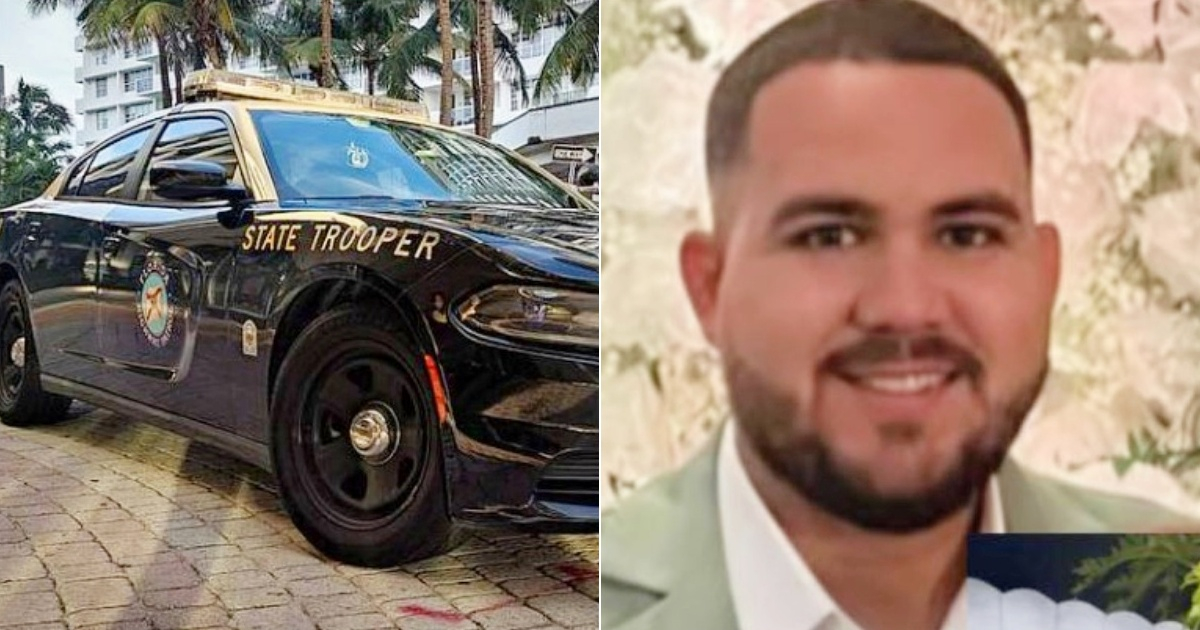
Daniel Reyes Acosta, a 29-year-old Cuban residing in the United States under an I-220A, was arrested this Tuesday at 11:00 a.m. in West Palm Beach by a Florida Highway Patrol (State Troopers) agent.
According to family testimonies, Reyes did not commit any traffic violations, has a valid work permit, a Real ID driver's license valid until 2029, and does not have a criminal record. He also did not have a cut-off date assigned in his immigration process.
The explanation given by the agent, as relayed by his family members, was unsettling:
"I stop it because my computer, when checking the car's license plate, notified me that its owner was neither a citizen nor a resident of the country, and that there was an immigration case pending. I will take it so that it can be processed and his case can be defined."
The case has sparked a wave of outrage on social media and among Cuban immigrant communities, as it is believed that arbitrary detentions are occurring for individuals who have not committed any crimes and who are in the midst of pending legal proceedings.
According to the report by Univision journalist Javier Díaz, Reyes was arrested in Cuba after participating in the protests on July 11, 2021.
Since arriving in the U.S., he has tried to rebuild his life: he is the father of an American child, works at his own window installation company, and, according to his family, is fully integrated into the community.
One of the most detailed testimonies was provided by his uncle, who went to the place of the detention to retrieve his vehicle. In his words:
“The young man has a valid work permit, license until 2029, clean record, an open LLC, and is not a public charge. The trooper told me that the system flagged him for having an I-220A and that I needed to verify if he was the driver. He helped me when I fainted, allowed me to say goodbye, and let me call his wife. He didn’t handcuff him; he treated him with dignity. But he took him away.”
The same witness noted that that morning several troopers were deployed in different areas of West Palm Beach, conducting what he described as a raid.
A community caught between indignation and fear
The story of Reyes has elicited an intense emotional response within the Cuban community in the U.S.
Messages on social media range from frustration over the legal situation of the I-220A to widespread fear of new raids.
Some express their disbelief that authorities can access immigration status simply by verifying a vehicle license plate.
“It is an injustice to detain a person without any wrongdoing. He is a hardworking man, with his own business, abiding by the law,” wrote a commentator.
"The saddest thing is that almost all of them are good people, from good families, adapted to the American system," reflected another user.
There are also reports of hypocrisy among certain sectors within the Cuban community:
"The hard part is that many of us came for political reasons, not economic ones, and it is the same Cubans and Latinos who applaud what is happening."
Others expressed a feeling of betrayal: "This country, which has been a refuge for Cubans for decades, is being undermined."
Between pain and faith
Many messages shared a common theme: faith as a refuge in the face of uncertainty. Prayers, biblical quotes, and appeals to God are abundant among the comments:
"We are living through terrible times. Daniel is the one who is arrested, but we are worried for Roberto and Mabelita, who face the same risks," wrote a visibly affected relative.
"This has been devastating for the entire family and friends. But we trust in an all-powerful God," added another person close to the detainee.
The call for a "second chance" for individuals like Reyes is being echoed, as they do not pose a risk but rather contribute to society.
Political debate and community division
The case has also reignited the political debate. Several users hold the current state administration of Florida responsible, linking these actions to policies supported by Governor Ron DeSantis and the advancement of an anti-immigrant agenda
"The police now have roles as ICE agents. That wasn't done before. It's part of the new laws that have been signed."
Others accuse the republicans of having deceived the Cuban community: "They sold us a lie. The decent are imprisoned while the criminals are free."
There is also criticism of Cuban-American congress members for their inaction, and there are calls for them to intervene in the cases of political prisoners
"Where are the Cuban congressmen? While other communities are protesting, we go out with little flags to say 'long live Trump'."
I-220A: The Legal Limbo
The I-220A is a conditional release document issued by ICE (Immigration and Customs Enforcement) to individuals who are undergoing asylum or deportation proceedings. While it allows them to remain legally in the country while the process is resolved, it does not grant immigration benefits such as an automatic cutoff date or protection against detention.
According to various voices in the comments, there is widespread confusion among those holding this status. Some mistakenly believe that not having a cutoff date protects them; others point out that many have been poorly advised by notaries or unlicensed lawyers.
"Not knowing is not an excuse before the law. Don't blame the government, but the scammers and the lack of information," said a commentator who claimed not to be a lawyer but was familiar with the process.
Daniel Reyes Acosta remains detained. His family, friends, and a broader community of Cubans with I-220A live in anguish, not knowing if the next to be detained will be one of them.
Calls to action have multiplied, urging people to contact congress members, foundations, and media outlets. But a sense of community and solidarity has also flourished, a collective cry against what many perceive as an injustice.
Filed under: