
Related videos:
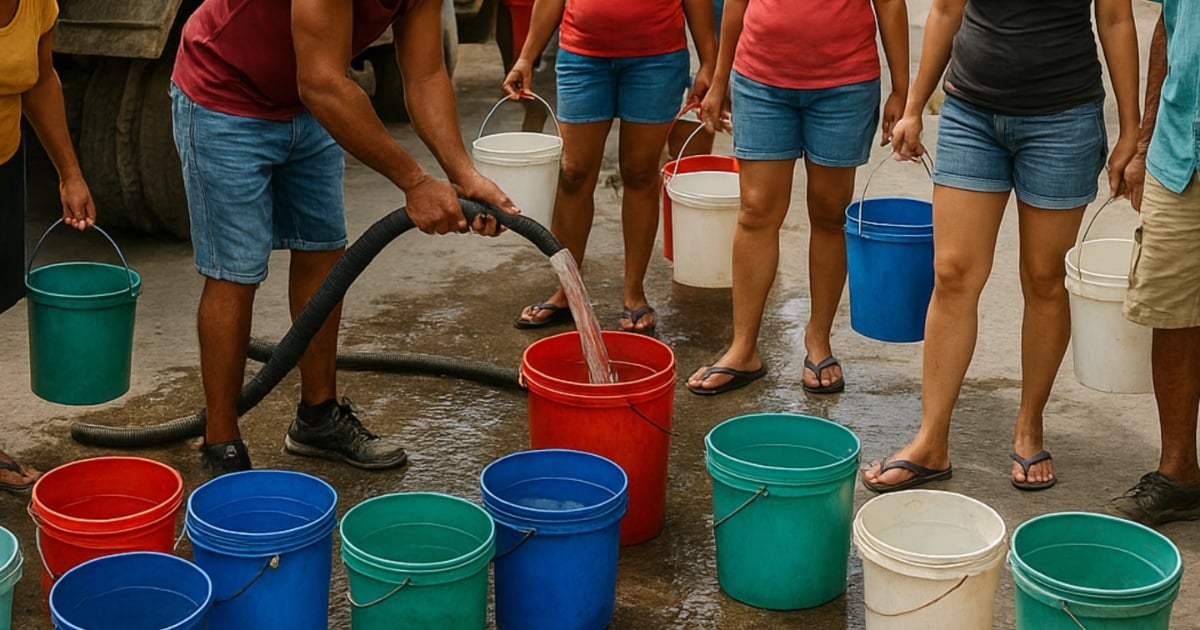
Residents from several neighborhoods in Matanzas reported that the shortage of drinking water has turned into a business that forces them to pay thousands of pesos for a water truck to meet their needs, while cuts in supply lasting weeks and months persist, along with alleged manipulations of the valves and failures in equipment and supplies that are never fully resolved.
On social media, retirees and the general population reported their cases, stating that every two weeks they have to pay for a truck to fill their home tank. The price has already reached one peso per liter of water.
“Since January 31st, not a drop of water has come to my block... I receive 4,300 CUP in retirement and 8,000 from an extra job… I pay 3,000 every two weeks. How can one keep living like this?” expressed a resident while describing the economic burden of surviving without stable service.
In the provincial capital and neighboring municipalities, the testimonies agree that shortages pave the way for abusive pricing.
“Ayer tuve que pagar una pipa en 3,000 pesos… ¿hasta cuándo? Esto es abusivo,” said one neighbor, while another neighbor criticized that the water does not reach the taps in low-lying areas despite the supposed opening times.
"It's been more than 15 days... I don't even know anymore... it's a nightmare." For many, "this has become a business," a perception that, according to reports, is reinforced with each day that passes without technical responses or a clear schedule for normalization.
Citizen reports also point to operational irregularities. In San Antonio de Cabezas, Unión de Reyes, residents are requesting that the situation be documented: they have been without water for six months and claim that there are “shady dealings regarding the faucets and their opening hours for each area.”
And what about the fuel for the trucks?
They also note that the fuel for the generator “arrives for a week but lasts two days”, and that the “free” fuel for trucks “is never seen”, which is why they demand that “the people, who are the ones telling the truth, be interviewed.”
"Today, no one is providing answers about where the turbine is or in what condition it is," adds the neighborhood complaint.
In areas of the city —such as San Carlos Street between Salamanca and Santa Isabel— residents claim that water does not reach “even at the lowest faucet” and question whether the valves are not being opened or if there are deliberate interruptions in the water supply cycles.
The combination of prolonged blackouts, unexplained technical failures, and the forced reliance on water trucks fuels the idea that the shortage benefits intermediaries and informal operators, while households incur costs that easily exceed the monthly incomes of retirees and workers.
The discomfort goes beyond just a specific complaint and turns into a political demand. “They need to check everything; I haven't had water for 10 months… it is necessary that, as our president says, the will that is so often asked of the people should also be asked of the government,” demanded another affected individual, referring to the lack of verifiable responses and the need to control both the technical processes (turbines, fuel, valve operation) and the charges associated with alternative distribution via trucks.
Meanwhile, vulnerable families — retirees, households with children or sick individuals — continue to pay out of their own pockets to secure basic necessities, in a system where, according to complaints, planning and oversight are lacking and profit-making thrives at the expense of an essential service.
The immediate demand of the neighbors is transparency regarding the actual state of the equipment, achievable pumping schedules, fuel control, and effective regulation of the trucks, with public monitoring of each measure until the water returns to the taps.
The company's justifications
According to the official newspaper Girón, in the city of Matanzas, resident Adelfa María Cáceres Pérez, from Salamanca Street No. 31016, between Capricho and Buena Vista, reported that for about eight months her home and those of her neighbors lacked drinking water.
"It doesn't even reach the tanks near the connection, which never stopped receiving water even in the worst moments." He acknowledges a widespread crisis in the province but points out that in nearby areas, "one day more than another, the liquid appears."
Request the Water and Sewage Company to check the connections and not to limit the explanation of the problem to "electrical disturbances."
"We ask for solutions, not explanations, and even less justifications," he wrote; "clean water today is a right of the people."
The company responded through Luis Ojito Almeida, a specialist in Public Attention at the municipal UEB, who visited the sender and attributed the scarcity to “excessive hours without pumping”, caused by the lack of electricity, which hinders the stability of the process.
He pointed out that the few hours of electricity "do not allow for the recovery of the hydraulic networks and, consequently, for water to reach the homes," and that, with the increase in electrical service, the liquid "though little, has become visible" in the home of Cáceres Pérez.
After that explanation, the neighbor insisted that “there is no sensitivity to the problems of the population” and that “all necessary actions” should be prioritized to maintain “a minimum pumping,” without waiting for higher instructions.
Filed under: