
Related videos:
The longest-serving prime minister in the Caribbean and one of the Cuban regime's staunchest allies, Ralph Gonsalves, suffered a crushing defeat in the general elections of Saint Vincent and the Grenadines, bringing an end to 24 years of uninterrupted power.
The downfall of the leader known as "Comrade Ralph" also represents a symbolic blow for Havana, which loses one of its strongest diplomatic allies in the Caribbean.
According to the agency EFE, the opposition New Democratic Party (NDP) won 14 of the 15 seats in Parliament, leaving the historic Unity Labor Party (ULP) with just one seat, coincidentally the one held by 79-year-old Gonsalves.
His son and Minister of Finance, Camillo Gonsalves, as well as the Minister of Agriculture, Saboto Caesar, also lost their positions to opposition candidates.
The new Prime Minister, Godwin Friday, 66 years old, took office immediately, stating that he did not want "a vacuum in governance" and promising "significant and transformative changes" for the country, as reported by EFE.
A defeat that shakes Havana
For the Cuban regime, Gonsalves's departure from power is not a minor detail. Saint Vincent and the Grenadines has been a key diplomatic platform for Castroism for two decades, a reliable vote against the embargo at the United Nations, a public defender of Díaz-Canel's government, and an active participant in regional mechanisms aligned with Havana.
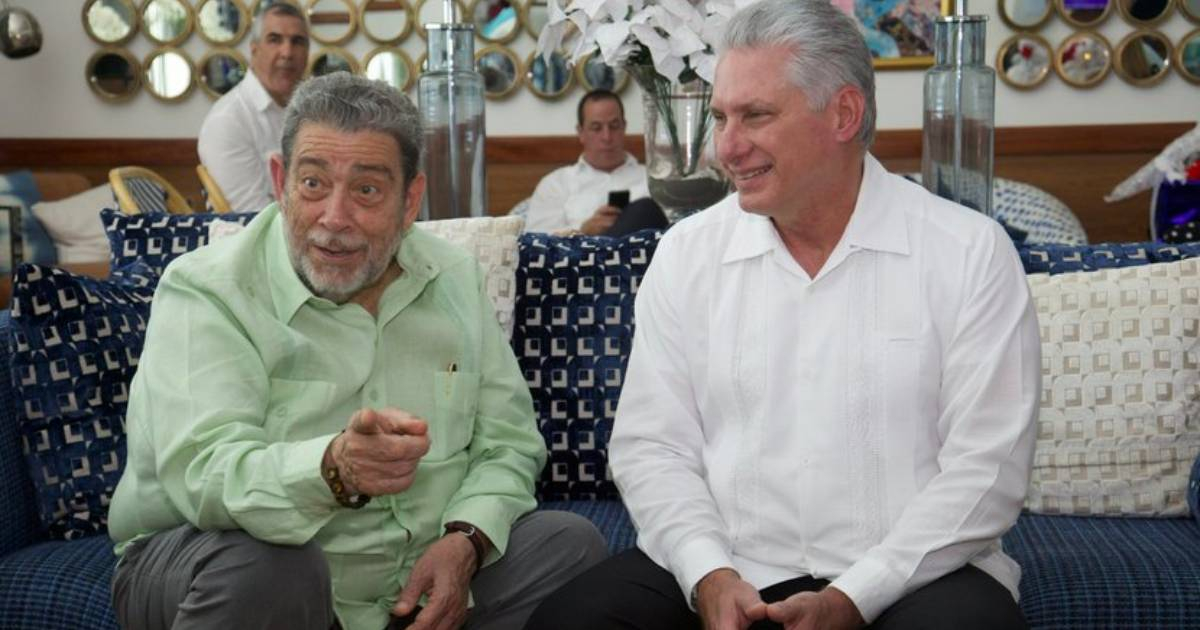
In 2022, during an official visit, Díaz-Canel referred to Gonsalves as a "dear friend" and spoke of a "deep, sincere, and brotherly relationship," according to reports from the official Cuban press.
The San Vicente leader, for his part, emphasized the "legacy" of Fidel Castro and praised Cuban cooperation as a gesture of solidarity that, he asserted, his country would always appreciate.
The connection was so strong that Gonsalves became one of the most vocal advocates for Cuban medical missions, even as multiple international organizations have reported labor exploitation conditions in those programs.
After the results were announced, the Cuban leader Miguel Díaz-Canel responded on X with a message that confirms the extent of the loss for Havana.
"Dear brother Ralph, we recognize in you a true friend of Cuba. Your legacy in Saint Vincent and the Grenadines, and in the Caribbean for regional integration and unity, along with your loyal friendship, will forever stand as symbols of brotherhood and solidarity between our peoples," he said.
Gonsalves defended the Cuban medical exploitation with a cynical argument
In 2025, Gonsalves sparked outrage by justifying that the Cuban doctors sent to the Caribbean would give part of their salary to the regime for receiving "free education." The then prime minister stated:
"That doesn't mean they are being exploited. (…) It's not unreasonable for them to put something in the box so that more people can get educated."
Meanwhile, reports from Human Rights Watch, the UN, and the U.S. Department of State have described medical missions as a form of "modern slavery," involving passport retention, surveillance, punishments for those who leave the mission, and mandatory contributions of between 70% and 85% of their salaries to the Cuban regime.
Still, Gonsalves insisted on defending the program and criticized Washington for sanctioning officials who hired Cuban medical personnel under abusive conditions.
The end of an era: “I will lead the opposition with dignity”
After the defeat, Gonsalves acknowledged the result, although he refrained from congratulating Friday. In a speech cited by EFE, he issued a warning filled with political resentment:
“At this critical point of the NDP, triumphalism marks the beginning of its decline. The collapse often starts imperceptibly and then turns into a wave of confusion.”
He assured that he would lead the opposition "with dignity," but the overwhelming opposition victory leaves his party in a minimal position. It is the first time since 2001 that the ULP has been practically erased from the political map of his country.
A Caribbean that is reconfiguring
Gonsalves' departure raises questions about the future of relations between Saint Vincent and Cuba, especially in key areas such as:
- medical missions
- diplomatic cooperation
- staff training
- joint voting in international organizations
For Cuba, which is experiencing one of the deepest economic crises in decades and increasingly relies on external alliances, the loss of such an influential ally in the Caribbean represents a significant setback in its regional strategy.
Meanwhile, the San Vicente opposition celebrates a "new beginning" for the country, while the region watches as one of the last Caribbean strongholds of Castroism crumbles after more than two decades in power.
Filed under: