
Related videos:
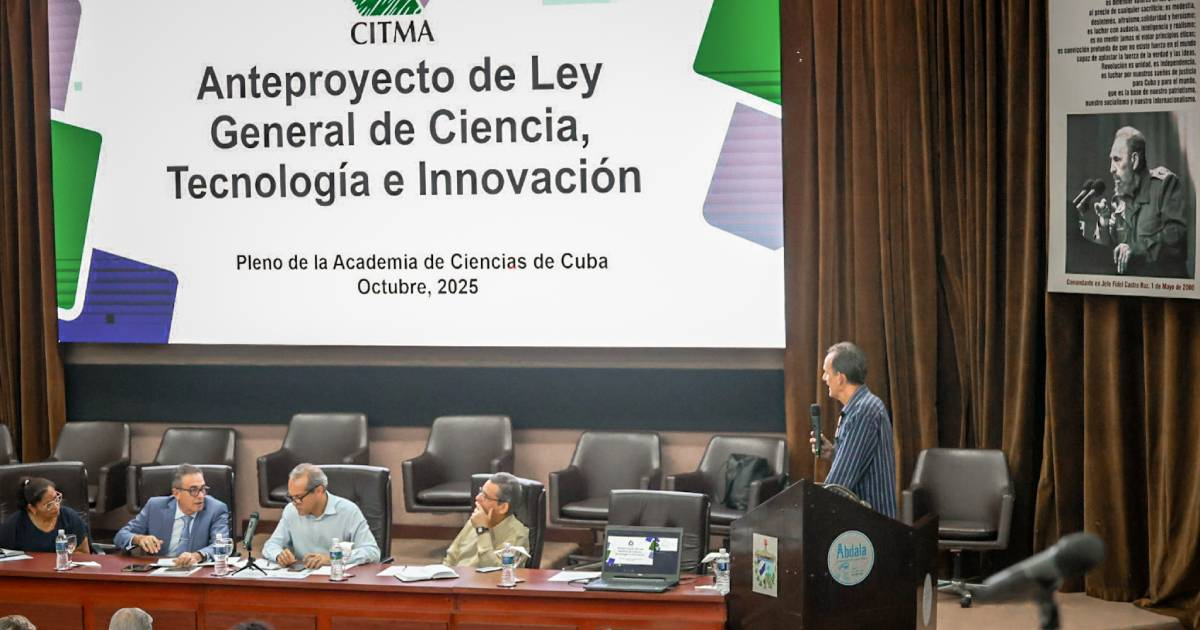
The Cuban regime presented a new General Law Project on Science, Technology, and Innovation that, while being announced as a tool to “promote, develop, and regulate” scientific activity in the country, consolidates a deeply centralized model where the State maintains absolute control over research, the production of knowledge, and its circulation.
The text, published on December 6 by the National Assembly along with an email for citizens to submit their opinions, is presented as part of the legislative process prior to its discussion in Parliament next week.
The proposal comes at a time of significant deterioration in the scientific sector, characterized by low salaries, talent flight, outdated laboratories, and a lack of funding. However, rather than promoting greater institutional autonomy or openness, the bill strengthens the vertical command structure that governs science in Cuba.
The Ministry of Science, Technology and the Environment (CITMA) is reaffirmed as the governing body at all levels, with the capacity to coordinate, supervise, and direct policies, funds, and national and territorial strategies, which renders any research initiative a process subordinate to state planning.
The document defines science as a "public good at the service of socialism" and emphasizes that every actor, from universities to private companies, cooperatives, local projects, and even independent scientists, must operate within a single system that is regulated, supervised, and evaluated by the State.
Governance is conceived as planned and multi-actor, but always under the leadership of CITMA and the Council of Ministers. Even scientific ethics remains under state control, as expressions that "generate alarm or false expectations" are prohibited, and discretion is required in research related to economic, political, or national security objectives—categories that, in Cuba, have an extremely broad scope.
Another central element is the control over scientific information. The project establishes the creation of a National Information System that will integrate all publications, data, results, and indicators, managed by CITMA.
Open science is discussed in discursive terms, but the digital infrastructure will be centralized, and all scientific production will have to go through official channels, which restricts editorial autonomy and the independent circulation of knowledge.
The publication of the law is accompanied by a call for "citizen participation," but the process is limited to sending opinions via email, a mechanism already common in the National Assembly that rarely leads to substantial modifications.
While the government seeks to demonstrate transparency, the regulation solidifies political control over a key sector for the country's development, in a context where many young scientists are leaving Cuba in search of better conditions, research freedoms, and real opportunities for innovation.
The Parliament will analyze the project in its next session period starting on December 18. If approved, as is already known in Cuban politics, Cuban science will become even more subordinated to state logic, reducing autonomy and deepening dependence on a centralized model that has shown limited capacity to retain talent and generate sustainable progress.
Filed under: