
Related videos:
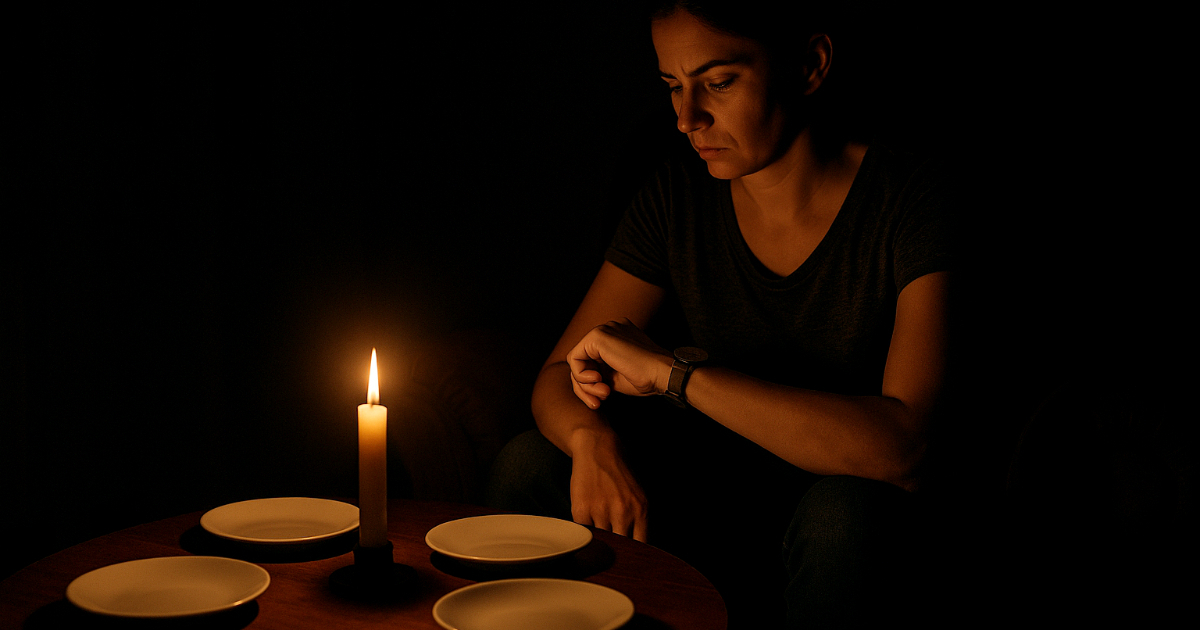
Cuba is entering the final stretch of the year engulfed in one of the worst energy crises in recent times, with widespread blackouts lasting throughout the day and a generation shortfall approaching 2,000 megawatts (MW), according to official data from the Electric Union (UNE).
According to the informative note regarding the status of the National Electric System (SEN) for this Friday, December 19, the electrical service was affected throughout the 24 hours of the previous day.
The greatest impact was recorded at 6:10 PM, when the generation capacity deficit reached 1,989 MW, a figure that reflects the extreme fragility of the system.
A system collapsed since early morning
This Friday, at 6:00 AM, the total availability of the SEN was only 1,330 MW, compared to a demand of 2,355 MW, resulting in an immediate shortfall of 1,038 MW.
For midday, the UNE estimated that blackouts would remain around 1,100 MW, confirming that there would be no relief during the day.
The situation is due to a combination of breakdowns, extended maintenance, technical limitations, and a severe lack of fuel, factors that keep a significant portion of the country's installed capacity out of service.
Breakdowns and maintenance in key thermoelectric plants
Among the main incidents reported are breakdowns in four units of the thermoelectric plants Máximo Gómez, Nuevitas, Felton, and Antonio Maceo.
This is compounded by blocks that remain out of service due to scheduled or extended maintenance at the CTE Mariel, Santa Cruz (two), and at the Carlos Manuel de Céspedes in Cienfuegos.
Due to limitations in thermal generation, the country has 397 MW unavailable, which further exacerbates the situation.
The lack of fuel continues to have its consequences
The energy deficit is also characterized by the shortage of fuels and basic supplies.
The UNE reported that 83 distributed generation plants, equivalent to 798 MW, are out of service due to this issue. Additionally, 108 MW are affected at the Moa Fuel Plant and 95 MW are unavailable due to a lack of lubricant.
In total, the problems associated with the supply of fuel and lubricants account for 1,004 MW of affected capacity, a figure that alone explains a significant portion of the power outages experienced by the country.
An even more critical nighttime peak
For the peak nighttime schedule, which is the most complex, the UNE anticipates the contribution of units 3 and 5 from the CTE Renté, with estimated outputs of 45 MW and 65 MW, respectively.
Still, the total availability would barely reach 1,440 MW, compared to a forecasted peak demand of 3,380 MW.
This would result in a deficit of 1,940 MW, so if the announced conditions persist, the impact could reach up to 1,970 MW, which is one of the highest levels recorded in recent months.
Solar energy cannot make up for the collapse
Although the government has committed to incorporating renewable energy, the results remain insufficient to offset the deterioration of the system.
The UNE reported that the 33 new photovoltaic solar parks generated 2,823 MWh, with a maximum power output of 520 MW during peak solar irradiation hours.
While this contribution is significant during the day, it does not meet the national demand nor provide a solution to the nighttime blackouts, when solar generation completely disappears.
Havana also in the dark
The Electric Company of Havana confirmed that the capital did not escape the crisis.
On Thursday, the electric service was affected for 12 hours and 25 minutes, with a peak impact of 334 MW at 6:10 PM.
The service was restored at 11:52 PM, but in the early morning, power outages returned: block 3 was affected starting at 5:14 AM due to a generation deficit.
The entity reiterated that these disruptions "depend on the demands of the SEN," a statement that is repeated day after day as the population faces increasingly prolonged outages.
A year-end marked by uncertainty
With power outages lasting over 20 hours in various parts of the country, Cuba enters the end of the year in a state of profound energy uncertainty.
Official figures confirm that the electrical system continues to operate far below actual demand, with no immediate solution in sight, while millions of Cubans face the closure of 2025 amid darkness, heat, and the paralysis of daily life.
Filed under: