Amid the most severe economic and social collapse Cuba has experienced in decades, the First Secretary of the Communist Party in Granma, Yudelkis Ortiz Barceló, reemerged on social media praising "revolutionary unity," and confirming the totalitarian power's disconnection from the reality faced by Cubans.
In a video recorded from his office and shared on Facebook, Ortiz Barceló delivered a monologue filled with slogans and heroic references to the landing of the Granma, the rifles of the expedition members, while displaying portraits of Fidel and Raúl Castro hanging in his office.
In a solemn tone, the official evoked the “faith and hope in victory” and called for “the unity of all revolutionaries” under the inspiration of José Martí, whom she also invoked while pointing to another portrait of the “national hero” hanging on the wall.
The scene, more characteristic of the Revolutionary Guidance Department (DOR) of the 1970s, was published this week as the country faces blackouts lasting over twenty hours, a national currency in free fall, and unprecedented shortages. In that context, Ortiz Barceló's speech sounded even more hollow than the usual propaganda.
The tone and staging—a leader reading her "directive" in front of portraits of national heroes and slogans—reflected the style of nationalist indoctrination that the regime is trying to revive in light of its credibility collapse.
But revolutionary nostalgia does not quench hunger or heal despair. Every word of the video sounded like an empty echo of a country that no longer exists, a mechanical repetition of the same ideological script with which the Party tries to maintain its dominance through the founding myth of the Sierra Maestra.
Ortiz Barceló, known for her repressive zeal, once again took center stage in a propaganda episode that places her at the heart of public criticism.
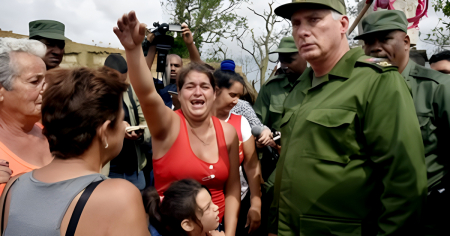
It was she who recently exhibited the elderly Francisca, forced to retract after questioning Díaz-Canel for having lost her bed, and before that, the detained mother Mayelín Carrasco, “very regretful” for protesting in Río Cauto.
Her transformation from oppressor to pamphleteer confirms the same purpose: to discipline, correct, and indoctrinate.
More than inspiring, the video provokes visceral rejection in its attempt to reaffirm submission. Instead of offering solutions, the PCC secretary proposed "fidelity." Instead of empathy, she demanded obedience. And instead of leadership, she delivered liturgy.
In a Cuba that is bleeding amid scarcity, fear, and emigration, appealing to the "spirit of Cinco Palmas" is an insult to the intelligence of an exhausted people.
Ortiz Barceló's message does not unite; it divides. It does not encourage; it recalls, in an almost militaristic tone, that there is only room for those who adhere to repetition. And in that echo of worn-out slogans, the silence of those who no longer believe is heard more loudly.
Filed under: