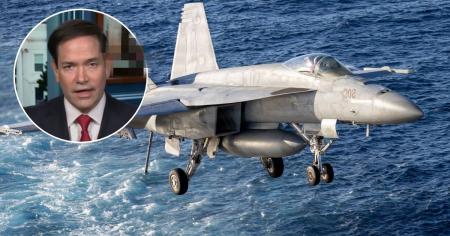
Days before the capture of Nicolás Maduro, the United States Secretary of State, Marco Rubio, hinted that he did not expect a real military reaction from Russia in the event of a U.S. attack on Venezuela.
His words, spoken on December 19 during a press conference in Washington, have gained new importance after it was noted that Moscow has only issued statements and diplomatic condemnations, without taking any further action.
In that meeting, Rubio was asked about the risk of an escalation with Russia after Foreign Minister Serguéi Lavrov warned that blocking Venezuelan oil or attempting to overthrow the Chavista regime would be “a fatal mistake.” With a sarcastic tone, the Secretary of State replied:
“We are not concerned about an escalation with Russia. We always expected them to provide rhetorical support to Maduro. They are fully occupied in Ukraine. And if you are watching me, Sergei [Lavrov], Merry Christmas!.”
That irony from Rubio, which was then perceived as a diplomatic provocation, has proven to be prophetically accurate.
Since the onset of U.S. pressure against Caracas, the Kremlin has issued a lengthy series of statements condemning Washington's "imperialist aggression," yet without backing those words with any effective action.
Among them, Russia "submitted a diplomatic request" demanding that the United States leave Venezuelan territory, and another on January 3, in which Moscow "promised an immediate response" to President Donald Trump, which never came.
Meanwhile, Venezuelan television broadcast images of Russian S-300 air defense systems, seemingly deployed, that were neutralized by American fire during the bombings over Caracas and La Guaira.
The pattern of "solidarity without intervention" recalls, according to analysts, the strategy that Moscow adopted in Syria after 2020, when, despite its historical support for the regime of Bashar al-Assad, it began to withdraw resources and limit its military involvement to symbolic operations.
In both cases, the defense of their allies was relegated to the diplomatic and media arena.
Meanwhile, Western diplomatic sources and defense analysts agree that Russia currently lacks the operational capability to project military power in Latin America, a region that the Kremlin itself acknowledges as a "zone of direct influence of the United States."
The economic sanctions resulting from the war in Ukraine and the toll of the conflict have reduced Moscow's maneuvering capacity, limiting its support for Venezuela to symbolic gestures and diplomatic statements.
Meanwhile, the official Russian discourse has shifted from initial belligerence to a more cautious tone. On January 3, Lavrov called for “dialogue” and to avoid “a regional catastrophe”, implicitly acknowledging that Moscow will not intervene.
Days before, Vladimir Putin himself promised “total support” to Maduro, assuring that “Russia will not abandon its allies.” The facts proved him wrong.
The U.S. operation —completed in a matter of hours and without any casualties— confirmed what Rubio had predicted: that Russian power in the Caribbean was purely symbolic. In the words of the Secretary himself, “Moscow's rhetoric is not a factor in how we view this situation.”
Experts in international politics interpret Russia's lack of reaction as a blow to its narrative as a global power. Analysts agree that Rubio sarcastically anticipated Russia's lack of a real response, highlighting the weakness of its influence beyond the Eurasian sphere.
For Washington, the outcome reinforces its regional hegemony and highlights the decline of the Moscow–Caracas–Havana axis, which is now weakened by economic crises, sanctions, and internal divisions.
Rubio said with a smile, “Happy holidays, Sergei.” What seemed like a casual remark turned, days later, into a geopolitical statement: the Kremlin only fights battles that it can narrate, not win.
Filed under: