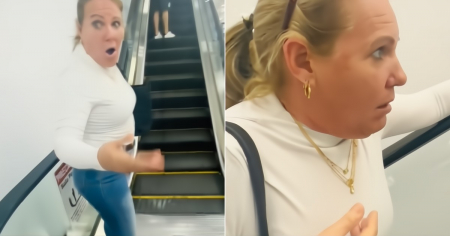
Amanda Tarajano, a Cuban who recently emigrated, posted a viral video on TikTok in which she conveys a strong message to her family, friends, and neighbors in Cuba, accusing them of trying to impose what she can or cannot say on social media.
"Don't write to me anymore, don't call me anymore," he began saying in an emphatic tone. "This is a message for all the people in my family, my friends, and my neighbors who have written to me not to give me advice, but to impose what I can say. Listen carefully: when I left Cuba, I did not ask anyone for money or support. I left in the face of the consequences of my decisions."
The young woman, visibly upset, explained that she feels completely free to express herself in the country where she lives, away from the censorship and fear that prevail in Cuba. "I am in an extremely free country where I can say and do whatever I want," she stated.
Tarajano also rejected claims that Cuban State Security might be bothering his family over his statements. "The dictatorship doesn't even have gasoline to send its henchmen to the homes of political prisoners; do you think they have the resources to harass my family?" he quipped.
With visible emotion, the Cuban woman recounted everything she lost when she left her country: “What more are they going to take from me? They took my home, my family, my roots, my culture, my dignity. They made me flee as if I were a criminal.”
In another part of the video, he denounced the severe health crisis that Cuba is facing and urged those who still have doubts to visit oncology hospitals. “Go and see what it's like to receive a cancer diagnosis without medication or treatment. That is to lose hope, dignity, and life,” he lamented.
Tarajano emphasized that his publications are not a call for confrontation, but rather an exercise of personal freedom. “I haven’t asked anyone to do anything at all. The only thing I said was: stay in your homes and don’t serve as a front for the dictatorship,” he clarified.
Finally, he delivered a message of hope: “Cuba is going to change. The dictatorship will fall, and I will return to Cuba. I don't care if I can't go now; my country is Cuba, and that is where I will die.”
The video, published with the phrase "Do not write to me anymore, do not call me anymore," has sparked extensive debate on social media, where many Cubans in exile have resonated with his testimony and his defense of the right to express oneself without fear.
Filed under: