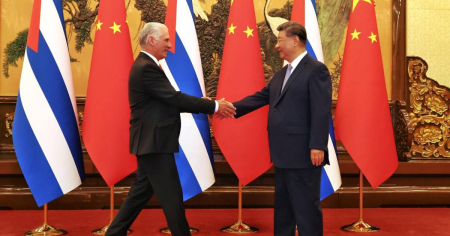
China has once again openly supported the Cuban regime in response to the recent warnings from President of the United States, Donald Trump, in a stance that mirrors the defense that Beijing maintains toward chavismo in Venezuela.
During her regular press conference, the spokesperson for the Ministry of Foreign Affairs, Mao Ning, expressed her country's "strong support" for Cuba in defending its sovereignty and national security.
The diplomat urged Washington to end the blockade, the sanctions, and "all forms of coercion" against the island, which she described as China's "historical friend."
The message comes days after President Trump warned that he would leave Cuba "without oil or money from Venezuela," after taking control of the energy resources of the South American country, and reiterated his advice to Havana to begin making changes and start a transition process on the Island as soon as possible.
Beijing, which had already condemned the U.S. military attack in Venezuela and the capture of Nicolás Maduro by U.S. special forces in December, maintains a policy of diplomatic support for the allied regimes of Latin American socialism.
In both cases —Caracas and Havana—, the Chinese government has demanded that Washington show "respect for sovereignty" and has defended the continuation of economic and political ties.
Analysts consulted by Reuters indicate that China aims to protect its influence in Latin America in the face of the U.S. offensive led by Trump and Secretary of State Marco Rubio, who are advocating for a political transition in Venezuela and pushing for regime change in Cuba.
Beijing's support, however, is set against a backdrop of increasing international isolation for Havana, which is affected by the economic crisis, energy collapse, and social protests.
The statements from the Asian giant had no effect on U.S. decisions regarding Venezuela, and they may prove equally ineffective in the case of the Cuban regime.
As Trump intensifies pressure and vows to "liberate Cuba from communism," China clings to a strategy of symbolic defense for its traditional allies, although it offers no substantial material support to alleviate the island's dire situation.
Filed under: