
Related videos:
The fall of Nicolás Maduro not only marked a political turning point in Venezuela. It also opened a deep rift in the global energy balance, reorganizing interests, routes, and alliances in a market where oil remains a tool of power.
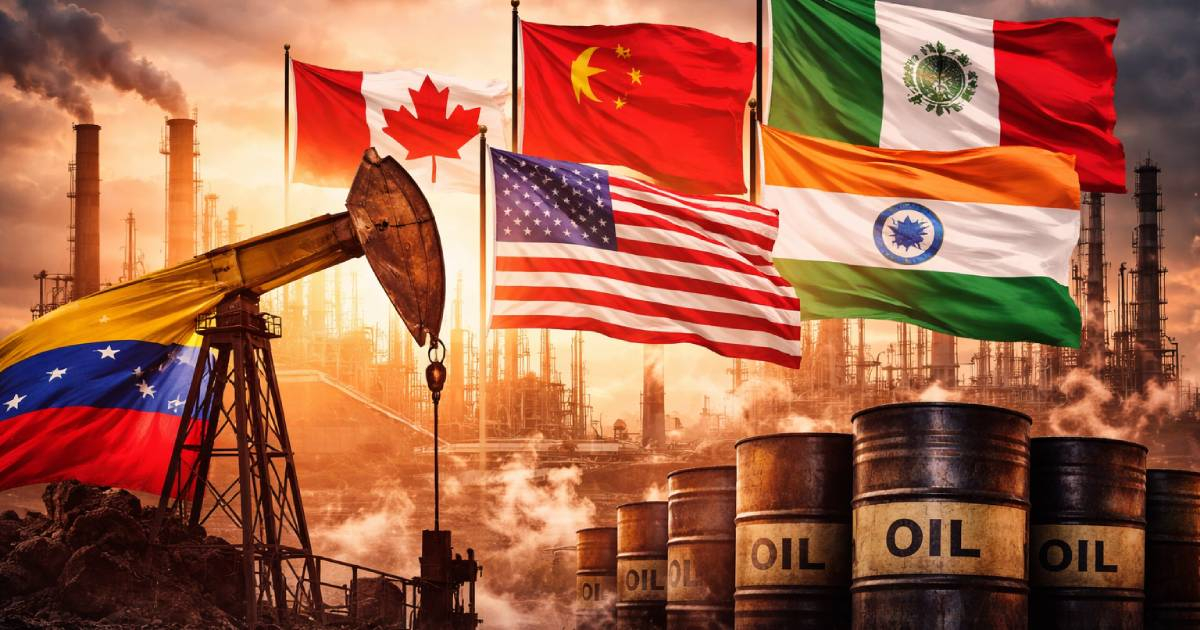
With the largest proven oil reserves on the planet, the fate of Venezuelan oil has become a strategic asset that is now contested by the United States, Canada, China, India, and indirectly, Mexico.
An analysis by Valora Analitik warns that, although Washington has made its interest in leading the reconstruction of the Venezuelan oil sector clear, with investments estimated at up to 100 billion dollars, other players are not willing to wait.
Canada, for example, sees in this new scenario an opportunity to redirect its heavy oil towards Asia, especially China and India, anticipating a potential return of Venezuelan crude to the U.S. market.
The key lies in time. Rebuilding Venezuela's devastated oil infrastructure will not be quick or inexpensive. According to experts cited by the outlet, this process will take years and require multi-billion dollar investments, which opens a window for producers like Canada to strengthen their presence in Asian markets.
The recent expansion of the Trans Mountain pipeline, which now allows for the export of hundreds of thousands of barrels daily to the Pacific coast, is aimed precisely in that direction.
Meanwhile, Asia watches cautiously but also with ambition. India, which stopped receiving Venezuelan crude in 2025, has expressed its willingness to resume purchases if options beyond American companies become available.
For New Delhi, Venezuelan oil represents a way to diversify supplies and secure heavy crude that is compatible with its refineries, amid a growing global competition for energy.
Mexico appears as one of the most vulnerable players in this reconfiguration. If the United States reduces its purchase of Mexican crude oil in favor of Venezuelan oil, Pemex would be forced to accelerate its market diversification.
Although there are long-term contracts that cushion the impact, the risk of losing ground in the strategic Gulf of Mexico market is real, especially if Venezuela manages to regain its export capacity.
Behind this energy board, hard politics is at play. President Donald Trump has not only fostered a controlled rapprochement with the Venezuelan oil sector, but he also has placed the oil revenue under the custody of the U.S. Treasury, shielding it from embargoes and lawsuits.
The measure seeks to stabilize Venezuela, reduce migration pressures, and sever ties with actors deemed hostile by Washington.
This redesign has direct consequences for Cuba. For years, Havana survived thanks to Venezuelan oil. Today, with Maduro out of power and Trump announcing that "there will be no more oil or money for Cuba", the island finds itself excluded from a new energy order that is being redefined without it.
While other countries compete for barrels and markets, Cuba is facing blackouts, shortages, and an ever-deepening isolation.
The global oil map is shifting rapidly. Venezuela is returning to the forefront, not as the reliable supplier of bygone days, but as a strategic territory in contention.
In that game of interests, alliances, and power, oil proves once again that it is not just energy: it is politics, influence, and, for many countries in the region, a matter of survival.
Filed under: