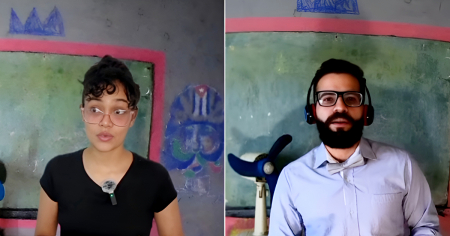
The Cuban visual artist and writer Emmanuel Castillo shared a message with the youth that the Castro regime uses to suppress protests, in which he questions the official narrative, denounces military privileges, and calls for not firing upon the people themselves.
In a brief audiovisual released through the Instagram profile of the NGO Juventud Cuba, Castillo addresses those "counting down the days until they are released" and those who have been placed "on combat readiness" without understanding the reason.
The young artist asserts that the political power is trying to prepare them for a war that "they have already lost," in which others make the decisions, but it is they who bear the burden.
The artist dismantles one of the pillars of the official discourse by stating that they are not “the shield of the Revolution,” but rather the shield “of a group of generals who invest in hotels while you go hungry,” referring to GAESA, the military conglomerate that controls a significant portion of the tourism industry and other economic sectors in Cuba.
Even during the covid pandemic and the following years, the military and governmental elite on the island prioritized the construction of luxury hotels, in stark contrast to the economic and social reality faced by most Cubans, who live amidst blackouts, shortages of food and medicine, as well as insufficient wages.
In his message, the young artist emphasized the contrast between the sacrifices expected of the youth and the benefits accumulated by the ruling caste and their relatives, whom he accused of enriching themselves while the base lives in precariousness.
Castillo warns that, in the face of a scenario of blackouts, confusion, and crisis, the authorities will seek to turn the people into an internal enemy.
On July 11, 2021, during the historic protests that spread across several cities in Cuba, the ruling Miguel Díaz-Canel, in a televised address, insisted that “the street belonged to the revolutionaries” and issued a battle order for law enforcement and shock troops to take to the streets to suppress the protesters.
In that context, he asserts that those who receive the order to shoot will not see mercenaries, but rather their own families facing scarcity and a lack of future.
The message emphasizes that repressing the people means extending decades of misery, and that true courage lies not in pulling the trigger, but in lowering it.
Castillo argues that the officers who give orders will not face the consequences when the crisis is over, while those who obey will bear the moral and social weight of their actions.
The audio concludes with a call to not allow oneself to be used as "the last nail in a coffin that is already closed" and to not fear freedom or one's own conscience.
The Cuban government has decided to dedicate Saturdays to military training due to the increasing tension with the United States following the capture of Nicolás Maduro.
The regime aims to raise the levels of readiness and willingness among the population in a context they perceive as an external threat.
Furthermore, it is framed within a narrative of national defense that seeks to maintain internal political cohesion in the face of international criticism and pressure.
Filed under: