
Related videos:
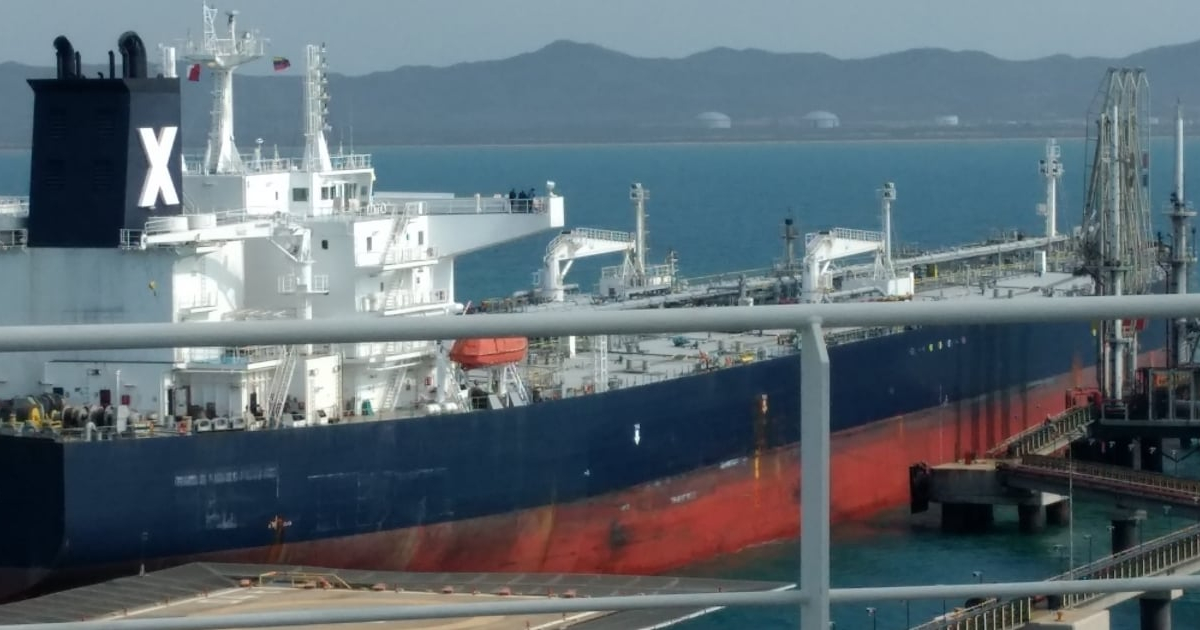
Two supertankers flying the Chinese flag that were headed to Venezuela to collect shipments of crude oil intended for the payment of Caracas's debt to Beijing turned around in the Atlantic and are returning to Asia, a clear indication that the direct flow of Venezuelan oil to its main buyer is encountering new obstacles in the short term.
According to maritime tracking data cited by Reuters, the ships - which only cover the route from Venezuela to China to transport oil used as a debt compensation mechanism - remained anchored for weeks off the Venezuelan coast awaiting instructions, amidst the political crisis and the tightening of the U.S. energy blockade.
The turnaround of these vessels occurs at a time when Washington announced an agreement to export up to 50 million barrels of stored Venezuelan oil, an operation involving large international trading firms.
After that announcement, President Donald Trump assured that China would not be excluded from Venezuelan oil, although he did not provide details on the mechanism that would allow that supply.
In practice, however, the figures show a clear slowdown.
China -the largest market for Venezuelan oil- has not received any direct shipments from the state-owned PDVSA since last month, while the United States continues to insist that the oil embargo remains in effect.
Instead of direct exports from PDVSA, the initial shipments resulting from the new scheme are being prepared by the companies Vitol and Trafigura, which are finalizing cargoes under a supply agreement valued at 2 billion dollars.
These shipments are intended for the United States and other markets, including India and China, which opens the door for Chinese refineries to receive Venezuelan crude through intermediaries, but no longer as a direct State-to-State flow, rather through triangular commercial operations.
The two ships that have changed course—identified as Xingye and Thousand Sunny—are not among those sanctioned, but they are part of a small group of supertankers that has historically covered the route from Venezuela to China to transport oil related to the service of the bilateral debt.
That scheme emerged after the energy sanctions imposed on Caracas in 2019, when Beijing granted a grace period for capital payments and agreed to settle the debt through oil shipments.
Last year, China was the main destination for Venezuelan crude, with exports nearing 642,000 barrels per day, accounting for approximately three-fourths of the total exported by PDVSA.
However, most of those volumes ended up in independent Chinese refineries through little-known intermediaries, while shipments directly tied to debt repayment represented only a fraction of the total.
The change in course of the supertankers highlights the fragility of the traditional export scheme from Caracas to its main creditor and suggests that, at least for now, Venezuela may be running out of the direct route it has relied on for years to fulfill financial commitments to China through oil shipments.
Regional context and growing pressure
The withdrawal of Chinese supertankers occurs in a context of high tension in the Caribbean, where the United States has increased military and diplomatic pressure against the networks that support Venezuelan oil trade outside of sanctioned channels.
The Southern Command has issued direct warnings to ships associated with the so-called "dark fleet", accused of transporting Venezuelan crude through opaque schemes to support circuits of illicit financing.
Washington has accompanied these warnings with a large-scale naval deployment, which includes the aircraft carrier USS Gerald R. Ford and several amphibious platforms, as part of Operation Southern Spear.
The mission, backed by various federal agencies, aims to intensify interdictions at sea and dismantle the maritime logistics that enable Caracas to move its oil despite the blockade.
U.S. forces have also increased the seizures of vessels linked to these networks, intercepting ships in the Caribbean and the Atlantic, some of which have flags of convenience or have been recently modified to evade sanctions.
This heightened surveillance environment further complicates any attempt to export directly from Venezuelan ports to key markets such as China.
Naval pressure is compounded by the repositioning of U.S. ships north of Cuba, a gesture interpreted by analysts as a warning to both Havana and Caracas regarding Washington's determination to close off the escape routes for sanctioned oil.
In this climate, the decision by two Chinese supertankers to cancel their journey and return to Asia without loading oil is not an isolated incident, but rather a symptom that the Caribbean has become an active front in the energy and geopolitical confrontation, where every maritime movement is watched and can disrupt the delicate balance of regional oil trade.
Filed under: