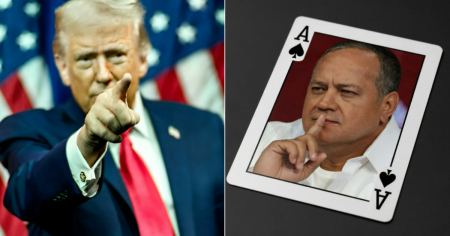
Diosdado Cabello surprised once again with a rhetorical shift that clearly contrasts with his historical rhetoric against the United States. The Chavista leader went from warning that "not a drop of oil" would head to U.S. territory in the event of aggression, to publicly claiming that Venezuela has "always" sold crude oil to the U.S., in a context marked by the capture of Nicolás Maduro and the increasing pressure from Washington on the Venezuelan oil industry.
The most recent statement was made during a press conference of the United Socialist Party of Venezuela (PSUV) held on January 12, when Cabello asserted without hesitation that the sale of oil to the United States is neither new nor exceptional.
"We have historically sold oil to the United States consistently," he said, even recalling export figures that, according to him, reached up to 1.5 million barrels per day in previous years.
The shift in tone is significant when compared to previous statements made by Cabello himself. Just weeks earlier, he had categorically asserted that "not a drop of oil can leave here for the United States if they attack Venezuela," a phrase that was widely shared and celebrated on social media as a demonstration of resoluteness against Washington. Today, that rhetoric has been left behind.
The shift occurs after the capture of Nicolás Maduro and Cilia Flores on January 3rd, an event that completely altered the balance of power in Venezuela and opened a new phase in relations with the United States. Since then, the official narrative has shifted from open confrontation to a forced pragmatism, focused on the political and economic survival of Chavismo.
In this new scenario, Petróleos de Venezuela (PDVSA) publicly confirmed that it is negotiating with the U.S. government for the sale of crude oil, under frameworks similar to those used with companies like Chevron. The state-owned company presented the agreement as a transaction that is “legal, transparent, and mutually beneficial,” although Washington made it clear that the revenues would remain under its control.
President Donald Trump himself announced that Venezuela will deliver between 30 and 50 million barrels of oil, while his administration advances a plan for energy control aimed at stabilizing and reorganizing the Venezuelan oil industry under U.S. supervision.
The Secretary of State, Marco Rubio, explained that it is a three-phase strategy—stabilization, recovery, and transition—designed to prevent an internal collapse of the country.
The acting president of Venezuela, Delcy Rodríguez, also took an unusually conciliatory tone regarding economic matters. She defended trade relations with the United States and acknowledged that a significant portion of Venezuelan exports is destined for that country, even though she labeled the military operation of January 3rd as an "aggression."
The contrast between the discourse of resistance and the current reality has been evident even within chavismo. While Cabello insists on calls for calm, peace, and national unity, his acknowledgment of the historic sale of oil to the U.S. serves as an implicit admission that the regime's room for maneuver has drastically diminished.
Thus, oil—central symbol of Venezuelan political power for decades—returns to the forefront, not as a tool of confrontation, but as a bargaining chip in a moment of extreme institutional weakness.
Filed under: