
Related videos:
The Ministry of the Revolutionary Armed Forces (Minfar) published a message on its social media stating that "the enemy will not have a single square meter where they can feel safe, where they are not threatened by a mine or fall into an ambush that annihilates them", and that "no enemy will be safe in Cuba".
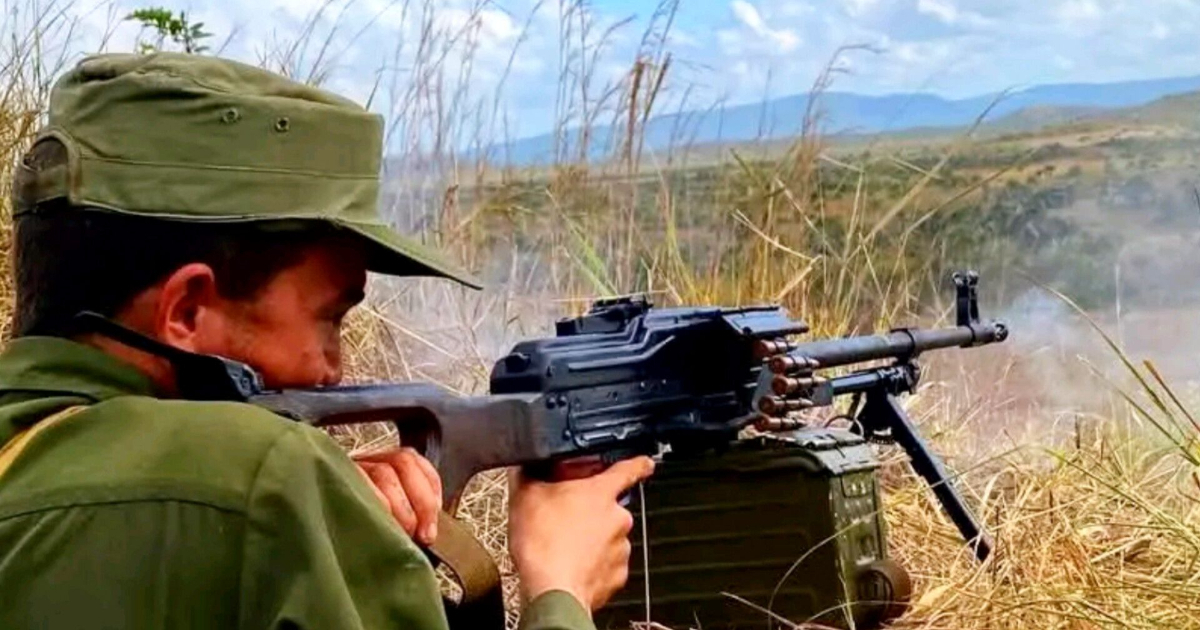
The text, accompanied by a photograph of a soldier firing a machine gun in a rural setting, adds that “any sophisticated means is vulnerable” and that “there is no technology against the movement of popular resistance driven by patriotic and revolutionary ideas”. According to the post, opposing military technologies would be “the courage, consciousness, and intelligence of each revolutionary fighter”.
A few hours later, the Minfar released another message on the same topic, stating that "the war of the entire people is the guarantee that no corner of the country will be left unprotected" and that in this type of defense "there will be no front or rear, as we will be wherever the enemy is, opposing them with determined and tenacious resistance". In that , several uniformed individuals can be seen watching as an officer handles a landmine.
Minfar's publications are taking place during a period of weekly military preparation across the country, announced during the National Defense Day, recently celebrated in various provinces. According to the authorities, each Saturday will be dedicated to “military, political, and ideological” activities with the participation of militias, reservists, and the civilian population.
During these days, images of Soviet-made rifles, shooting exercises in rural areas, and basic training have been disseminated under the slogan of "defend every inch of our homeland". These actions take place in a context of rising tension between Washington and Havana, following the capture of Nicolás Maduro by American special forces.
While the Minfar promotes territorial defense exercises, the United States continues a process of modernizing its military power. Under the leadership of Secretary of War Pete Hegseth, the country is advancing the campaign “Arsenal of Freedom 2026”, focusing on technological investments, aircraft carrier construction, and the development of cutting-edge armaments.
The contrast between both scenarios has also become evident in the use of drones. While in the United States they are integrated into the national defense and security strategy, in Cuba they were used in symbolic and propaganda exercises during National Defense Day, according to recent reports.
In recent days, the official channels of Minfar have been consistently active, with messages highlighting resistance, territorial defense, and "revolutionary consciousness" as the pillars of the Cuban military system.
The new publications from Minfar generated dozens of comments on Facebook. Although institutional profiles and government-affiliated accounts repeated slogans about the preparation of the people and the duty to defend the homeland, the predominant tone among the responses was one of criticism or mockery. Many Cubans questioned the meaning of the messages, pointing out that the regime "uses young people as cannon fodder while the children and grandchildren of the ruling elite stroll through capitalist countries" or that "the enemies are you, who have an entire nation starving." Others sarcastically commented on the weaponry, asking "what are you going to do it with, weapons from the 60s," or recalled that "Venezuela said the same thing."
There were also more direct opinions expressed about the country's situation. Some users described the posts as “a clown show” and criticized the disconnection between military propaganda and economic reality. Others called for political change, stating that “it is time for freedom” and that many Cubans aspire to greater civil, political, and economic liberties in the face of the current system.
The publications from Minfar are part of a campaign to exalt the military, which has intensified in recent days, featuring messages that evoke a "war of the whole people" and appeal to resistance against an unnamed external enemy. Amid power outages, shortages, and a prolonged economic crisis, the regime once again relies on trench rhetoric and threats as tools for cohesion and political control, while showcasing on social media a military might that exists only in discourse.
Filed under: