
Related videos:
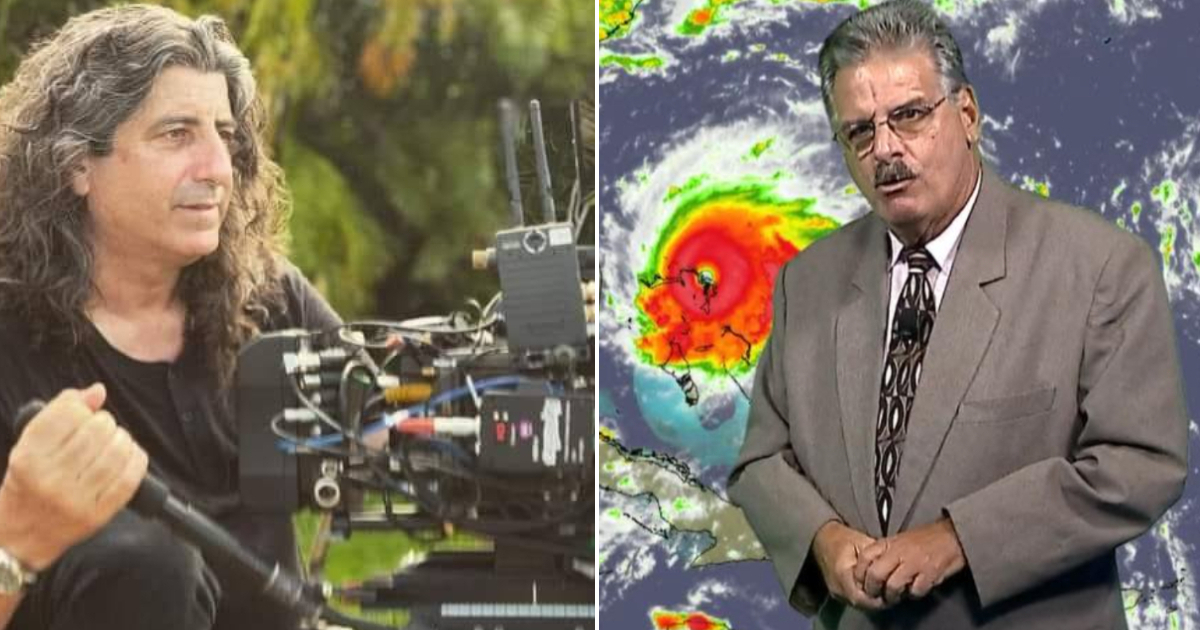
The exiled Cuban filmmaker Lilo Vilaplana reflected on the role of the weather report on state television as a mechanism of political and psychological control, recalling the repeated phrase “there will be dangerous seas for small boats” that has been used for years in the island's news programming.
In a post published on his Facebook account, titled "The Exile", Vilaplana noted that this weather warning “acted as an intimidating message aimed at those considering fleeing the island by sea. It was not just a precautionary alert, but a political signal.”
The filmmaker, who worked for years in Cuban television before emigrating to the United States, stated that the phrase was repeated even "in the absence of extreme conditions, with a clear objective: to instill fear, discourage escape, and reinforce the idea that leaving the country equated to certain death."
"The climate thus became an instrument of control, presented as a technical and neutral fact," added the filmmaker, who emphasized that "meteorologists, broadcasters, and executives participated in the daily dissemination of this implicit message — 'don’t leave' — wrapped in maps, figures, and scientific language. Without explicit threats, the State used the facade of informational responsibility to exert psychological intimidation."
Vilaplana compared this mechanism to the current official discourse regarding the supposed "State of War" in Cuba. "This same pattern is repeated today when the regime declares the country to be in a State of War without there being any actual combat. It is not about describing an objective situation, but about fabricating a permanent threat that justifies obedience, militarization, and sacrifice," he wrote.
The filmmaker's message arrives shortly after the National Defense Council approved “the plans and measures for transitioning to a State of War”, a decision portrayed by state media as part of the “Defense Day.” The official announcement did not clarify what specific measures this entailed or their impact on the civilian population.
This bellicose language has intensified following the capture of Nicolás Maduro in Caracas on January 3, a development that has heightened the rhetoric of "resistance" and the symbolic actions of military preparedness on the island, while the population faces blackouts, shortages, and an unprecedented economic crisis.
Vilaplana's reflection also aligns with the debate initiated by historian and activist Alina Bárbara López, who publicly questioned whether the Government had suspended constitutional guarantees following the announcement by the National Defense Council. "When a state of war is declared, are constitutional guarantees suspended?" she asked on Facebook, in a context marked by the systematic repression of peaceful protests.
Consulted jurists warned the academic that the implementation of war plans could effectively lead to severe restrictions on rights, even without a formal declaration. López clarified that “since they haven’t done it, I assume they won’t, and I go out without worries,” referring to his monthly civic action in Matanzas.
In this context, Vilaplana's words take on a symbolic dimension: the manipulation of technical language—whether meteorological or military—as a tool for psychological and social control. "Today, it is an abstract and invisible war. In both cases, power employs a supposedly technical language to instill fear and remind citizens that there is no escape, not even symbolically, from the control of the State," concluded the filmmaker.
Filed under: