
Related videos:
An investigation led by the Mexican Secretariat of Foreign Relations (SRE) has uncovered a network dedicated to the irregular issuance of Mexican birth certificates, allegedly used by Cuban citizens to carry out procedures at Mexican consulates in the United States.
The first alerts emerged in Houston, Texas, but the phenomenon points to a broader and more organized operation, with ramifications in several states of Mexico.
The first signs: Houston sounds the alarm
Between January 15 and 21 of this year, the Consulate General of Mexico in Houston detected a series of requests for consular procedures from individuals claiming to have Mexican nationality, as revealed by the local press in Mexico.
However, when interviewed, they confessed to being born in Cuba, having no legal or familial ties to Mexico, and acknowledged having obtained fraudulent documents through intermediaries.
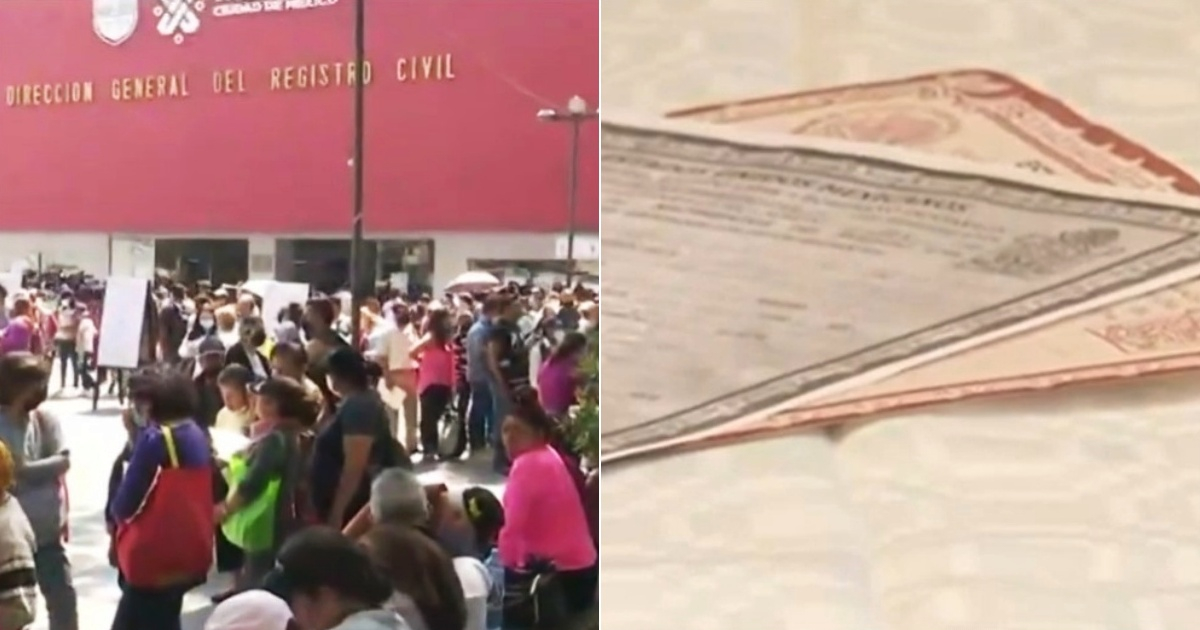
The records in question were allegedly issued by the Civil Registry of Tapachula, Chiapas, and despite being listed in official systems and having a certified Unique Population Registry Key (CURP), they displayed notable inconsistencies.
The false certificates lacked marginal notes and the birth certificate number, two essential requirements for a certificate to be legally valid.
According to authorities, the applicants "admitted that the records were obtained through a fraud operated from Tapachula," a key point in migration routes from Central America and the Caribbean to the northern continent.
A scheme that extends
What started as an anomaly in Chiapas soon escalated into a broader investigation.
The same consulate in Houston detected at least five additional cases with records allegedly issued in other states of the country, such as Aguascalientes, Nayarit, and Puebla.
These findings suggest that the fraudulent scheme may be replicating itself in different regions to evade controls and go unnoticed.
The SRE confirmed that it "will strengthen the mechanisms for control and verification in the issuance of official documents," and that it is working in coordination with other federal government agencies to identify and dismantle those responsible.
Tapachula, Motozintla, and Comitán: Epicenters of the operation
The initial investigations point to three municipalities in the state of Chiapas as the epicenters of the network: Tapachula, Motozintla, and Comitán.
There, staff from the Civil Registry allegedly operated in collusion with illegal networks dedicated to human trafficking to issue false birth certificates to foreign citizens, particularly Cubans, who then used them to obtain immigration benefits or regularize their status in third countries.
A source from the federal government explained that "the documents appeared to be registered in official systems and had a certified CURP, but lacked essential elements for their legal validity."
The judicial lead: employees arrested and serious accusations
The Attorney General's Office of the State of Chiapas confirmed that, following an internal audit conducted by the Internal Control Body of the General Directorate of the Civil Registry, irregularities were detected in the management of information and the use of computer systems.
This led to the filing of a formal complaint on January 12th.
After the investigations, three employees of the Civil Registry were identified, noted for their direct involvement in the illegal issuance of documents.
They are Artemio “N”, Juan “N”, and Jorge “N”, who are facing charges of abuse of authority, criminal association, and unlawful access to computer systems.
The Attorney General of the State, Jorge Llaven, confirmed that “the three defendants have already been detained and are at the disposal of the corresponding judicial authority.”
A phenomenon with migratory implications
Although Mexican authorities have focused on the fraudulent issuance of documents, the case also sheds light on a growing trend: the use of illegal means by Cuban citizens to obtain nationality or immigration documents.
The migration pressure from Cuba, combined with Mexico's geographical proximity and its role as a transit point to the United States, has led many Cubans to turn to document forgery networks.
The case remains open, and authorities do not rule out new arrests or the expansion of the investigation to other states.
The SRE has reiterated its commitment to strengthening documentary verification mechanisms and has warned that the forgery of documents is a serious crime, which can lead to criminal consequences for both those who issue the documents and those who use them.
Filed under: